Tampilkan postingan dengan label cel animation. Tampilkan semua postingan

Sabtu, 28 Januari 2012

Nausicaä of the Valley of the Wind (風の谷のナウシカ, 1984)


When I was a girl there were few heroines in animation with whom I could identify.  Snow White and Cinderella were too good and unattainably beautiful.  I was a bit of a tomboy, so I recall doing some Wonder Woman and She-Ra: Princess of Power role playing, but I found their sexy costumes a bit off putting.  It is such a shame that Hayao Miyazaki’s Nausicaä of the Valley of the Wind (風の谷のナウシカ, 1984) was not dubbed and released in North America in its original version, for I suspect my then ten-year-old self would have fallen in love with the gutsy young heroine Nausicaä.

My suspicions were confirmed when I watched the film on DVD with my two children.  Both Lukas and Anna loved the film, but my young daughter really warmed to Nausicaä.  Her heart melted in the scene where Nausicaä adopts her furry fox-squirrel companion Teto.  She cheered during the fight scenes and both children were excited by the dynamic animation of the scenes in which Nausicaä is flying her Mehve jet glider.  They had no great love for Kushana, the Princess of Tolmekia but warmed to the buffoonery of her aide-de-camp Kurotowa .

My children are also both nature-lovers and Nausicaä appealed to their interest in the environment.  The environmentalist message of Nausicaä is even more important today than it was in the 1980s, and is so well executed that it won the film the seal of approval of the World Wildlife Fund (WWF).  Nausicaä is set in a future world in which is facing an environmental apocalypse.  Humanity clings to survival on a planet that is being taken over by the polluted “Sea of Corruption.”  The few communities (the Valley of the Wind, the Pejite, the Tolmekia, and the Dorok) that are left have begun to fight each other for the dwindling resources.  Nausicaä is one of the few who recognizes that in order for people to survive, they need to find a way to live in harmony with the other creatures of the world such as the Ohmu – giant crustaceans that resemble pillbugs – whereas others see violence and warfare as their only means of survival.

Flashback sequence animated in a different style.

This is not a film that one can just pop into a DVD player and leave kids to consume alone.  There is a lot of violence, including the murder of innocents / the defenceless both human and non-human, and challenging themes (senseless destruction of the environment, warfare, and so on).  I think the part that upset my children the most was the cruel torture of the Ohmu by the Pejites.  Although these are difficult topics, I found the film really invigorated my kids to talk about how the lessons of the film can be applied to their own everyday lives.  From discouraging their friends from harming insects and other small creatures to the day-to-day things we can do to better the natural world around us, Nausicaä inspired my children to stand up for what they believe in.

In addition to being a terrific story, Nausicaä is also a fine example of animation.  It won Miyazaki his second Noburo Ofuji Award for innovation at the Mainichi Film Concours.  Particularly notable are the exhilarating flying sequences with Nausicaä on the Mehve and the God Warrior sequence animated by Hideaki Anno (of Neon Genesis Evangelion fame).  My favourite sequence was the flashback / dream sequence of Nausicaä's youth (image above), which was animated in a completely different style than the rest of the film.


This review is part of Nishikata Film's series on the Noburo Ofuji Award.

Jumat, 28 Oktober 2011

Momotaro’s Sea Eagle (桃太郎の海鷲, 1942)


World War II inspired many governments around the world to sponsor animated propaganda to rally support on the home front. Some, like the films of Norman McLaren in Canada, were aimed at encouraging people to support the war financially – see V for Victory (1941), Five for Four (1942) , and Dollar Dance, 1943 (NFB Overview). Disturbingly in the United States (see Ducktators), Japan, and Germany (see Der Störenfried), propagandists decided to target children for their campaigns by using characters from popular folk tales and movies. 
   
In Japan, the legend of Momotaro, the Peach Boy, was commandeered by propagandists as a patriotic hero. In the original tale, Momotaro was found by an elderly couple floating down the river in a peach. When he grew up, he became unusually strong. One day, Momotaro decides to Demon Island in order to defeat the demons that are terrorizing the people there and the elderly woman who adopted him gives him millet dumplings to take with him. Along the way, he encounters a dog, a monkey, and a pheasant and he gives them millet dumplings so that they will join him on his mission. They defeat the demons and return home with wonderful treasures. 

Momotaro’s Sea Eagle (桃太郎の海鷲/Momotarō no umiwashi, 1942) reframes this story in a manner designed to encourage people to celebrate the December 1941 attack on Pearl Harbor as a victory against evil forces. Unlike the original tale where Momotaro actually engages in battle with the dog, monkey, and pheasant, in Momotaro’s Sea Eagle, Momotaro assumes the role of a military leader who orders his troops of dogs, monkeys, and pheasants into battle while he follows the action from the battleship. “I, your captain,” Momotaro pronounces, “will await your return.” Momotaro towers above the animals who are quite childlike in both appearance and behaviour. 

The film sets up a number of gags to endear young audiences on the side of the Japanese forces. The ground crew are rabbits who use their floppy ears to make signals. On one of the planes, a dog and a monkey play with building blocks that are in danger of collapsing. The Japanese, the film suggests, are on the side of all that is good and natural in the world. At one point, they even befriend a baby sea eagle and his parent in a bizarre sequence that takes place on the wing of one of the aircraft – as if there would be no wind while in flight! 

The conceit is that Hawaii is Demon Island and that the inhabitants there are the demons of legend. When the attack commences, we are disturbingly shown events from the point of view of the people on the ground. The Americans are depicted in human, not animal form, but the horror of the event is subverted into slapstick comedy. The central American character resembles Bluto from the popular Fleischer Studio’s Popeye series. These films were well-known and loved by Japanese children in the 1930s and the character would have been immediately recognizable as Popeye’s nemesis. In the unlikely circumstance that a child did not recognize him as Bluto, he is clearly demarcated as “bad” because he has demon horns and a tail and is associated with heavy drinking. 

Apart from the fact that it is disquieting to see an event in which 2,402 Americans were killed and more than a thousand wounded depicted as if it were an extended slapstick comedy routine, there are a number of historical inaccuracies promoted by the film. Two of the most obvious are the suggestion that some Japanese troops were on the group and set airplanes on fire by hand (a chain of monkeys, like the S-shaped Barrel of Moneys toy game, descends from an airplane window to do this with matches) and worse, the suggestion that all the Japanese returned home safely. In actuality 55 Japanese airmen and 9 submariners were killed in action that day. 

The attack on Pearl Harbor  with Americans depicted as fat demons.

A great deal of the film is taken up with showing off Japanese military might. It takes many minutes for action to get underway because the opening scenes are so concerned with instilling a sense of awe and pride in the technology of war.  The film was billed at the time as being Japan’s first feature-length animation – which was a bit of a stretch considering that the film is only 37 minutes long. The true recipient of this title was the sequel to this film Momotaro’s Divine Sea Warriors (Mitsuyo Seo, 1944). 

Momotaro’s Sea Eagle is the centrepiece of Zakka Films’ DVD The Roots of Japanese Anime which also includes a bonus extra of posters from the time advertising the film as “A thrilling, unparalleled naval battle that makes the red and blue demons tremble!” The posters also suggest that Momotaro’s army will not only be fighting Bluto but also Popeye and Betty Boop, declaring: “Roosevelt and the American gangster Popeye are no match. They face Momotaro’s troops and end up all wet.” Popeye and Betty Boop do not appear in the film itself.  Most disturbingly, the ads proclaim that the film is not only sponsored by the Naval Ministry but recommended by the Ministry of Education “as a living textbook for your children.” From today’s perspective it is certainly a valuable film to watch in order to teach about how propaganda is produced and disseminated. 

Apart from the troubling nature of the subject matter, the film is historically significant in terms of demonstrating how sophisticated cel animation had become in Japan by the 1940s.  It is important to note that the politics of the film do not reflect that of the director, Mitsuyo Seo (瀬尾 光世, 1911-2011), who actually had left-leaning political sympathies and was pressured into making propaganda films.  Tragically, due to historical forces beyond his control, Seo was saddled with these beautifully animated but deeply propagandistic films as his legacy to animation history.  Seo does at least have the distinction of being the first Japanese animator to use multiplane camera and his work is said to have influenced Osamu Tezuka.  It was also interesting to see puppet animation pioneer Tadahito Mochinaga listed in the credits for this film.  

The Zakka Films DVD includes informative historical information by Jasper Sharp (Midnight Eye) and Aaron Gerow (Yale U) which help contextualize the film. The Roots of Japanese Anime has optional English subtitles and comes with an informative booklet featuring an historical overview by  and film notes by  Individuals can purchase this DVD for a reasonable price from independent film distributor Film Baby. Institutions should contact Zakka Films directly for purchasing information

Film Credits:
Sponsored by the Naval Ministry 
Production Company: Art Film Production (Geijutsu Eigasha) 
Producer: Einosuke Omura 
Director and DOP: Mitsuyo Seo 
Music: Noboru Ito Animation Technique and Composition: 
Tadahito Mochinaga, Toshihiko Tanabe, 
Tamako Hashimoto, Shizuyo Tsukamoto 
Special Effects: Hajime Kimura

.

Catherine Munroe Hotes 2011


Selasa, 25 Oktober 2011

Danemon Ban – The Monster Exterminator (塙団右衛門化物退治の巻, 1935)


One of the reasons that animation really took off in Japan is the wealth of Japanese folklore that lends itself well to the medium. While Japanese ghost stories adapt well to live action movies, animation is the ideal medium for bringing to life the monsters and shapeshifting animals of Japanese legend.

The animated short Danemon Ban – The Monster Exterminator (塙団右衛門化物退治の巻/Ban Danemon – Shojoji no tanuki-bayashi, 1935) brings together both folklore and historical legends. The central character, Danemon Ban (塙 団右衛門), is an historical figure from the late Sengoku / early Edo period. Born Naoyuki Ban (塙 直之, 1567-1615). He was a samurai general legendary for his enormous strength and leadership qualities. Danemon Ban – The Monster Exterminator has fun with the legend of Danemon Ban using his rumoured love of drinking and fighting to set up amusing gags. He strides confidently onto the screen on his extra-tall geta (wooden sandals) and pushes through a gaggle of men to read a sign posted at the foot of an oversized, pagoda-like castle and reads that there is a reward of 1000 ryo for the man who defeats the monster in the haunted mansion.

In order to read the sign this legend of old amusingly squints and pulls out some spectacles because it turns out that Ban is short sighted. Then he announces that he will defeat the monster not in order to be a hero, but to pay for his sake. The gags continue inside the haunted castle. Danemon Ban discovers a beautiful woman with a Betty Boop-esque face dressed in a kimono and bound with rope. When he tries to free her, she reveals herself to be a monster and her magic causes him to fall asleep. A one-eyed serpent monster descends from the ceiling and licks his head so that the woman can shave him bald. A humiliating ritual, which I suspect is a reference to the tradition of a samurai’s hair being shorn off in defeat.


In the next scene it is revealed that these two monsters haunting the mansion are actually tanuki (raccoon dogs) in disguise. In Japanese legends, tanuki are shapeshifters who are notorious for causing trouble in the human world. When Danemon Ban wakes, they transform themselves into human beings, with the head tanuki turning himself into the popular one-armed ronin Sazen Tange announcing “I am the tanuki movie star!” (read previous review of Chameko’s Day for more on Sazen Tange). Danemon Ban must defeat the tanuki in order to win the 1000 ryo reward.

Animated by Yoshitaro Kataoka (片岡芳太郎), Danemon Ban – Monster Exterminator was written by Kazumitsu Masuda and partly inspired by the song “Raccoon Dogs on a Moonlit Night” (Shojoji no tanuki-bayashi) by Ujo Nobushi and Shinpei Nakayama. Kataoka uses some wonderfully innovative techniques in this film. For example, when Danemon Ban approaches the mansion, he hears the woman crying for help and Kataoka animates her words as they travel to Ban’s ears. The way in which Ban’s horror at seeing the woman transform into a monster is depicted by using the shadow of her hand over his shocked face and the vortex depicting his dizziness as the magic puts him to sleep reminded me of the special effect techniques that Alfred Hitchcock would use many years later in films like Spellbound (1945), Psycho (1960) and Vertigo (1958). Simple, but highly effective ways of visually depicting extreme emotional states.  I also really liked the overhead shots of Dan taking down circle after circle of disguised tanuki with his club.  In reminded me of a phenakistoscope.  


There is a shorter benshi cut of Danemon Ban – Monster Exterminator extant and available on the Digital Meme Japanese Anime Classic Collection Box Set. The benshi performance on this version is done by  Midori Sawato. It is not as good as seeing her perform live – which I did at the First Benshi Performance that I ever attended back in 2006 – but it’s the next best thing. 

The sound version of Danemon Ban – Monster Exterminator appears on the Zakka Films DVD The Roots of Japanese Anime: Until the End of WWII. Of the 8 works appearing on this DVD, Danemon Ban is in the worst condition. The years have not been kind to early Japanese animation and cinema – with the vast majority of films produced pre-WWII being either lost or existing only in fragmentary form. Despite the heavy scratching and flashing on this extant print of Danemon Ban, the beauty and originality of Kataoka and his animation team still shines through. We are indeed lucky that the efforts of Japanese archivists have at least managed to preserve this delightful film.

The Roots of Japanese Anime has optional English subtitles and comes with an informative booklet featuring an historical overview by Jasper Sharp (Midnight Eye) and film notes by Aaron Gerow (Yale U). Individuals can purchase this DVD for a reasonable price from independent film distributor Film Baby. Institutions should contact Zakka Films directly for purchasing information.

Catherine Munroe Hotes 2011


Senin, 10 Oktober 2011

Chinkoroheibei and the Treasure Box (ちんころ平平玉手箱, 1936)


The early anime pioneer Noburo Ofuji (大藤 信郎, 1900-1961) is best known for his kirigami (cutout) animaton and kage-e (silhouette) animation. He was also quite skilled in the art of cel animation as demonstrated by his 1936 animated short Chinkoroheibei and the Treasure Box (ちんころ平平玉手箱/Chinkoroheibei to tamatebako).

An upbeat, lively animation aimed at a young audience, Chinkoroheibei and the Treasure Box tells the tale of a young fellow named Chinkoroheibei. He is a mischievous character with a real knack for getting himself into trouble either unwittingly or due to his own heedless actions. Taking a nap under a tree, a spider falls into his mouth and when Chinkoroheibei spits it out, the poor creature has lost some of his legs causing a turtle to laugh at the spider's misery. This inspires Chinkoroheibei to poke at the turtle, causing the turtle to bite Chinkoroheibei’s finger in order to escape. Incensed, Chinkoroheibei  runs after the turtle who leads him into the sea.

Underwater, Chinkoroheibei discovers the wondrous palace of the fish king. A big celebration is underway with the large fish king surrounded by cheering smaller fish with their unusual round black heads. Initially, Chinkoroheibei is not allowed into the party but he disguises himself as a fish and enters the palace. He watches as the fish king is presented with a box that the fish and crabs use to perform magic tricks in which bubbles are transformed into various sea creatures. Chinkoroheibei recognizes the box as the “legendary treasure box” and schemes to steal it away. A comical chase sequence ensues with Chinkoroheibei receiving his comeuppance in the end.

In addition to using the kind of slapstick comedy popular in both animated and live action cinema of the day, Ofuji also uses a visual device developed in the silent period: the iris. As zoom lenses were rarity in the 1930s, irises were used in order to focus attention on one part of the screen. In the case of cel animation, it removes the need to draw a new background in order to shoot a close up. A matte is placed over the existing image and gives a similar effect as a close up.

Examples of the use of irises and mattes in Chinkoroheibei.
Ofuji uses mattes (cutout frames) not just as irises but also cut into cloud shapes to focus attention on one part of the screen. Some of the mattes even appear to be made of patterned chiyogami. At first, I thought the cloud-shaped mattes may have been used for practical reasons – covering part of the frame in a matte reduces the amount of the screen that needed to be drawn and re-drawn on celluloid, an expensive commodity at the time. Ofuji may also have been saving time on certain scenes in order to have more time to work on more complex scenes like the celebration of the fish king and the dramatic final chase scene. But, then in one of the shots of the treasure box, some of the creatures that appear out of the bubbles swim away over the chiyogami matte, suggesting that Ofuji may just have used the mattes because they simply appealed to him aesthetically.

Chinkoroheibei resembles a kind of tailless mouse with small, round ears.  He bears a striking resemblance to Mickey Mouse. Japanese animators in the 1930s (and the next generation of animators and manga-ka who were just children at the time like Osamu Tezuka, Takashi Yanase, Yoichi Kotabe, Monkey Punch, and so on) were strongly influenced by the two of biggest names in animation of the time: Walt Disney and the Fleischer brothers. This stylistic influence can be seen not only in the character design, movement, and use of physical comedy in Chinkoroheibei and the Treasure Box, but also in other cel animation by Ofui and his peers.  Kon Ichikawa’s Shinsetsu Kachi Kachi Yama (1936), Yasuji Murata’s Private 2nd Class Norakuro (1934), and Mitsuyo Seo’s Sankichi the Monkey: The Storm Troopers (1934) are a few examples that I have seen.
Examples of complex animated sequences in Chinkoroheibei.

Ofuji uses the standard cel animation practice of using a stationary background with movement in the middle- and fore-ground. The character movement is smoother than in his cutout animation (see: The Village Festival or Song of Spring). Ofuji adds depth to the underwater scenes through the use of bubbles and swaying sea plants both in front of and behind the central action. The most impressive scene technically is the final chase scene. Water is notoriously difficult to animate and Ofuji does a stellar job of it considering the technical limitations of the time.

Chinkoroheibei and the Treasure Box  appears on the Zakka Films DVD The Roots of Japanese Anime with optional English subtitles. A striking image of Chinkoroheibei in profile is used on cover of and in promotional materials for the DVD.  The Roots of Japanese Anime comes with an informative booklet that includes historical background by Jasper Sharp (Midnight Eye) and film notes by Aaron Gerow (Yale U). Individuals can purchase this DVD for a reasonable price from independent film distributor Film Baby. Institutions should contact Zakka Films directly for purchasing information.

Catherine Munroe Hotes 2011


Rabu, 20 Juli 2011

Story of a Certain Street Corner (ある街角の物語, 1962)


Osamu Tezuka’s childhood experiences in wartime Japan indelibly shaped the themes and motifs of his manga and anime. His award-winning animation Story of a Certain Street Corner (aka Tales of the Street Corner/ ある街角の物語, 1962) is the most lyrical expression of Tezuka’s humanist, anti-war sentiments.

It is the first of Tezuka’s jikken animation – or experimental works – which Tezuka made for artistic rather than commercial purposes. Although the animation does employ some unusual techniques such as a POV shot of a plane tree seed flying to the ground, it is not “experimental” in the usual sense of the word. When I think of experimental Japanese animation, I think of Yōji Kuri, Takashi Itō, Naoyuki Tsuji, Mirai Mizue, and others – animators who actually experiment with image, narrative, and sound. Although Story of a Certain Street Corner appears more indulgent in terms of visual aesthetic than Astro Boy (1963-75), it was done using Mushi Pro’s usual practice of “limited animation”: using as few cels as possible in order to keep the budget down. Story of a Certain Street Corner took over a year to complete and was funding by Tezuka’s work as a manga-ka. It was co-directed by Eiichi Yamamoto (Cleopatra, One Thousand and One Nights) and Yusaku Sakamoto. Gisaburo Sugii (Night on the Galactic Railroad) worked as an animator on the film.

The 39-minute animation opens by introducing the central characters one-by-one using title cards – a method dating back to the earliest silent feature films. Living in the attic of a tall city apartment is a young girl with her blue teddy bear. In a hole in the wall of the same building lives a mischievous mouse named Kanku-Bōya and his enormous family. On the street below is an alley way lined by colourful posters. On the corner sits a Platanus – known as a plane tree in English – who is given a delightful sequence in which she releases her seeds. Other star turns are put in by an impish “chinpira” moth, an old street light, and the centerpiece of the film: the figures on the posters themselves.

The setting is a kind of idealized European setting – with a colour palette reminiscent of MGM musicals of the 1950s like An American in Paris (Vincente Minelli, 1951) and Singin’ in the Rain (Gene Kelly/Stanley Donen, 1952). The drama begins when a red balloon escapes from a street vendor passing down the street. It distracts the little girl who drops her teddy bear. The teddy bear gets stuck in the eaves trough, where the little mouse encounters it and mistakes it for being a real animal.

The most impressive sequences of the film begin when the mouse accidentally falls down the downspout and stares dizzily at the posters. One of male figures takes on the role of conductor and leads the others in a musical number. The posters feature romance – between a violinist on one poster and a pianist on another – and comedy. Although the setting is distinctly European in flavour, there are posters that reference Japanese culture, while others play up the comedy of using stereotypes of world cultures such as kangaroos for Australia or bull fighters for Spain. There are also references to world art such as Rodin’s The Thinker (1902) and Toulouse-Lautrec’s famous Moulin Rouge – La Goulue (1891) poster.  The comic effect of this sequence is enhanced by the delightful original music by Tatsuo Takai (who was also responsible for the Astro Boy music). 

The strongest influence aesthetically to the animation is 1950s graphic design and illustration. The vibrant colour palette is similar to that of the collage work of Ezra Jack Keats (Peter’s Chair, A Snowy Day) and both the style and colours are reminiscent of the work of Walt Peregoy. Check out examples of Walt Peregoy and other illustrators from this period at Amid Amidi’s excellent blog Cartoon Modern to see what I mean.

The delightful poster sequence comes to an abrupt halt with the arrival of a pair of military boots marching down the street. The feet stop and hands put up a poster of a decorated military official – in a style that clearly demarcates it as regime propaganda. The other posters are clearly intimidated by this poster and freeze in fear. The mood is briefly lifted again by sequences that feature the plane tree, the moth and the streetlight, and the mouse and the teddy bear in the rain. But the idyll of this romantic street corner is again interrupted by the forces of totalitarian propaganda. Some of the posters  – such as that of the girl on piano and the male violinist  – resist the totalitarian forces.  The papering of posters escalates into full scale war which ends in the destruction of the neighbourhood. Among the rubble, however, there is a fluttering of hope for both humanity and the natural world in form of the young girl being reunited with her teddy bear and the sprouting of the seeds of the plane tree.
This film won Tezuka the first ever Noburō Ōfuji Award, which the Mainichi Film Concours established the year following the death of esteemed animation pioneer Noburō Ōfuji (大藤 信郎, 1900-1961). It is an interesting choice considering the fact that Yoji Kuri had just won the Special Jury Prize at Annecy in 1962 for Clap Vocalism. Kuri would be honoured with a Noburō Ōfuji Award a few years later, but for the inaugural prize, they decided to go with a film with an uplifting social message. The Story of a Certain Street Corner is not only an antiwar film, but also a story about the importance of freedom of expression.

Cartoon Modern: Style and Design in 1950s Animation
Buy Amid Amidi's book
The Astonishing Work of Tezuka Osamu (Sub)

Osamu Tezuka Jikken animation sakuhin shu / Animation

This review is part of Nishikata Film Review’s  2011 Noburo Ofuji Award Challenge.

© Catherine Munroe Hotes 2011

Minggu, 17 Juli 2011

Legend of the Forest (森の伝説, 1987)


Legend of the Forest (森の伝説/Mori no Densetsu, 1987) is Osamu Tezuka’s flawed, unfinished masterpiece. It took Tezuka and his staff more than a decade to complete the first and fourth movements of the piece. In 2008, there were rumors that Tezuka’s son Macoto Tezka (Black Jack, Akuemon) would finish the project but from what I understand, it is still a work in progress.

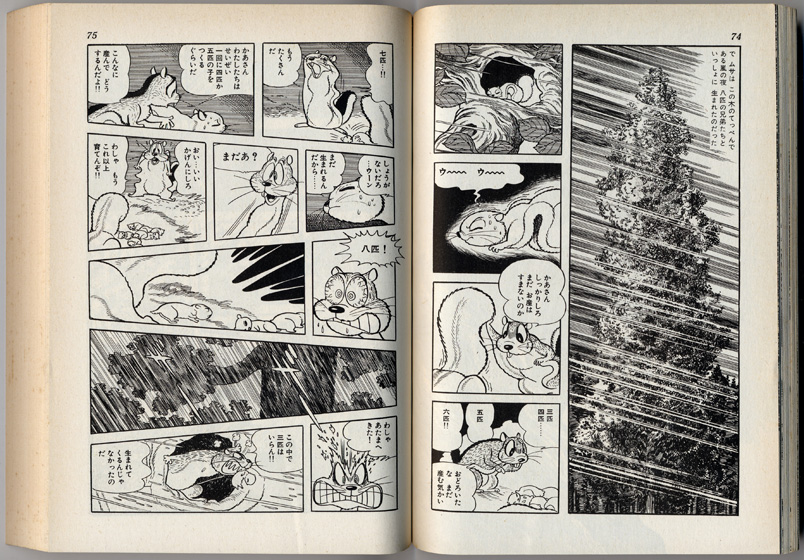
Emulating Disney’s Fantasia (1940), the animation was designed with a classical piece of music in mind: Tchaikovsky’s Fourth Symphony Op. 36 as performed by the Tokyo Symphony Orchestra under conductor Kenichiro Kobayashi.  The story is an adaptation of a Tezuka manga called Musa the Flying Squirrel (モモンガのムサ, November 1971) which was #9 in his 1970s manga series Lion Books (ライオンブックス). Click here to see sample pages from this manga.

The film opens with the camera appearing to track forwards into a ghostly forest. The sense of depth of field and forward movement was likely accomplished by using a multi-plane animation table.  At the end of this sequence, the camera comes to a halt upon an illustration of a giant ancient camphor tree (kusu no ki). Such camphor trees are often seen in Shinto shrines throughout Japan, and the sacredness of these trees is very familiar territory to fans of Hayao Miyazaki’s My Neighbour Totoro (1988) where the giant Totoro lives at the foot of such a tree. In Legend of the Forest, the trees are threatened by the forces of modernity in the shape of a large, burly lumberjack. Birds cry out in protest and take flight, animals scurry down the tree in terror.

Note the human emotion of rage on the flying squirrel's face.
The emotion of the scene is increased through the camera panning over the illustrations and cuts to new illustrations and close-ups, for this sequence is not animated. It is a series of illustrations in the style of a children’s storybook (In fact, it reminded me of early to mid-20th century illustrated children's books set in nature like those of Robert McCloskey.) After the panic of the animals is established, the story focuses on a pair of flying squirrels (momonga) whose nest is in the tree that is being chain-sawed. The mother and father desperately try to rescue their tiny, hairless newborn babies one-by-one before the tree falls to the ground. The tension increases until the terrifying moment when the father squirrel loses hold of one of his infants and the baby falls to certain death.

The father’s squirrel’s rage following this moment seems to trigger the film’s transition from storybook montage to animation. Thus begins the film’s secondary layer of story: a journey through animation history beginning with a reference to the 19th century animation toys the Zoetrope and Eadweard Muybridge’s Phenakistoskope.


It is at this moment that the camphor trees come alive as well, with their bark making their faces look wizened and knots turning into eyes. It seems these benevolent trees were watching the flying squirrel family’s struggle and intervened to catch the infant squirrel, gently catching him on one of their leaves. The camphor tree holding the infant, drips some sap down to him in order to give him nourishment.

As the baby squirrel turns his head to drink, the scene moves again from illustration to animation, this time referencing the white on black of early chalk drawing animations of such animation pioneers as J. Stuart Blackton and Émile Cohl. As the baby grows up, we are treated to a wide range of references to key moments in animation history from the early animation of Winsor McKay to Fleischer Studios and; of course, Disney.

Disney was perhaps the greatest influence on Osamu Tezuka and many other Japanese animators of his generation. In addition to the Fantasia influence that I mentioned earlier, Legend of the Forest also references early works by Disney and Ub Iwerks like the Alice Comedies (1923-27), Oswald the Lucky Rabbit (c.1927-28), and Plane Crazy (1928, the first Mickey Mouse picture). When the baby squirrel flies for the first time, the animation style of his flight references Dumbo (Ben Sharpsteen, 1941) – including some rapscallion crows. There are many obvious references to Snow White and the Seven Dwarfs (David Hand, et al., 1937) such as an old crone with an apple and seven dwarfs. The romanticizing of the squirrel’s romance with a purple female squirrel is straight out of Bambi (David Hand, 1942) – a film from which Tezuka also borrowed the theme of corrupt humans destroying innocent nature.


It is this borrowing from Bambi that causes the most flawed aspect of the film. The man vs. nature motif is very heavy-handed and goes to such extremes that it seems unlikely that the film will win over anyone to the cause apart from the already converted. The two main flaws are depicting all of humanity monolithically as a force of evil and destruction and the anthropomorphization of nature. It does nothing for the cause of environmentalism to depict animals of having such human emotions as anger, outrage, and vengefulness. The moment the baby squirrel, now grown, decides to exact revenge upon the lumberjack, the environmentalist message is lost. Following this logic, the only conclusion can be an apocalyptic war between humanity and nature in which everyone loses.

Interestingly, the natural world (and its fairies and other mythological creatures) are animated in a style associated with the cinema – the Disney styled in particular, whereas the lumber town and its inhabitants are depicted in the angular style associated with 1960s and 70s television series and commercials.

The visual concept of the film is certainly ambitious and deserving of the 1987 Noburō Ōfuji Award for excellence in animation. In addition to this the film was featured in Laputa’s selection of 30 Treasures of World Animation deserving of mention that were missing from their list of the 150 Best World and Japanese Animation. I look forward to Macoto Tezka’s completion of his father’s film to see how it fills out the story. The film in its current version is weighted very heavily in favour of American animation history and it will be interesting to see if the completed version fills in some of the gaps in the history of world animation.

As there seems to be a lot of misinformation about this film being cut-and-pasted about the web, I thought I would provide the complete credits for the film as they appear in the film itself:

Scenario, Storyboard + Design: Osamu Tezuka
Art Director: Masami Saito
Sound Director: Takashi Ui
Musical Score: Tchaikovsky’s Fourth Symphony Op. 36
Tokyo Symphony Orchestra conducted by Kenichiro Kobayashi
Key Animation:
Masateru Yoshimura
Junji Kobayashi
Shinji Seya
Toshi Noma
Teruo Handa
Yoshiaki Kawajiri
Yoshinori Kanemori
Shinichi Suzuki
Checking: Kaoru Kano
Illustration: Masaki Katori
Colour Design: Rika Fujita
Special Effect: Takashi Maekawa
Camera: Mushi Productions
Editor: Harutoshi Ogata
Producer: Takayuki Matsutani
Assistant Producer: Minoru Kubota
Director: Osamu Tezuka
Sequence Director: Takashi Ui

The Astonishing Work of Tezuka Osamu (Sub)

Osamu Tezuka Jikken animation sakuhin shu / Animation

This review is part of Nishikata Film Review’s  2011 Noburo Ofuji Award Challenge.

text © Catherine Munroe Hotes 2011
 

reiview movies and books Copyright © 2012 -- Powered by Blogger