Tampilkan postingan dengan label rhys ifans. Tampilkan semua postingan

Rabu, 26 Oktober 2011

London Film Fest 2011 Day 15 - ANONYMOUS


The use of the interrogative tense in the poster for ANONYMOUS is misleading. Director Roland Emmerich and writer John Orloff aren't asking whether Shakespeare was a fraud. They are telling us, without doubt, with complete certainty, that he was. Their theory is that it is inconceivable that a poorly educated provincial dolt could have written plays of such genius and erudition. Rather, they posit that the Earl of Oxford, Edward de Vere, a man of great wealth and learning, wrote the plays. But at a time when theatres were next to brothels, and plays seen as seditious, it would have been degrading for Oxford to be publicly acknowledged as an author.  He therefore allowed the boorish, illiterate actor, Will Shakespeare, to take the credit, and the cash, with Ben Jonson as the unwilling go-between.  If this weren't scandalous enough, the movie further raises the stakes by positing that Oxford was at the centre of a conspiracy by his enemy, the puritan Cecil family, that involved the line of succession, incest and bastards. 

Taken on its own terms, ANONYMOUS is a great success. Indeed, I was quite amazed that Roland Emmerich - director of such dubious, mainstream disaster movies as 2012; 10,000 BC; and THE DAY AFTER TOMORROW - could direct something with such elegance and beauty. Because, make no mistake, ANONYMOUS is a brilliantly directed film. The way in which Emmerich deftly handles the transitions between different periods in Oxford's life is elegant and never confuses.  The conspiracy is woven with great delicacy so that even in the final act, we are genuinely surprised and saddened by the turn of events.  In front of the camera, Emmerich coaxes a career best performance from Rhys Ifans as the older Oxford, and uses CGI to create a completely engrossing and compelling Tudor London.  I was absolutely delighted to see Southwark and the Tower recreated, complete with squalor and grandeur.  Kudos to cinematographer Anna Foerster, shooting with the Arri Alexa (the first feature to do so).  She manages to create a colour palette of warmth and depth, beautifully capturing candelit pageants, and snow-covered country mansions. Most importantly, I cared. I deeply cared about the battle between Oxford and the Cecils - I cared about the fate of young Essex, the Queen's bastard son and pretender to the throne - and I cared about the Queen herself, wonderfully portrayed by Vanessa Redgrave as frail and vulnerable and hounded on all sides. 

Of course, when I stand back from the film, the whole thing seems a bit pointless. I've always thought that these debates - who wrote Shakespeare; was Shakespeare a crypto-Catholic; was the Dark Lady really a boy - pretty pointless, as there simply isn't the documentary evidence to decide it either way. So you're just left with dogmatic people using thin supposition.  In particular, the idea that Shakespeare couldn't have written the plays because they required great education strikes me as peculiarly class-ist. Just because someone is provincial and working class doesn't mean they aren't capable of genius - I mean, isn't the whole point of genius that it's like a lightning bolt. And anyway, according to Rene Weis' superb book "Shakespeare Revealed", Shakespeare attended a local grammar school and was taught by a string of Oxbridge graduates in all the subjects and to the very same standard that the movie suggests Oxford was tutored in and to....

But as I said, there's no point quibbling about the truth. I am perfectly happy to believe Will Shakespeare was indeed Shakespeare.  That didn't stop me having a cracking good time watching ANONYMOUS.  To that end, this movie falls firmly in the same category as SHAKESPEARE IN LOVE - a pleasing fiction.

ANONYMOUS played Toronto and London 2011. It is currently on release in Portugal, Finland and Norway. It opens on October 28th in Canada, Ireland, the UK and the USA. It opens on November 3rd in Germany; in Spain on November 11th; in France, Russia and Singapore on November 17th; in the Netherlands, Mexico and India on December 1st; in Sweden on December 16th; in Hong Kong and Hungary on February 2nd.

Sabtu, 20 November 2010

HARRY POTTER AND THE DEATHLY HALLOWS: PART 1 - Everything is possible and nothing is meaningful


David Yates continues his plodding, faithful, uninspired direction of the Harry Potter series with the first half of the final book. After ORDER OF THE PHOENIX and HALF-BLOOD PRINCE we should've known what to expect - a workmanlike film adaptation of the novel, with neither the gothic style of Alfonso Cuaron's AZKABAN, nor the ability to portray emotion without mawkishness from Mike Newell's GOBLET OF FIRE. In David Yates hands, this franchise has become a dreary endurance test for anyone other than hard-core Potter fans - descending from the banality of the last installment to unwatchable boredom interspersed with cringe-worthy emotional scenes in this film. I'd blame screenwriter Steve Kloves too, but somehow I can't imagine that these emotional mis-steps can really be the fault of the man who, in a happier earlier career, penned WONDER BOYS.

The upshot is that HARRY POTTER AND THE DEATHLY HALLOWS: PART 1 is unwatchable - dull, badly acted, ploddingly paced, full of failed attempts to tug at our heartstrings and basically a complete waste of time. The producers should have had the balls to condense the admittedly baggy source-text into just one film, cutting out scenes where the teenagers sit and brood and focusing on the destruction of the horcruxes. Because this film basically reads as two and a half hours of prologue. I left the cinema thinking, "Is this it?" and worst of all, "Dear God, if Guillermo del Toro wanted to direct this, why on earth didn't they let him?!"

In fairness, it must be hard to inject these films with suspense and emotional shocks - after all, most of us have read the books. Indeed, I am lucky enough that having read them on release, and forgotten most of the detail in the interim, I was more likely to be drawn into the plotting than true fans. As the movie opens another year is beginning at Hogwarts but Harry, Ron and Hermione aren't going back to the happy, colourful adventures of the early films. The world has changed - fascist goons fill the Ministry of Magic; Dolores Umbridge has installed Snape as headmaster of Hogwarts; and there are dark rumblings about registering all muggles. The tone of the film is established - it will be dark, cool-coloured, cold, and full of mis-trust and peril. The film opens and closes with the death of a trusted character and the death of minor characters litters the film throughout.

As the movie opens Harry is being transported by convoy from the Dursley's house, where he has spent the summer, to a safe house run by the Weasleys. The friends are betrayed and Harry, Ron and Hermione set off to destroy the horcruxes that contain Voldemort's soul. Problem is, they don't know where the horcruxes are, or even how to destroy them. And in carting the horcrux around, it fouls their temple, Ring-style. As the film progresses the kids find the sword of Griffindor; discover that Dumbledore had a brother; and that a kid called Grindelwald has been nicking stuff from Bellatrix Lestrange's bank-vault. But we don't really get much further along in understanding the bigger picture of what is actually happening. The plot of the film is thus made up of long periods where the teens sit and brood, inactive, and short spurts of danger where they find, or destroy a horcrux or escape the clutches of Death Eaters. By the end of the film, you are no clearer as to key characters' motivations than at the start.

I was so bored by the inaction, or numbed by the CGI fuelled action, that I started to contemplate the logical holes in the plot. Harry is in such danger his friends have to put him in hiding. And yet he can walk through the Ministry of Magic for a good few minutes before any of the fascist goons recognise him! And, even before that, Harry's friends risk his life to transport him to safety. Why don't they just apparate him to the safe-house? And why didn't Ron, Hermione and Harry just apparate out of the Ministry of Magic once they found the horcrux? After all, apparating is used to get them out of plenty of holes later on in the film - unless the director feels we need a good chase scene. And if apparating has been used too much, they can use the convenient fiction of the house-elf, who can apparently go where he pleases and find what he wants. If it's so easy for Creature and Dobby to locate Mundungus and bring him to Harry, why don't the kids ask them to find the Horcruxes and sit back and relax? Now I know that's just ridiculous, but by using these deus ex machina so often, J K Rowling damages our belief in the rules of her universe and makes everything possible and nothing meaningful.

So, is this film worth seeing? No, not unless you're a mega-fan. The only things that really work as cinema are a beautifully animated sequence telling the tale of the Three Brothers, made by Ben Hibon; and the character Dobby the House-Elf, voiced by Toby Jones, who alone delivers lines that are genuinely funny and genuinely moving. Together these two factors make up perhaps twenty minutes of screen time leaving two hours of dross. Low-lights include a scene where Harry tries to cheer Hermione up by making her dance - the actors looked as embarrassed as the audience - and a gauche scene where Ron imagines Harry and Hermione kissing.

HARRY POTTER AND THE DEATHLY HALLOWS: PART 1 is on global release in all bar France, Switzerland and South Africa where it opens next week and Hong Kong and South Korea where it opens on December 16th.

Senin, 01 November 2010

Late Review - MR NICE


Director Bernard Rose takes a break from contemporising Russian literature, with his straight-ahead adaptation of Howard Marks' autobiography, MR NICE. The charm of Marks' story is that he stands against the cliché of the drug dealer typically seen in films. He doesn't grow up in a mean urban setting - he doesn't push drugs to survive - he isn't particularly flash - he doesn't do whores - he's faithful to his wife and kids - and he studiously avoids Class A drugs - both dealing them and taking them. In fact, he is rather more like a hero of an Ealing Comedy - stumbling into drug dealing quite by accident and permanently amused that he is getting away with it.

Marks was basically just another middle-class kid studying at Oxford and smoking hash when a mate asked him to do a favour and drive a car stuffed with drugs back from Germany. Marks was quite happy to quit teaching for easy money-making and soon hooked up with the Provos to bring his hash into UK airports without the inconvenience of customs checks. Before long he's got the biggest outfit in the UK and tries to crack America. Moreover, he's been recruited by his old college chum to be a spy in Kabul - after all, he moves in circles they can't penetrate! The first time he's busted for dealing he gets off on grounds so spurious he seems to be amazed, but he does eventually serve time - and not because of hubris, or narcissism, or betrayal - but basically because he was too bored to quit.

The film is charming and fun, and uses a deliberately lo-fi amateurish style, with live action footage digitally inserted into grainy old vintage footage of the 60s and 70s. Rhys Ifans is suitably bumbling and charming as Marks and he and Chloe Sevigny as his wife seem genuinely in love. I also love David Thewlis - who has just that edge of danger required to play the Provo, Jim McCann. The charm and the fun is entirely in keeping with Marks' carefully cultivated persona as Mr. Nice. Yes, that was his real alias, but he also wants to be seen as basically a good guy. To that end, this movie drips with family values, and to watch it, one would think that his wife and daughters never blamed him for one second for being absent from their lives. The film also refuses to question how far his involvement with the Provos was morally pretty nasty - after all, the dodgy money they were earning wasn't going into real estate, was it? And there is a deliberately cultivated equivocation about how far he ever really did any spying for the British.

So, MR NICE is basically a rather fawning film - frothy, light, charming, disposable. It doesn't get to grips with Howard Marks - but provides him with a yet another self-justificatory platform. Is that bad? Who knows. But there is something rather, well, distasteful in an international drug dealer who consorted with the IRA palming himself of as a charming rogue.

MR NICE is currently on release in the UK.

Kamis, 21 Oktober 2010

Overlooked DVD of the month - GREENBERG


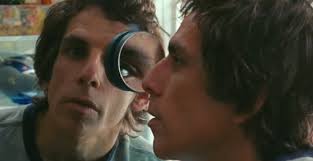
Writer-director Noah Baumbach makes excruciatingly well-observed films about financially privileged, neurotic, unsympathetic middle-aged Americans. When his films work, they are masterpieces of razor-sharp dialogue and uncomfortable silences and fleeting moments of sympathy for the fundamentally unsympathetic. His latest film, GREENBERG, features a classic Baumbach character, brilliantly played by Ben Stiller. Roger Greenberg is the definition of the bi-coastal American mid-life crisis. He's a forty-something, neurotic failed pop star turned carpenter who spends his life feeling sorry for himself, using recreational drugs, hitting on younger women and basically being self-indulgent and whiny. He is a walking embarrassment - the Uncle who won't grow up - the brother who won't get himself together - the friend who won't admit to his failures. 

Greenberg comes to LA to house-sit his brother's house and, taking the family's cue, casually abuses the services of their au pair/social secretary/general all round skivvy Florence (Greta Gerwig). The interaction between the passive-aggressive Greenberg and the vulnerable, low-self-esteem Florence is fascinating. She is sympathetic but hopeless. Greenberg is simultaneously repelled by her openness, and inflated by the fact that he has finally found someone in such dire circumstances that even a loser like him can help her. (I've been rewatching the classic 1981 BRIDESHEAD REVISITED recently, and as far apart as these things are, I thought I recognised something of the relationship of Sebastian Flyte and Kurt in Greenberg's attraction to finally being of use.)

I liked GREENBERG. Or maybe it's a film that you don't so much like, or enjoy, but see as a reflection of people you know, and admire for its honesty in depicting a certain slice of life. Greenberg is a profoundly unsympathetic character, but I did care about his journey and find some satisfaction, if not redemption, in the final scenes of the movie. GREENBERG isn't as bitterly funny as THE SQUID AND THE WHALE, nor does it have as interesting a cast of characters. GREENBERG feels more like a character study - a closely drawn, almost claustrophobic, portrait of a man in a crisis. It felt real, and painful and sometimes infuriating. But I was happy to have spent time with its characters and bought into the relationships and narrative arc.

Baumbach is, like Nicole Holofcener, the great chronicler of our decadent, pampered lives. Of rich people who feel guilty for being rich, but want all that being rich gives them. Of emotionally unstable people self-sabotaging. Of people in their thirties and forties who refuse to grow up and take responsibility. Of emotional narcissism and the difficulty of connection. I am grateful that there is room for his kind of cinema, even if it is, by definition, a painful watch.

GREENBERG played Berlin 2010 and opened earlier this year. It is available on DVD and on iTunes.

Minggu, 26 September 2010

Random DVD Round Up 1 - EXIT THROUGH THE GIFTSHOP


One-trick pony mockumentary in which notorious street-artist Banksy sends up the modern art world by showcasing nutty video-voyeuer turned artist Thierry Guetta. Guetta starts out behind the camera, documenting the early days of street art in LA, creating a mammoth collection of unedited tapes. He then morphs into an artist, apparently on Banksy's urging, creating works of suspiciously derivative quality and creating an art-world hoop-la in the process. Presumably this has all been faked, and Banksy is trying to make a point about how credulous the punters will be when faced with the latest fashion. Which is all very plausible, but hardly a radical thought, and certainly not enough to sustain a feature length film.

Additional tags: Banksy, tom fulford, chris king,

EXIT THROUGH THE GIFTSHOP played Sundance and Berlin 2010. It opened in the UK, US and Russia earlier this year and opens in Germany on October 2010. It is also available on DVD and on iTunes.
 

reiview movies and books Copyright © 2012 -- Powered by Blogger