Tampilkan postingan dengan label catherine keener. Tampilkan semua postingan

Senin, 01 Agustus 2011

Late Review by A.H. - SYNECDOCHE, NEW YORK (2008)

Everyone is disappointing the more you know them.
By turns comic and poignant, the maze of love, and of the memory of love, and the idiosyncratic forms that maze takes, has been a motif of the writer Charlie Kaufman’s recent work. And yet the maze of SYNECDOCHE, NEW YORK – in contrast to his previous doubling rabbit-holes – is neither internal, nor scrambled through; rather it is a large-scale theatre, a simulacrum of the city of New York, where director Caden Cotard (Phillip Seymour Hoffman) meticulously puts on, observes, and so re-experiences the daily troubles and past disappointments in his relationships with his wives and lovers. That the protagonist is an artist considering his time with the women around him may be a nod to the familiar – but it is in the effect of this life-long, theatrical, melancholic project that the film becomes a remarkable and ambitious variation in Kaufman’s characteristically unique design.

From the opening of the film, Cotard is, as his name suggests, preoccupied with the approach of death and the disintegration of his body, which only seems to widen the tense distance between himself and his wife. He directs a successful production of Death of a Salesman, and is subsequently awarded a MacArthur Fellowship that gives him the funds to create his immense life-theatre in a disused airplane hangar. This time of achievement in his professional life is weighted by his increasingly failing health (an unending anxiety seems to surface in pustules, disturbing shakes, problems in bed), and his complex personal life, marked by absence and regret and obsession, which in turn, Escher-like, becomes material for his grand play.

Kaufman has always drawn skewed perspective brilliantly, particularly in highlighting the difference in perception within relationships, and he continues this trick in SYNECDOCHE. When Cotard’s first wife Adele (Catherine Keener), a painter, declines an invitation to attend a performance of one of her husband’s plays because she must spend time packing up her canvases for an exhibition abroad, there is a hilarious cut to a shot of her canvases in their boxes – she paints on the most miniscule of scales and the crates she uses resemble matchboxes she could pack in a few minutes. Similarly, when Cotard discovers, to his horror, that his daughter from his first marriage has become a tattooed celebrity at the age of ten, his second wife Claire (Michelle Williams) exclaims that everyone has tattoos and turns her back to lift up her shirt revealing an enormous, monstrous tattoo of her own – which Cotard then denies having ever seen.

Keener and Williams are faultless in these roles, as the rest of the cast generally tend to be whenever they are on screen. That cast includes Samantha Morton; Jennifer Jason Leigh; Hope Davis; Emily Watson; Dianne Weist; and it feels important to name the soaring ensemble here as they are each gone too swiftly. But that, achingly, is the nature of the piece. As the play comes to its end, so Kaufman’s questions become plain: where does love go? Where does life go? Their ethereal conclusion is one of the many ways this film rewards watching and, of course, re-watching.

SYNECDOCHE, NEW YORK played Cannes (where it was beaten to the Palme D'Or by GOMORRAH), Toronto, Chicago and London 2008. It won the award for Best First Feature and the Robert Altman Award at the Independent Spirit Awards in 2009. It went on limited release in 2008 and 2009, and is now available to rent and own.

Minggu, 03 Oktober 2010

CYRUS - He *loved* his mother


I love CYRUS. It’s a movie that’s honest, funny, dark and moving. I haven’t seen a sweeter more unlikely romance on screen in years – and rarely one in which the characters are at once so spiky and unusual and yet express such honest emotion. John C Reilly plays a basically good guy, also called John, who is still reeling from divorce and lacks the confidence to date again. Pushed to a party by his remarkably tolerant ex-wife (Catherine Keener) he stumbles upon the beautiful Molly (Marisa Tomei). The scene in which they meet could be taught in film-school as a lesson in how to subvert the “meet-cute” with something far more surprising. There’s a drunk, dejected guy pissing against a tree and a woman walks by and says “Nice penis!” I mean, what an awesome reaction! Immediately we know that’s she’s got an off-beat sense of humour. And then John starts talking to her and immediately denigrating himself: “What are you doing in the garden with Shrek?” But as much as he thinks he’s scored, he’s so drunk and, in a sense, so innocent, that when the Human League’s “Don’t you want me?” starts playing he basically brushes her off to go dance in the living room. Of course he makes a complete ass of himself, but the most amazing thing happens. Rather than being weirded out by what a drunk loser he is, the hot chick saves him by dancing and singing too. I think this is pretty much the most genuinely cute meet-cute I’ve seen.

There is, of course, a glitch to this odd-couple romance, otherwise we wouldn’t have a narrative arc. Molly has a son called Cyrus. And Molly and Cyrus have a very un-boundaried relationship. Cyrus is the kind of kid who should have grown up and gone to college and gotten a girlfriend but is so molly-coddled by his mother that he has become self-centred and unstable. He is massively threatened by John, who he sees as a rival for his mother’s attentions and basically tries to sabotage the relationship. This leads to a comedy of manners in which both Cyrus and John pretend to be getting on well to please Molly but are secretly sabotaging each other. Things come to a head and John’s ex-wife’s wedding where all the bitterness is exposed. This leads to a truly amazing third act, where the movie turns from indie rom-com into tragic-drama, as Cyrus and Molly confront how messed up their relationship is.

I love CYRUS on so many levels it’s hard to know where to begin. John C Reilly has that great mix of being able to act both as a loveable chump but also as a wily reader of the messed up relationship he encounters. Marisa Tomei is one of those charming actresses with whom you’re happy to spend time. But the actor who really impressed me was Jonah Hill, who for the first time managed to beyond his smart-ass, slightly weird screen persona and deliver a heart-breaking redemption scene. Behind the camera, I think you have to give the writer-director Duplass Brothers mad props for managing to portray a situation that could have been gross – oedipal complex plays out – as basically sweet, but never cloying. I also love the fact that no scene or line is wasted. There’s an economy to their screenwriting and editing that could also be held up to film students. A classic example is the way in which they handle what would conventionally be a montage scene – mixing visuals with audio from another scene – and audio that sounds improvised and natural. And maybe that’s the biggest achievement of all. The Duplass Brothers have taken a caricatured movie situation – ludicrously clingy son sabotages mum’s relationship – and have used that as a hook for dialogue that actually sounds real, and so moves us.

Additional tags: Jas Shelton, Michael Andrews, Jay Deuby, Mark Duplass, Jay Duplass

CYRUS played Sundance 2010 and was released earlier this year in the US, Canada, France, Finland and the UK. It opens later this month in Belgium and in November in Russia, Germany and the Netherlands.

Sabtu, 03 Juli 2010

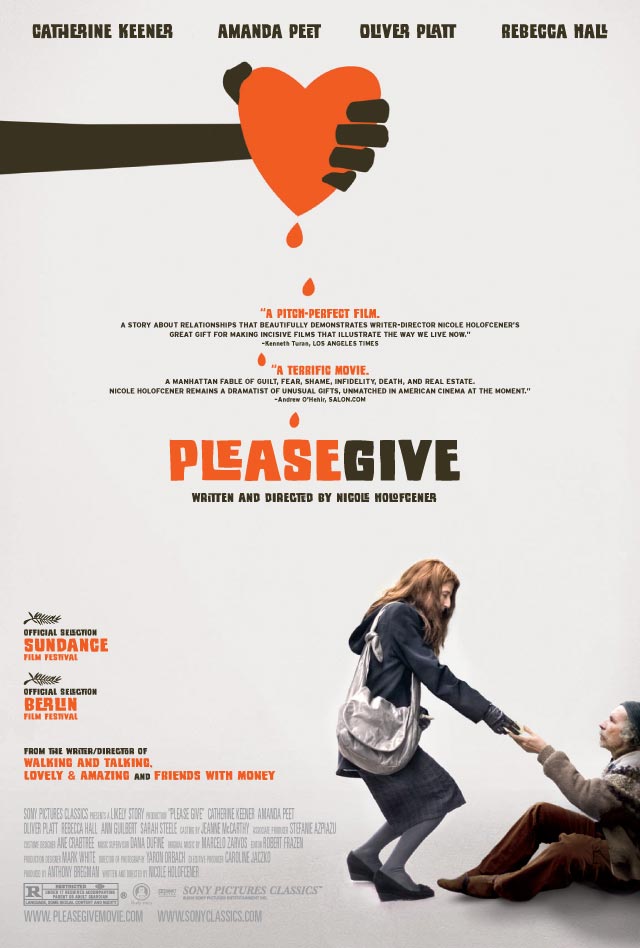
PLEASE GIVE - They fuck you up your mum and dad - Part One

So, I've watched about five movies in the past three months - compared to the old standard of five a week. It's been strange. Mostly I've been watching movies on a date rather in a screening room - and typically I've rescinded control of what we're watching, and watched more lazily - less with an eye to detail and a future review. At any rate, the whole experience has been different, and I think speaks to how film critics become jaded by seeing too many films in too sterile an environment. The upshot is that while I had decided to go completely cold turkey from blogging about cinema, I am going to jump back in with a few quick reviews of a couple of films that really made me think deeply about cinema and about relationships.

First up is the latest film from American indie writer-director, Nicole Holofcener. With LOVELY AND AMAZING and FRIENDS WITH MONEY, Holofcener established herself as a director who was able to communicate an authentic idea of how real women interact with each other, as friends and across generations. She writes movies that contain dialogue and situations that are uncomfortably real, and isn't afraid of presenting protagonists who may not be all that likeable. Their conflicts are self-involved and can seem petty to the viewer. But then, in all honesty, how many of us behave differently?

PLEASE GIVE sits somewhere between the lighter, more forgiving LOVELY AND AMAZING and the more bleak, alienating FRIENDS WITH MONEY. It poses difficult questions about body image, how we treat the elderly, and how we can choose not to speak of family trauma as a sort of defensive amnesia. Most importantly, PLEASE GIVE deals with middle-class guilt. How far should privileged people feel bad about how much they have? And is there such a thing as an authentic gesture of giving back, as opposed to mere self-interested guilt-mitigation?

Catherine Keener and Oliver Platt are superb as Kate and Alex - a wealthy married couple living in Manhattan, making a living from buying furniture from the children of the recently deceased, and selling it on at a huge mark-up in their store. Alex feels fine about what they do for a living, but Kate feels guilty about shaking down people who don't know the market price of their possessions. So she reacts by giving beggars money and by volunteering her time. Problem is, Kate is so self-involved in her misery that she brings the people she's meant to be helping down, and comes across as just plain patronising. Kate's self-involvement has more dire consequences. She alienates her teenage daughter, struggling with teenage skin; and bores her husband. One of the best scenes in the film sees the husband and daughter have a conversation that is ostensibly about facials but really speaks to her knowledge that he is having an affair. It's one of the great emotionally devastating scenes in the film. You know that the daughter will remember it for the rest of her life - it's one of those moments of complete emotional damage - all too typical in real life.

Set against this tale of upper middle-class angst we have the story of Audra and her two grand-daughters. Kate and Alex live next door to the 91 year old Audra, and have bought her apartment. Essentially they are waiting for her to die so that they can knock through and create a dream apartment. Audra is an old battle-axe, and her grand-daughter Mary (Amanda Peet - where has she been hiding?!) calls a spade a spade. She has no problem treating Audra like shit, and openly talks about the remodelling plans. But what I love about the writing and Amanda Peet's performance is that you can tell that underneath all that tough-girl no-nonsense jazz there's a deeply vulnerable woman so lacking in self-esteem that she'll throw herself onto a completely unsuitable guy. By contrast, Mary's sister Rebecca (Rebecca Hall) is one of life's quietly suffering good girls - caring, overlooked, but ultimately grounded enough to have a proper relationship.

PLEASE GIVE is one of those films that isn't necessarily fun to watch - I didn't enjoy my time with these characters. But when I watch Nicole Holofcener films I see characters that I actually know in situations I find familiar and it's just so refreshing to see real life on screen. And more than that, to see a writer portray a relationship between a mother and daughter - or between two sisters, that has the ring of authenticity. Thank Christ movies like this can still get made and get some kind of a release.

Additional tags: Yaron Orbach, Marcelo Zarvos, Robert Frazen, Elizabeth Keener, Elise Ivy, Josh Pais, Ann Guilbert, Sarah Steele, Nicole Holofcener

PLEASE GIVE played Sundance and Berlin 2010 and was released in the USA and Canada earlier this year. It is currently on release in the UK and opens in Germany next week.

Senin, 22 Februari 2010

PERCY JACKSON AND THE LIGHTNING THIEF - also not entirely unwatchable

Another movie that’s easy to deride is PERCY JACKSON AND THE LIGHTNING THIEF. The similarity of the source material and the fact that it shares the same director as the first two HARRY POTTER films have led many reviewers to call it “Harry Potter lite” or a Harry Potter rip-off. Certainly, you can see their argument. Percy Jackson is a boy who is “special” and that being “special” relates to his now absent father. His being special leads him to a special school where he will learn to use his secret powers, and to make two friends – a loyal but doltish boy and a much more clued-on girl. They will ultimately have to contend with another student who has conflicting loyalties, and to go on a quest for high stakes. They will be guided by a wise old teacher and their adventures will take place both in a magical realm and in our real world. The only difference is that Harry Potter is a wizard and Percy Jackson is the son of the Greek god Perseus, and is thus a demi-God. And rather than battling Voldemort, he is battling to restore to Zeus his bolt of lightning in order to prevent a war between Zeus and Hades. There are even similarities in the production design, largely because of the journeyman-like-quality of all Chris Columbus movies. He’s the go-to-guy if you want a movie to come in on time, on budget, to have some serviceable special effects and not do anything too crazy.

The resulting film is just fine. It’s not the sort of kids film that adults should go and see unless they are accompanying a small child, but I’m betting good money that any kid, bored in the school holidays, will have a good time watching this film.

PERCY JACKSON & THE LIGHTNING THIEF is on global release.

Jumat, 18 Desember 2009

WHERE THE WILD THINGS ARE - weather with you

Spike Jonze, the visionary director behind BEING JOHN MALKOVICH and ADAPTATION, returns to the big screen with an adaptation of Maurice Sendak's iconic children's book. The book is slight, dark but also joyful: a little boy called Max throws a tantrum, is sent to his room, and disappears into an imaginary world of wild things. The wild rumpus if fun, but he grows lonely and returns home in time for his supper, which is still hot! BBC Radio 4 produced a marvellous programme on the book and its iconic status, interviewing Sendak. He said he thought the book was radical because Max wasn't a WASP but a little Jewish kid, and because Max wasn't a classic innocent child but a realistic rage-filled, energy-filled little boy. And after all, he had it both ways - King in his imaginary world, but also welcomed back into his home.


Spike Jonze and writer David Eggers have taken the slender meat in the book and spun it out into a beautifully rendered, overwhelmingly dark and pyschologically truthful film about the fears and resentments of childhood. In truth, there isn't much joy left in it, and I'm not sure what kids will make of it. But for adults, the film is a deeply emotionally affecting depiction of what it's like to be a child, and indeed, the pressures on parents in a modern world of working parents and divorce.

The first hour of the film gives us the reality of little Max (Max Records), a nine year old kid growing up in the snowy American burbs. His elder sister is too busy being a teen to hang with him, his working mum (Catherine Keener) tries her best to give him attention but has her own stress to deal with. He loves mischief - instigating a snowball fight with his sister's friends - but gets scared when the fight gets out of control and they smash his igloo. The film is full of visual references to kids seeking small dark places to hide and feel safe in, but that safety being intruded upon. It's also full of play fights that have real emotional consequences. In these early scenes, I love the efficiency with which Jonze and Eggers essay Max's emotional life. The fight that triggers his running away comes out of nowhere. I also love the freedom of the camera, capturing with handheld the rumpus, but also shooting from Max's POV and height. There's a lovely scene where Max is sitting under his mum's desk tugging at her tights - a wonderfully intimate moment but also hinting at his need to express himself and incapability of doing so with words.

By the second half hour, Max has run away from his house having thrown a tantrum and bitten his mother on the shoulder - a highly charged scene. He takes a boat and through scary waves, lands in the land of the wild things. There he meets a loose collective of monsters and becomes their king, starting play-fights that soon sour. All of these monsters are expressions of Max's own insecurities and fears - the fear of not fitting in, of being abandoned for cooler friends, of not being understood, of not being loved, of sadness. The fear that doing a robot dance won't make his mum happy and won't make the monsters happy either.

I love this section for its wonderful visual style. When Carol (James Gandolfini) takes Max to see his model world, it really is magical. There's a kind of magic to the simple mastery of making and doing rather than CGI wizardry. That translates to the monsters themselves. They are giant muppets that have been ever so lightly CGI animated to show the facial expressions of the actors voicing them. It's a really wonderful result - they look real, they have weight, but they also look, well, muppety enough to have come from a kids imagination. I also love the wry humour. Classic example: Max and Carol are walking through a desert and an absolutely enormous monster appears on the horizon. Carol dismisses it as a harmless pup: "don't feed it or he'll follow you around." But there's no denying that this section is also pretty much a constant downer. The monsters talk like a bunch of depressed characters from a Woody Allen film, filled with neuroses about failed relationships and low self-esteem. They speak in phrases that kids must hear and not quite understand. They have an abiding sadness that poor Max can't shift because, after all, he's not a real king.

In the final section, emotions come to a head. Some of the monsters realise that Max favours KW and Carol - that's he not an equal opps king. And then they realise that he's not really a king at all. And then, most crucially, as Max tries to convince KW about the need for family and why she should return "home" to Carol, he also realises that he too needs to go home. What is learned? Maybe not much. Max always loved his mum, and still has trouble expressing himself. The rage and the fear are still there.

WHERE THE WILD THINGS ARE is a brave, bold and beautifully imagined movie that takes us into the psyche of a kid who has trouble expressing himself. Is it a kids film? Not sure. But it is certainly a superb film about being a kid, and about being a parent. It is uncompromising, challenging, dark, scary and makes you cry. Spike Jonze remains one of the most fascinating directors working today.

WHERE THE WILD THINGS ARE was released in October in the USA, Canada and Italy. It was released in November in the Ukraine, Malaysia, the Czech Republic and Romania. It is currently on release in Australia, New Zealand, Israel, Denmark, Lithuania, Norway, Turkey, the UK, France, Switzerland, Germany, Austria and Spain. It opens on December 30th in Belgium. It opens in January in Brazil, Singapore, Finland, Taiwan, the Netherlands, Japan, Argentina, Greece, Portugal, Venezuela and Sweden. It opens on February 4th in Russia.

Minggu, 23 Agustus 2009

THE SOLOIST - schadenfreude

THE SOLOIST is a bad movie. Bad, in ways that fawning Hollywood studios in search of Oscar-pay-dirt can't mask. Witness the fact that is was completed in October 2008, and could've been released in Oscar contender season but was instead pushed back to a 2009 release. The film is not bad because of the central performances. Robert Downey Junior is just fine as real-life LA Times columnist Steve Lopez and Jamie Foxx is impressive as Nathaniel Ayers, the schizophrenic, homeless Cellist that Lopez befriends. The film is bad because of the poor choices made by its director, Joe Wright, the very same director lauded for his adaptations of PRIDE AND PREJUDICE and ATONEMENT. I was astonished at the critical acclaim the latter achieved. To my mind, Wright took a delicate, clever book and ruined it with his heavy-handed, showy, directorial "style". His self-conscious over-choreographed cinematography got in the way of his material.

THE SOLOIST is the ultimate exemplar of the fatal flaw in Wright's direction and, in my worst moments, I am rather glad he has been exposed as a mere stylist. We have impressive shots everywhere. A liquid camera curves through a newsroom taking up the editor (Catherine Keener), then a reporter, and finally our icon of liberal angst, Steve Lopez. After a chance encounter with the homeless savant is written up in a LA Times column, a reader sends in a cello. Rather than cut to the scene where Lopez delivers it to Ayers, we have a Cello-POV tracking shot through the same newsroom. When Lopez hears Ayers play the cello for the first time, the camera swoops up to the skies and follows birds in flight. All of this shows some technical ability, but again and again I asked myself WHY? Why do we need the cello-POV-shot? What does it add to my understanding of Ayers' plight or my response to it?

If self-conscious camera-work is a continuous problem with Wright's work, THE SOLOIST has its own particular problems. The biggest is how Wright chooses to depict schizophrenia. Rather than depict illness from the inside-out, as in A BEAUTIFUL MIND or THE DIVING BELL AND THE BUTTERFLY, he goes for a rather lazy sound-scape. He doesn't really seem all that interested in mental illness as an internal experience, but rather in bludgeoning the film-goers over the head with some propaganda for a more caring society. (Note the continuous use of the US flag as an icon as a contrast to the most marginalised citizens). The second problem is that Wright clearly isn't that interested in music. Yes, it's there as a backdrop, and we are meant to tear-up, as Lopez does, hearing Ayers play. But there is no transcendental moment for the audience, as there is for Lopez. We are moved neither by Beethoven nor by Ayers' plight.

Note to director: next time, concentrate more on how to evoke an emotional response from the audience and less on how to create cool effects with the camera.

THE SOLOIST was completed in October 2008. The studio chose not to release it until April 2009 in the USA and Canada. It goes on release in the Netherlands, Australia, Greece, New Zealand, Israel, Mexico and the UK in September and in Germany, Portugal, Brazil, Denmark, Romania, the Czech Republic and Argentina in October. However, it is already available on Region 1 DVD replete with some rather self-congratulatory and pompous extras.

Selasa, 21 Juli 2009

Overlooked DVD of the month - WHAT JUST HAPPENED?

Over a decade after making the political satire WAG THE DOG, veteran Hollywood director Barry Levinson made a Hollywood satire, WHAT JUST HAPPENED? It features Robert de Niro in the thinly fictionalised role of producer Art Linson, upon whose memoirs the film is based. De Niro's character is trying to get a British auteur (Michael Wincott) to recut his movie so that the studio (Catherine Keener) will give it a Cannes premier. Meanwhile, he's trying to get Bruce Willis to shave off his beard and look the part of a leading man in his forthcoming picture. And then there's the wife he wants to reconcile with (Robin Wright Penn) despite the fact that she's sleeping with the screenwriter (Stanley Tucci); the daughter (Kristen Stewart) who's going off the rails; and the Hollywood groupies who'll do anything, any time, for an interview.

I really liked this film for exactly the reason that all the other reviewers seem to have skewered it. They complain that it isn't caustic enough - that the stakes aren't high enough. All that's at stake, they say, is the continuing functioning of the well-oiled Hollywood money-making machine. By contrast, in Altman's THE PLAYER, or indeed in Levinson's previous political satire, it was a matter of life and death. But surely the point is EXACTLY that the studios, the starlets, the directors and producers are prostituting themselves for worthless commercial dross. In SULLIVAN'S TRAVELS the movies were worth something and that partially excused the shameless behaviour. But this movie is all the more tragic because it shows just how meaningless the whole sharade is.

More superficially, this flick is great because of all the scabrous one-liners. It's eminently quotable in the way that GLENGARRY GLEN ROSS is eminently quotable. It also features a great performance from Michael Wincott as the auteur - a guy who last got a role as memorable when he played Guy of Gisbourne in the Kevin Costner's ROBIN HOOD. You also get to see Catherine Keener in one her most subtle performances as the quietly threatening studio boss who can turn on a dime if she gets a faint whiff of box-office success.

WHAT JUST HAPPENED played Sundance 2008 and Cannes, out of competition. It opened in the UK and US in winter 2008. It is available on DVD and on iTunes.
 

reiview movies and books Copyright © 2012 -- Powered by Blogger