Tampilkan postingan dengan label rebecca hall. Tampilkan semua postingan

Selasa, 25 Oktober 2011

London Film Fest 2011 Day 14 - THE AWAKENING

Dominic West (Robert) and Rebecca Hall (Florence) star in THE AWAKENING.

THE AWAKENING is an intelligent, adult horror movie that sees Florence (Rebecca Hall), a notorious debunker of spiritualism, invited to a boy's boarding school by Robert (Dominic West) to investigate an apparent haunting. This sets up a classic haunted house movie, in the manner of Alejandro Amenábar's The Others - but with the refreshing site of a clever, independent woman as the protagonist, and the pervasive air of  post-war mourning hanging heavy over proceedings. The resolution is satisfyingly complicated and there were enough genuinely unexpected scary moments to make this good horror - particularly the pivotal bathroom scene. Admittedly, there is nothing particularly innovative in the set up (Nick Murphy and Stephen Volk), but first time feature director Murphy creates and sustains a genuinely tense and morbid atmosphere that completely sucked me in, largely thanks to superb cinematography from DP Eduard Grau (A SINGLE MAN, BURIED) and a desaturated colour palette.


THE AWAKENING played Toronto and London 2011. It opens in the UK and Ireland on 11th November.


Jumat, 15 Oktober 2010

London Film Fest 2010 Day 3 - EVERYTHING MUST GO


You lose your job. You come home. Your wife has locked you out of your house, left your belongings on the front lawn and asked for a divorce. What do you do? If you're Nick Halsey, you drink beer, you order take-out, you shower with a hose and start a yard sale, largely to pass the time. You strike up a friendship with the nice pregnant lady across the street, you ask your neighbours to throw you some electricity, and you play ball with a young bored kid. Maybe you even start to think about your life - about the alcoholism that has landed you in this situation - and try to reconnect with an old high school friend. But there are no easy answers.

It's a great movie set-up, and Dan Rush's debut feature, based on a short story by Raymond Carver, is a quiet, sympathetic little movie. Will Ferrell, in the lead role, gives a muted, restrained performance that is convincing and charming. He is ably supported by Rebecca Hall, Laura Dern and, in particular C J Wallace as the little kid. I like that Rush/Carver give the alcoholic no easy wins - this isn't that kind of film. But, still, this movie has a sort of Hollywood sheen to it - a warm glow - that was entirely subverted in another low-key film - CYRUS. During the movie, I really did care about what happened to the lead character. But once the lights came up, it was utterly forgettable. There wasn't enough bite to it - or enough content to sustain the run-time. Apparently this movie started off as a short-film, and I couldn't help but wonder if that was the best format for this novella turned movie.

EVERYTHING MUST GO played Toronto and London 2010. It doesn't yet have a commercial release date.

Selasa, 05 Oktober 2010

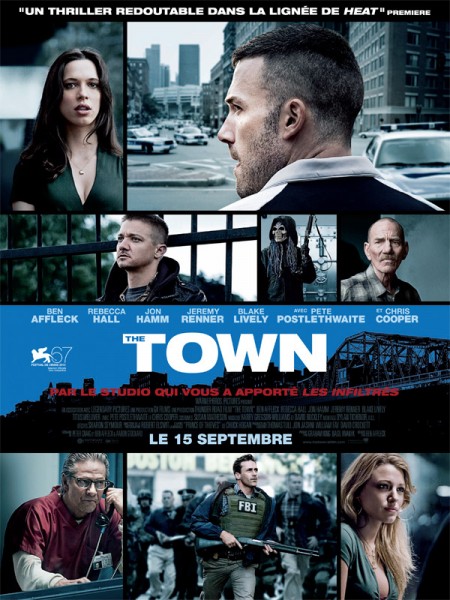
THE TOWN


GONE, BABY, GONE was a surprise. Who could have foreseen that washed-up screen actor, Ben Affleck, could’ve directed a movie with such assurance and heft – capturing not only the tension of a crime-drama but also the particularity of a neighbourhood. By contrast, THE TOWN is a disappointment. It’s a solid crime thriller but nothing more than that – and given the acting heavyweights on screen, it should’ve been far better. The plot is straight out of the conventions of the genre. Doug (Ben Affleck) is a bank-robber, based out of Charlestown, Boston. As in all good crime thrillers, Doug is conflicted about what he does, feels bad about terrorizing a hostage, and is doing that “one last job” that we know is going to go horribly wrong. Also true to genre, Doug has a side-kick called Jem (Jeremy Renner) who is a bit of a nutcase (Joe Pesci – anyone?) and takes too many risks. It’s because of Jem’s instability that the robbers end up taking the hostage in the first heist, and cross the line into murdering cops and bystanders. Also by convention, Doug’s loyalty to Jem means that he will go through with that One Last Job despite his better instincts. And, of course, Doug has a girlfriend, from whom he is hiding his true nature. In this case, she is the hostage he was sent to stake out.

The script does a disservice to its minor characters, and the high-powered actors wasted in those roles. Chris Cooper plays Doug’s father in a wasted cameo; Pete Postlethwaite plays the local crime boss in another wasted cameo, and John Hamm shows none of the subtlety that makes Mad Men so great, in his role as the FBI investigator. The worst used is Blake Lively, of Gossip Girl fame, presumably cast to draw in the teen-girl crowd, and given little to do but trigger the final betrayal. At least she makes a stab at an authentic accent though. Jeremy Renner doesn’t bother and Ben Affleck fluctuates in how broad he takes his accent. And this works against what should’ve been Affleck’s greatest strength – his ability to depict the neighbourhood and the society that spawns these robbers. Compare Affleck’s portrayal of Charlestown with Debra Granik’s portrayal of the Ozarks in WINTER'S BONE, and you’ll see just how far short he has fallen.

THE TOWN played Venice and Toronto 2010 and is currently on release in the US, Canada, Germany, Austria, the UK, Belgium and Malaysia. It opens later this month in Australia, Portugal, India, Greece, Hungary, the Netherlands, Singapore, Brazil and Iceland. It opens in December in Russia, Finland and Poland.

Additional tags: Peter Craig, Aaron Stockard, John Hamm, Blake Lively, David Buckley, Harry Gregson-Williams

Sabtu, 03 Juli 2010

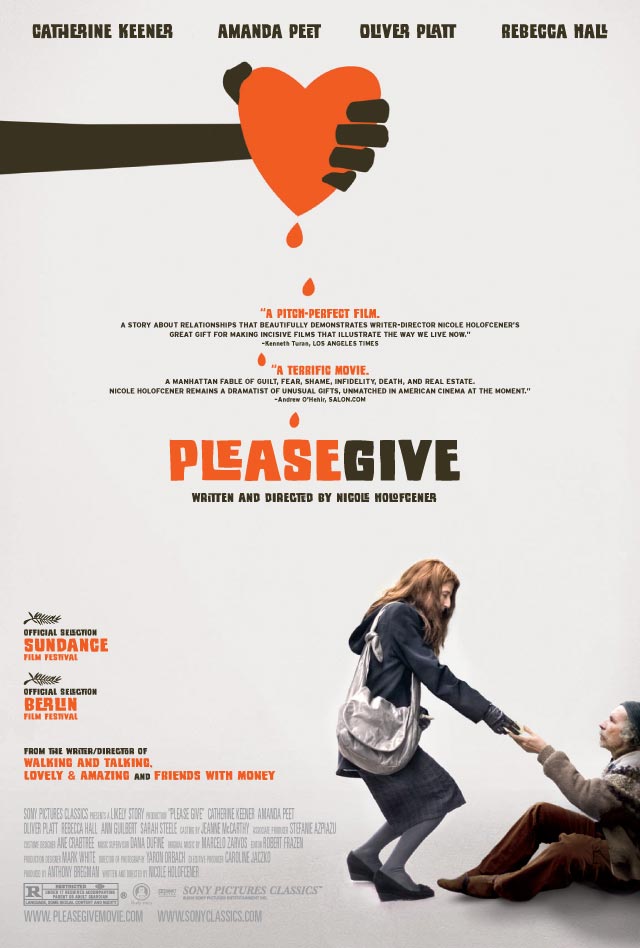
PLEASE GIVE - They fuck you up your mum and dad - Part One

So, I've watched about five movies in the past three months - compared to the old standard of five a week. It's been strange. Mostly I've been watching movies on a date rather in a screening room - and typically I've rescinded control of what we're watching, and watched more lazily - less with an eye to detail and a future review. At any rate, the whole experience has been different, and I think speaks to how film critics become jaded by seeing too many films in too sterile an environment. The upshot is that while I had decided to go completely cold turkey from blogging about cinema, I am going to jump back in with a few quick reviews of a couple of films that really made me think deeply about cinema and about relationships.

First up is the latest film from American indie writer-director, Nicole Holofcener. With LOVELY AND AMAZING and FRIENDS WITH MONEY, Holofcener established herself as a director who was able to communicate an authentic idea of how real women interact with each other, as friends and across generations. She writes movies that contain dialogue and situations that are uncomfortably real, and isn't afraid of presenting protagonists who may not be all that likeable. Their conflicts are self-involved and can seem petty to the viewer. But then, in all honesty, how many of us behave differently?

PLEASE GIVE sits somewhere between the lighter, more forgiving LOVELY AND AMAZING and the more bleak, alienating FRIENDS WITH MONEY. It poses difficult questions about body image, how we treat the elderly, and how we can choose not to speak of family trauma as a sort of defensive amnesia. Most importantly, PLEASE GIVE deals with middle-class guilt. How far should privileged people feel bad about how much they have? And is there such a thing as an authentic gesture of giving back, as opposed to mere self-interested guilt-mitigation?

Catherine Keener and Oliver Platt are superb as Kate and Alex - a wealthy married couple living in Manhattan, making a living from buying furniture from the children of the recently deceased, and selling it on at a huge mark-up in their store. Alex feels fine about what they do for a living, but Kate feels guilty about shaking down people who don't know the market price of their possessions. So she reacts by giving beggars money and by volunteering her time. Problem is, Kate is so self-involved in her misery that she brings the people she's meant to be helping down, and comes across as just plain patronising. Kate's self-involvement has more dire consequences. She alienates her teenage daughter, struggling with teenage skin; and bores her husband. One of the best scenes in the film sees the husband and daughter have a conversation that is ostensibly about facials but really speaks to her knowledge that he is having an affair. It's one of the great emotionally devastating scenes in the film. You know that the daughter will remember it for the rest of her life - it's one of those moments of complete emotional damage - all too typical in real life.

Set against this tale of upper middle-class angst we have the story of Audra and her two grand-daughters. Kate and Alex live next door to the 91 year old Audra, and have bought her apartment. Essentially they are waiting for her to die so that they can knock through and create a dream apartment. Audra is an old battle-axe, and her grand-daughter Mary (Amanda Peet - where has she been hiding?!) calls a spade a spade. She has no problem treating Audra like shit, and openly talks about the remodelling plans. But what I love about the writing and Amanda Peet's performance is that you can tell that underneath all that tough-girl no-nonsense jazz there's a deeply vulnerable woman so lacking in self-esteem that she'll throw herself onto a completely unsuitable guy. By contrast, Mary's sister Rebecca (Rebecca Hall) is one of life's quietly suffering good girls - caring, overlooked, but ultimately grounded enough to have a proper relationship.

PLEASE GIVE is one of those films that isn't necessarily fun to watch - I didn't enjoy my time with these characters. But when I watch Nicole Holofcener films I see characters that I actually know in situations I find familiar and it's just so refreshing to see real life on screen. And more than that, to see a writer portray a relationship between a mother and daughter - or between two sisters, that has the ring of authenticity. Thank Christ movies like this can still get made and get some kind of a release.

Additional tags: Yaron Orbach, Marcelo Zarvos, Robert Frazen, Elizabeth Keener, Elise Ivy, Josh Pais, Ann Guilbert, Sarah Steele, Nicole Holofcener

PLEASE GIVE played Sundance and Berlin 2010 and was released in the USA and Canada earlier this year. It is currently on release in the UK and opens in Germany next week.

Selasa, 05 Januari 2010

RED RIDING - 1974 - Less slippery and subversive than the novel but well put together nonetheless

1974 is the first of three films produced for television by Britain's Channel 4, based on the "Yorkshire noir" novels of David Peace. Each of his four books, 1974, 1977, 1980 and 1983, is about the corruption of policeman, priests, politicians and businessmen who murder and extort for no reason other than that they can. There never seems to be much money or success to be had from it, other than protecting the status quo. These crimes are posited as endemic in a region crippled with obsolete heavy industry and chippy toward outsiders. The greatest tragedy is to think you can remain an outsider - a cool observer - and that you can affect change. West Yorkshire is a law unto itself, and that law is policed by West Yorkshire's Finest, and spun by the compliant journalists of the Yorkshire Post. David Peace's world is one of almost complete corruption and casual evil. There are no heroes, but there are characters through whom we investigate the world and with whom we come to empathise.

In 1974, that character is a cocky young journalist called Eddie Dunford, newly back from a failed stint as a journo in Fleet Street, and desperate to make a name for himself by proving that someone is serially killing little girls despite the obfuscation of the rozzers; competition from senior crime reporter Jack Whitehead; and the powerful forces protecting a successful local property developer, John Dawson.

The movie is directed by Julian Jarrold, whose previous directorial efforts included the painfully superficial and hi-gloss remake of BRIDESHEAD REVISITED. 1974 is a far more successful film. Shot in sepia tones through the perpetual haze of cigarette smoke, the movie feels claustrophobic and sinister - just as it should. There's a superb scene where the camera looks over Dunford's shoulder through the patterned glass to a distorted image of Paula Garland - mother to a murdered girl - and soon to be Dunford's lover. That sums up Dunford: he sees through a glass darkly. And the tragedy of the film is that his eventual knowledge brings no relief. In a pivotal scene, he hands over a bag of documents - the research of his dead colleague Barry Gannon - to the one policeman he thinks is honest. Dunford is relieved - elated - as he drives toward his lover for an escape to the South. What a fool, the film-makers say, to think that he could actually escape the clutches of Yorkshire corruption. What a selfish, naive fool to think he could dump the files and fuck of to the South, where the sun shines.

Andrew Garfield is superb as Dunford - with his performance in THE IMAGINARIUM OF DOCTOR PARNASSUS - he has become an actor I will go out of my way to watch. Rebecca Hall is moving as his lover, Paula Garland. In John Dawson, Sean Bean finds yet another role that capitalises on his slightly sleazy charisma. But the real strength is the depth and quality of British character actors filling the cast, from John Henshaw as the harsh-but-fair Editor, to Peter Mullan's Reverend Laws.

The resulting film is atmospheric, sometimes like a bad dream, hard to hold on to, unnverving, and very hard to let go of. Tony Grisoni has done a good job in adapting a ferociously complicated novel for a hundred minute runtime, and cleverly compresses characters. What the film looses, however, is the sheer force of its brutality. The novel is hard work, both in terms of language and descriptions of violence and sex. Every time Julian Jarrold cuts away from a blackmail photo or pans away from a scene of torture, David Peace takes you into the mind of the aggressor. And where the worst crime Grisoni's Dunford can be accused of is naivety, and a final loss of temper, Peace's Dunford is a far more ambivalent character. If policemen casually rape whores, then in the novel Dunford treats women as casually and cruelly, though playing, as it were, in the minor leagues.

And, without ruining either, I found the "solution" of 1974 and the closing scenes too neat and twee, where they should've been more slippery and open-ended. Presumably this was the result of the compression of a large conspiracy into a single culprit but the result was that the ending felt rushed and just plain bizarre - the logic behind the killing was almost given as a throw-away line, and significantly undermines the slow build-up.

RED RIDING was shown on UK TV in 2009 and is available on DVD and on the Channel 4 4oD video on demand service.

Sabtu, 19 September 2009

DORIAN GRAY - a mess

In recent years, filmgoers have been treated to some rather lovely adaptations of Oscar Wilde's work, not least director Oliver Parker's AN IDEAL HUSBAND. Therefore, I was rather hopeful about Parker's adaptation of Wilde's The Picture of Dorian Gray. However, Dorian Gray is a very different beast to Wilde's society plays. They dealt with issues of contemporary morality, certainly, but in light atmosphere. By contrast, Dorian Gray is a pyschological novel, dealing with debauchery and corruption, using the genre tropes of gothic horror. The key question was whether Oliver Parker's directing style - high-gloss Merchant Ivory with whimsical modern touches - would be flexible enough to grapple with a meatier book.

The novel opens in late nineteenth century London. Talented artist Basil Hallward falls in love with handsome young Dorian Gray while painting his picture. Of course, there is no crude declaration of love given that homosexuality is taboo, but sublimated "ownership" of Gray's social life. This is put under threat when Dorian becomes fascinated with Basil's friend Lord Henry Wootton - a man who, while a member of the British establishment at the height of Victorian prudery, preaches a life of unrestrained sensuality. Encouraged by the man he admires, falling prey to narcissism seeing the finished portrait, Dorian starts to value beauty and art above all else, casually wishing that he could remain as young and beautiful as his portrait. He callously rejects his young lover Sibyl Vane when her talent fades and learns that his casual wish has been fulfilled: the wages of sin show on the portrait but he remains outwardly youthful and innocent.

With this apparent freedom, Dorian degenerates into a life of excess and cruelty - sexual encounters straight and gay, and eventually to blackmail and murder. It is here that Wilde most brilliantly takes aestheticism to its logical conclusion - positing that crime is merely, as art, "a means of procuring sensation". Eighteen years later, returned from his travels, Dorian tries to turn his life around, looking to his portrait as the ultimate barometer of authentic repentance. In this latter portion of the book, we are privy to some of the most high-stakes soul-searching in modern literature. Wilde, an artist who turned his life into art, simultaneously warns us of the dangers of so doing - themes he later explored in De Profundis. A the end of novel, order is restored: art is restored, in its frame, beautiful - life is separated from it, real, variegated.

The new movie of Dorian Gray is, essentially, a failure. Director Oliver Parker and debutant screenwriter Toby Finlay, fail to translate the feeling of menace and corruption to screen, condensing crucial episodes (Sibyl Vane) and introducing new material that amps up the Hollywood action and romance for crass commercial reasons. Ben Barnes is mis-cast as Dorian. He just doesn't have the acting chops to depict inward moral disintegration in the way that, say, Al Pacino did in the GODFATHER movies. Colin Firth is also mis-cast as the corrupting Sir Henry Wootton. He just can't play sinister. Imagine how much better this movie would have been with Eddie Redmayne and Jeremy Irons in the lead roles. In terms of execution, the movie features some of the most unsexy orgy scenes since EYES WIDE OPEN and some of the cheapest CGI. The only plus points are the lovely costunes, settings and the breath of fresh air that is Rebecca Hall's performance as the newly invented daughter of Sir Henry.

DORIAN GRAY is on release in the UK and played Toronto 2009. It will be released in Italy on October 23rd, in Australia on November 12th and in Finland on Christmas Day.
 

reiview movies and books Copyright © 2012 -- Powered by Blogger