Tampilkan postingan dengan label romance. Tampilkan semua postingan

Selasa, 29 Mei 2012

MOONRISE KINGDOM


Wes Anderson was, for me, a film-maker like Tim Burton.  A man with a distinct and beautiful visual style but whose tendency to rework the same themes, with the same actors, playing essentially the same characters, had begun to pall.  I particularly hated his last live action film, THE DARJEELING LIMITED, for its self-absorption, narcissism, rather exploitative attitude toward its Indian context, and ultimately for just being dull. With this in mind, I went into  MOONRISE KINGDOM with barely any hope that I would find the kind of film - at once whimsical and yet also profound (echoes of Tarsem Singh's THE FALL!) - that I had fallen in love with while watching THE ROYAL TENENBAUMS.

Well, my fears were groundless. MOONRISE KINGDOM is a simply wonderful film.  It is, of course, beautifully designed, rich in background detail, empathetically scored, and well-acted.  It affects a sweet yet knowing innocence - it's full of characters struggling to deal honestly with themselves and their loved ones - it deals with the darkest of emotions but it drips with hope - in friendship, in people doing the right thing - in family.  It's as if everything that began to feel so clichéd about Wes Anderson has finally been re-united with sincere emotion - and that this emotional authenticity has cut through the stagey-ness of the costumes, locations, soundtrack - and transformed a whimsical confection into something altogether more lasting, provocative and memorable.  It's as if Wes Anderson finally gave in and just told the story he always wanted to tell - about first love.

Suzy B (Kara Hayward) falls in love with an eagle-scout called Sam (Jared Gilman) one golden summer in 1965. The carefully hatched plan to leave together triggers a sequence of scrapes, jams, shenanigans, emotional revelations and deeds good and ill.  

Anderson perfectly captures that intensity of feeling when you're a kid and you feel nobody understands you apart from this one perfect person. Suzy's trying to escape her family - her kid brothers, her distant father (Bill Murray) and the mother (Frances McDormand) she suspects of sleeping with local policeman (Bruce Willis). Sam's an orphan and a misfit with a good heart. In one of the most affecting scenes, written in exact mimicry of how we speak at that age, Sam tells Suzy he loves her but she's talking nonsense for hating her parents. Suzy and Sam run away together.  They're at the age and living in the time when you're hold world fits into a suitcase, and you take your're favourite adventure stories rather than clothes. When you can place you're entire life into the hands of another person without second-guessing yourself.  

There's a deep vein of melancholy running through the film. Most of the adults seem desperately lonely, none moreso than Ed Norton's majestically decent scout leader.  The exception is the almost mechanical Social Services, played by Tilda Swinton with steely efficiency. But the kids are in their own world, where all things are possible, and where adults barely skim the surface, except as occasional constraints and only too rarely as facilitators. There's excitement and wonder and threat and crushing disappointment. As the movie builds to a pivotal final scene (superbly scored to Britten's Noye's Fludde) I realised that I deeply cared about these kids.  I wanted desperately to know what they happened to them, and not just to download the soundtrack they were listening to. It's been a long time, but we finally have a Wes Anderson movie that makes us feel as well as admire its surfaces.  

MOONRISE KINGDOM opened Cannes 2012. It is on release in France, Germany, Ireland, Turkey, the UK and he USA. It opens next weekend in Belgium, Iceland, Hungary and the Netherlands. It opens on June 6th in Sweden, on June 8th in Norway, on June 15th in Greece and Spain, on June 21st in Russia, on June 2nd in Portugal and Lithuania, on August 16th in Slovenia and Argentina and on August 30th in New Zealand.

Kamis, 24 Mei 2012

The Mirage Flower (あんてるさんの花, 2012)


Tonight the 13th Japan FilmFest Hamburg is hosting the world premiere of The Mirage Flower (aka The Mysterious Flower of Anteru / Anteru-san no hana, 2012) directed by up and coming young filmmaker Tadaaki Horai.  The film is set in Kichijōji, a bustling neighbourhood of Musashino city. 

Shigemitsu Ogi (Paradise Kiss, Always: Sunset on Third Street 2) plays Teruo Ando, the quiet unassuming proprietor of an izakaya (Japanese-style bar) which he has named using his own nickname “Anteru”.   While doing a guest spot on a local radio station to promote his izakaya, Anteru learns about a mysterious flower from Peru whose petals can cause realistic hallucinations for up to three days.

On his way home, Anteru spots a flower fitting the description at a florist, purchases it on a whim, and takes it back to the izakayato show his wife Namiko (Misato Tanakaof Bride of Noto).  Namiko suggests that they test the flower’s powers out on three of their regular customers: Kusanagi, a divorcee with a young son; Chisato, a recently signed musician trying to make a name for herself; and Takayuki, a part-time security guard with a meddling little sister.

After having contact with Anteru’s flower, each of the central characters encounters an important figure in their lives – someone who has been haunting their dreams and whose relationship with them is unresolved.  Kusanagi (Hidenori Tokuyamaof Slackers 2) is still suffering from the pain of his recent divorce and struggling with being a single father to Shuichi.  The sudden reappearance of his ex-wife (Megumi Satoof Happy Flight) forces him to confront his conflicting feelings towards her.


Chisato (Megumi Yanagi) now considers herself a professional musician on the up-and-up, but her new record producer is pressuring her to change her style in order to become more successful.  After coming in contact with Anteru’s flower, Chisato’s former band mate Naomi (Yukina Kasai) reappears in her life.  Naomi reminds Chisato of her roots as an artist and causes her to question whether or not she has become a sell-out.

Unlike his two friends, Takayuki (Ren Mori) doesn’t seem to have any skeletons in his closest – apart from a troubled relationship with his parents – but he does have secret fantasies about the kind of girl he’d like to meet.  One day while on the job the beautiful girl of his dreams turns up and engages him in conversation.   Remembering his encounter with Anteru’s flower, Takayuki immediately presumes that this girl must be a hallucination.  Real or not, Takayuki is happy to go with the flow for as long as this trip lasts.

The film unfolds in a dream-like fashion with some scenes shot overly bright to add to the ethereal quality.  The multiple plot lines weave in and out of one another in a manner reminiscent of Krzysztof Kieślowski’s Three Colours Trilogy with a colour scheme similar to that of The Double Life of Véronique. The line between what is real and what is hallucination is so thin that we start to realize that even the envelope story of Anteru and his wife may not be all that it seems.  The references to Hans Christian Andersen remind us that this is not a realistic story but a more of a fable about life.   It is a film about unfinished business and second chances, not to mention love, loss and forgiveness. 

The Mirage Flower will be released in Japan on the 16thof June at the Baus Theatre.  For more information, check out the film’s official websiteor the website of the production company Musashino Eiga.


Catherine Munroe Hotes 2012

Sabtu, 28 April 2012

This is not a review of - 2 DAYS IN NEW YORK

Because Sundance projected the film for 30 minutes without subtitles, then faffed about for 10 minutes, then cancelled the screening. In all my years of going to LIFF and watching c50 films per fest, I've never seen something like that happen. Just sayin'

Rabu, 07 Maret 2012

THE BEST EXOTIC MARIGOLD HOTEL


THE BEST EXOTIC MARIGOLD HOTEL is a movie of questionable taste and worse political judgement.  It's a testament to its charming cast that it manages to slip down rather easily, all the same. 


The basic concept is that a bunch of middle-class English pensioners move to a ramshackle Rajasthani hotel and experience epiphanies. The recent widow (Judi Dench) learns independence; the retired civil servant (Bill Nighy) and his wife (Penelope Wilton) learn that they do not love or even like each other; the two desperate singles (Celia Imrie and Ronald Pickup) learn that are still sexually attractive; the racist (Maggie Smith) learns tolerance; and the gay high court judge (Tom Wilkinson) finds peace. 

The problem with the film is the typical problem that modern England has in viewing its colonial heritage. On the one hand, it simply has to acknowledge the dirt, disease, discrimination and general chaos of modern India. On the other, it is faintly embarrassed of this disapproval given its own guilt regarding the Raj, and still has a deep-seated love of the country whose culture, language and cooking have so influenced the home nations. The result is a depiction of India that is at once patronising and awe-struck.  India is the country of spiritual revelation and ancient wisdom.  But it is also depicted as a country of almost child-like innocents who believe in happy endings, ideally set to a musical number.  This absurd juxtaposition is best summed up in the movie SLUMDOG MILLIONAIRE - marketed as a "feelgood movie" despite scenes of child beggars deliberately blinded, capped off with the obligatory song-and-dance number straight after a scene where the hero's brother has shot himself.  


THE BEST EXOTIC MARIGOLD HOTEL isn't quite as crass as SLUMDOG MILLIONAIRE. And indeed, in one storyline, we see a reconciliation between ruler and ruled played out as a reconciliation between two homosexual lovers - one a colonial, one an Indian. That at least shows some self-awareness on the part of the film-makers, although it falls far short of the kind of self-examination seen in the novels of E.M.Forster.  But at the end of the day, this is just another movie in which India is a colourful, exoticised backdrop against which pampered Westerners can gain "self-knowledge".  There's no real concern with what life there is really like. And the self-knowledge is easily gained - in the case of Maggie Smith's character, the personality alteration so swift as to beggar belief. 

Still, as I said, the movie is a surprisingly pleasant watch, mainly because it's cast is top-notch and charming, partly because where the movie is on "home soil" it is actually quite insightful.  In other words, when focusing on the disappointments of old age, the movie actually has interesting things to say about the way in which the middle classes are seeing their pension income eroded - their healthcare costs increase - the shock to discover the welfare state and corporate pension simply aren't enough - the indignity of realising one's sex life might be over - the desperation of knowing that the chances to turn one's life around are limited, if they exist at all.

THE BEST EXOTIC MARIGOLD HOTEL is on release in the UK and Ireland. It opens on March 15th in Germany; on March 22nd in Australia; Norway, the Netherlands,  New Zealand, Russia, Estonia, Finland, Spain and Sweden; on March 28th in Belgium; on March 20th in Italy and Lithuania; on April 12th in Portugal; on May 4th in India and the USA; on May 9th in France; on May 11th in Brazil; on May 17th in Hong Kong and Singapore; and on May 24th in Argentina.

Rabu, 22 Februari 2012

OKI'S MOVIE


Hong Sang-soo’s quartet of short linked films features three characters—a young man, a young woman, and an older man—who study or work in the film department of a university. Each short reveals a little of the relationship between these characters, from different viewpoints, and mostly in retrospect.
Running through the quartet is the theme of filmmaking itself and the accompanying uncertainty of being able to realise one’s intentions within the medium (and the world outside it). This draws us into the fourth film where the young woman, Oki (Jung Yu-mi), presents a movie she has made in an attempt to assemble her own experiences at selected points in her recent life.
Overall, the linked films are unadorned in style: quiet, minimal, observational (perhaps this reviewer looks on these qualities a little too favourably generally), but they do make for a good disguise when the tone becomes darker, or poignant, particularly during two separate instances of question and answer sessions.
It is partly in these last-mentioned, unassuming scenes that the threads running through the films reveal the skill and intricacy of their pattern—when they separate off into two snowy walks concluding the quartet, it is a gently reflective parting. For this reason and at this time, with all the dazzling pictures currently nearing the finishing line of their season, OKI’S MOVIE may well be a sight for sore eyes.

OKI's MOVIE aka OK-HUI-UI YEONGHWA played Toronto and Venice 2010 and went on release in South Korea in 2010 and in France in 2011.  

Minggu, 18 Desember 2011

Paradise Kiss (パラダイス・キス, 2011)


Things have been quiet here on Nishikata Film the past couple of weeks because I have been ill.  When I am under the weather and sofa-bound, I turn to what for me is the movie equivalent of chicken noodle soup: romantic melodramas.  2011 has been so jam-packed for me with work that I have not had the free time to indulge in the guilty pleasures of a cheesy romantic drama.

First on my list was the live action adaptation of Ai Yazawa’s popular manga series Paradise Kiss (パラダイス・キス, 1999-2003).  I am a huge fan of Yazawa and have been suffering from withdrawal since she abruptly stopped writing her Nana (2000 – hopefully ongoing) manga series in 2009 due to illness.  Paradise Kiss is a standalone sequel / spin off of Yazawa’s Neighbourhood Story (1995-8).  The manga tells the story of a high school student called Yukari who gets discovered by some fashion students who want her to model the designs of their studio "Paradise Kiss" at their school's end of year fashion show.  Yukari is torn between her desire to give modelling a go and pleasing her mother, who puts a lot of pressure on her to succeed academically and go on to a good university.


Like Nana, the fashion in the manga is influenced by British punk, Vivienne Westwood, and the Harajuku alternative fashion scene.  The character of George Koizumi, for example, is based on the character of Brian Slade as played by Jonathan Rhys Meyers in the film Velvet Goldmine (Todd Haynes, 1998).  In addition to the avant-guard look of the manga, the central character has a strong coming-of-age storyline.  Yukari (called Caroline by the Paradise Kiss fashionistas) does not yet know who she is as a person or what she really wants to do with her life and she is struggling not only with the intense pressure her mother puts on her, but is also having to deal with confusing feelings of sexual desire for the charismatic fashion designer George Koizumi.  The manga also has a very strong supporting cast of characters with their own subplots – Isabella, a transgender woman and childhood friend of George, and the love triangle between childhood friends Miwako (whose sister was the central character in Neighbourhood Story), Arashi, and Hiroyuki.

The live action feature film Paradise Kiss (パラダイス・キス, 2011) is adapted from the manga by Kenji Bando and directed by Takehiko Shinjo.  Shinjo is known for directing romantic TV dramas and sentimental feature films like Heavenly Forest (ただ、君を愛してる, 2006) and I Give My First Love to You (僕の初恋をキミに捧ぐ, 2009).  To put it plainly: Shinjo has basically given the story a TV-dorama makeover that guts the original story of its edginess.


To begin with, the feature film is woefully miscast.  In the manga, Yukari/Caroline is taller and more sophisticated than most girls her age and really stands out in a crowd.  While she is undoubtedly a beautiful young woman, actress Keiko Kitagawa is of average height.  Ordinarily, height would not be much of an issue except that Yukari’s height and body type are the reasons why Arashi picks her out of the crowd in the opening scene of the manga.  Kitagawa’s average height might not have stood out so much if it weren’t for the fact that Miwako, played by Aya Omasa, towers over her.  Miwako is meant to be a petite “kawaii” girly girl – so tiny in the manga and anime as to be doll-like.  Also miscast is Osamu Mukai who is much too sweet to play the charming but predatory George Koizumi.    


I knew I was going to be deeply disappointed right from the opening credits, which seemed more like an advertisement for nail polish than the engaging, up-tempo montage opening of the anime.  The music throughout is simpering J-pop ballads, which pale in contrast to the funky up-tempo music of the anime adaptation (IE Tomoko Kawase’s “Lonely in Gorgeous” and Franz Ferdinand’s “Do You Want To”).  I am no fashion expert, but the clothes looked more mainstream than avant-garde – instead of hiring Vivienne Westwood to design the costumes (which would have been a lovely tribute to Ai Yazawa), the clothes seemed calculatedly selected with an eye to fashion magazine and store tie-ins. 

Now I know that practically speaking the limitations of time for a feature film meant that much of the subplots had to be excised.  Even the TV anime adaptation with its 12 episodes found itself scrambling to fit everything in towards the end.  However, the substantial cuts to the subplots in the feature film meant that all the supporting cast were rendered one-dimensional.  Isabella’s gender identity only gets passing references – there is no depth to her relationship with George.  Speaking of which, George’s sexuality is much less ambiguous than in the manga/anime.  Even worse, Arashi comes off as a creeper and Miwako as promiscuous.  

What made Yukari special in the original manga was the fact that her story was messy and complicated.  Her friends also led messy and complicated lives.  There were no simple answers to problems and her romantic feelings towards George and Hiro-kun were confused – just as it is in real life.  By over simplifying Yukari’s story, the filmmakers have just turned it into over-polished Disneyesque schlock for teenaged girls.  I don’t mind a fluffy sentimental romance now and then, but Paradise Kissshould have been more Molly Ringwald in Pretty in Pink (John Hughes, 1986) and less Sandra Dee circa late 1950s.  This "happy ending" version of Paradise Kiss may have been enough to please the target audience of the film (IE adolescent girls), but to fans of the original manga it is simply lacking. 


Cast

Keiko Kitagawa as Yukari 'Caroline' Hayasaka
Osamu Mukai as Jōji 'George' Koizumi
Yusuke Yamamoto as Hiroyuki Tokumori            
Shunji Igarashi as Isabella
Kento Kaku as Arashi Nagase                   
Aya Omasa as Miwako Sakurada            
Natsuki Kato as Kaori Asō           
Hitomi Takahashi as Yukino Koizumi      
Shigemitsu Ogi as Joichi Nikaido
Michiko Hada as Yasuko Hayasaka

Available from cdjapan:

Sabtu, 05 November 2011

WEEKEND

An encounter. Quiet, solitary Russell (Tom Cullen) sleeps with Glen (Chris New) after noticing him in a club, and two of them spend the weekend together. The few days they share are spent largely in hungover, hungry conversation, and it is this naturalistically-played series of exchanges that makes for the potent draw of WEEKEND.

Glen, we learn, is doing an art project on the sexual experiences of gay men, and, in bed the morning after the night before, he opens a tape recorder and records Russell’s tentative description of their encounter and questions his thoughts and intentions around it. When Glen switches off the recorder, this confessional discussion continues for the next forty-eight hours. We discover that Russell is mostly settled and reticent in his behaviour whereas Glen is restless and confrontational and angry at a public that he predicts will pay no attention to his project and the queer truths it offers.

During this time, writer/director Andrew Haigh stays the camera on his leads, watching them from the coffee table or above the bed, letting the talk and the characters work their ordinary magic. Though Russell and Glen never feel quite symbolic, they are particular – each having been able to act repeatedly on his desires from a young age, in the context of a certain city culture – and, in its strength, their story never feels like an overshadowing of the spectrum of our own poignant routes and experiences. There is space enough for any of us here.

As it will, the pair's weekend draws to a close, and the spell runs its course. What of this unexpected relationship? What of love and its queerness? A beautifully measured ending, with the sound stripped away at a crucial point, maintains the unostentatious style the film clings to. Glen’s project, which is ultimately Haigh’s own, emerges then as a quiet and involving success.

WEEKEND played SXSW, London and many other festivals this year. It opened in the US in September, in Germany in October and is currently on release in the UK. It won the Grand Jury Award at LA Outfest; a Special Mention at the Dinard British Film Festival; Tom Cullen won Best Actor at Nashville; Andrew Haigh won the Emerging Visions award at SXSW; Andrew Haigh won the Audience Award at San Franscisco International LGFF; and the Audience Award at the Toronto Inside Out LGFVF.

Senin, 24 Oktober 2011

London Film Fest 2011 Day 13 - W.E.


It would be all too easy to write off W.E.  - a biopic of Wallis Simpson and King Edward VIII - as a self-financed vanity project from Madonna, a highly successful musician who has serially failed to translate that success to celluloid.  However, if one is able to forget who has directed the film, and review it on its own merits, a far more nuanced and fair-minded discussion can ensue.  Because, much to my surprise, W.E. is a beautifully photographed, acted, and directed film, let down only by the concept of intertwining the story we all care about with the story of a modern bored housewife called Wally Winthrop.  This unnecessary, unenlightening contemporary drama frustrates us - it comes off as an hour long PR stunt for Sotheby's New York - and takes precious time away from Andrea Riseborough's charismatic and sympathetic portrayal of Wallace Simpson.  If this movie had just had the courage to stick to the source material, it could've been truly great.

The contemporary story is bland and predictable.  Abbie Cornish plays the bored and abused houswife of a financially successful but cheating husband.  She obsessively visits an exhibition of Wallace Simpson's personal artefacts, envisioning Wallace's life and desperate to know what it feels like to be loved that much.  It is a "way in" to the story that is completely unnecessary and not helped by a completely cliched "rich woman meets poor man with a soul" love story between Wally and the security guard Evgeni (Oscar Isaac).  

The Wallace Simpson-King Edward story is told in a far more balanced and sympathetic manner than most retellings.  Madonna briefly and deftly essays her unhappy first marriage in Shanghai, with a powerful bathroom scene.  Wallace (Riseborough) then turns up in London, breaks into the royal circle, and we see her evident intelligence and wit win over the less impressive but again, sympathetically portrayed, King Edward VIII (James D'Arcy).  Once again, with elegance and economy, Madonna shows Wallace's talents for throwing parties, refusing to pander to the King - her complete understanding of her own limitations and attractions - and her foreboding at the life she would lead post-abdication.  She does not come across as grasping or materialistic but as a vibrant woman hoist by her love affair -  a truly tragic tale. These scenes beautifully portray her dilemma, and give the low budget of the film, are stunningly well produced.  The costumes, hair, the very look of that era is brilliantly captured, and DP Hagen Bogdanski (THE YOUNG VICTORIA, THE LIVES OF OTHERS) captures the crisp light of the Cote d'Azur as well as the dank, claustrophobic interiors of the royal palaces.  In the supporting roles, Natalie Dormer is particularly waspish as the jealous and manipulative future Queen Mother. I wanted to spend far more time in this story, and particularly to know more about Wallace's life post-abdication.  But sadly, that was not to be.


Andrea Riseborough (Wallis Simpson); Madonna (Writer-Director) and 
James D'Arcy (King Edward VIII)at the UK premiere of W.E. 
at the BFI London Film Festival 2011.

W.E. played Venice, Toronto, Hollywood (where Andrea Riseborough won the Spotlight Award) and London 2011. It will be released in the US on December 9th; in the Netherlands on December 22nd; in the UK on January 20th and in Sweden on March 16th.

Selasa, 18 Oktober 2011

London Film Fest 2011 Day 7 - THE ARTIST

Jean Dujardin and Berenice Bejo, the stars of
THE ARTIST, at the UK premiere at the
BFI London Film Festival 2011.


Michael Hazanavicius’ charming silent movie about the end of silent movie-making stars Bérénice Bejo and Jean Dujardin (of the recent secret-agent spoofs OSS 117) as actors Peppy Miller and George Valentin, who fall in love against the dreamy backdrop of an early golden-age Hollywood. When the talkies take off, George, the go-to man of the silent picture, finds himself outcast by a determined and winning Peppy, a role in which Bejo dazzles, and where THE ARTIST might have kept up with her singular energy it slows to the nostalgic time spent by George in relative poverty and obscurity. Nonetheless, Dujardin's performance remains a broad and irresistible focus, and there may be no modern leading man better suited to the demands of the silent movie genre. Rare in any case does it seem to enjoy watching actors watching themselves on screen.

THE ARTIST played Cannes, where Jean Dujardin won Best Actor; Toronto and London 2011. It is on release in France. It opens in the US on November 23rd; in Italy on December 9th; in Spain on December 16th; in Greece on December 22nd; in Germany on January 26th and in Hong Kong on February 9th.


Senin, 17 Oktober 2011

London Film Fest 2011 Day 6 - RESTLESS


Gus Van Sant seems to alternate between directing genuinely art-house cinema often with an experimental edge and directing more mainstream fare.  It has to be said that RESTLESS is very much in the latter camp, and may well be his most banal film since FINDING FORRESTER.  Based on a debut feature film script by playwright Jason Lew, the movie feels like a sort of watered down romance with pretensions to the style and feel of HAROLD & MAUDE or even second-rate Wes Anderson (himself already derivative of H&M). You can't start a film with a lead character obsessively crashing funerals while wearing a three-piece suit and end the film to the sound of Nico without raising eyebrows.

If you set aside all that stylistic pilfering what do you get? A wannabe cute romance between two quirky teenagers: Mia Wasikowska's terminally ill Annabel and Henry Hopper's morbid, mournful Enoch.  They share a dark sense of humour, they don't quite fit into the world, and run around being kooky. We're meant to care. And then she dies. I just couldn't get into the film at all. I wanted the subversive comedy that the opening references to funerals implied, but which the movie didn't deliver aside from one very funny staged death scene.  I wanted the film to make more of it's one genuinely new and good idea - Enoch's imaginary friend, the kamikaze pilot Hiroshi (Ryo).  I wanted the movie to tackle the death from cancer with the honesty of Will Reiser's 50/50 but to no avail. I wanted to care, but just plain didn't.  I mean, there's something wrong with a movie when you care more about the plight of the hero's imaginary friend than the hero himself.  I think the problem here is the script, which once you strip it off its affectations, is pretty banal. The direction, photography and lead performances are just fine. Forgettable, derivative, blah.

RESTLESS opened earlier this year in Egypt, Malaysia, the Netherlands, Italy, Argentina and France. It played Cannes, Toronto and London.  It is currently on release in German, Greece, Russia and Spain and opens on October 21st in Finland and the UK. It opens in Portugal on November 10th; in Sweden on November 25th; in Hong Kong on December 1st and in Japan on December 23rd.

Rabu, 29 Juni 2011

iPad Round-Up 2 - GULLIVER'S TRAVELS


When I was a pre-teen and we all obsessively watched the lo-rent sci-fi TV comedy, RED DWARF, the phrase "almost Swiftian in its rapier-like subtlety" became a standard term of praise, long before we'd read Swift in class and fully appreciated the radical, deliriously scabrous nature of his political satire. That was back in the day when schools taught children useful shit like calculus and Latin.  Nowadays, family audiences have no use for political satire - although one might have thought that in the post global financial crisis world - with governments insolvent and political systems ossified by special interests - now would be EXACTLY the time for it.  And so, dear reader, we get the movies we deserve. Towit, Rob Letterman's utterly banal children's movie, GULLIVER'S TRAVELS - a film based on Swift only insofar as it incorporates a man who wakes up in a land filled with tiny little people called Liliputians.

So, Swift aside, how does it fare as simple family entertainment? Shockingly poor.  A mindlessly simple plot, piss-poor CGI effects, hammy acting from the largely British cast of character actors, and Jack Black playing the character he always plays - the childish, rock-obsessed but ultimately love-able frump. Director Rob Letterman and writer Joe Stillman display none of the wit or imagination seen in MONSTERS VS. ALIENS or SHREK. Must try harder.

GULLIVER'S TRAVELS was released over the 2010/2011 holiday season. It is now available to rent and own.

Senin, 02 Mei 2011

Random DVD Round-Up 1 - THE ROMANTICS


THE ROMANTICS is a movie about a bunch of late-twenties college friends reunited at the Long Island wedding of two of the group. The marriage forces the group to re-assess their friendships, loyalties and sexual attraction - and all this should create tension around whether the wedding between Tom and Lila (Josh Duhamel and Anna Paquin) will actually go ahead given that Laura (Katie Holmes) is still carrying a torch for the groom. The audience is meant to be drawn into the emotional lives of characters who feel mixed-up and sympathetic - just like us! And debut feature director, Galt Niederhoffer (adapting her own novel, employs lots of obvious tricks to try and manufacture that empathy and a sense that we are watching an hip counter-culture indie flick rather than an inauthentic Hollywood rom-com: gloomy lighting; painfully indie sound-track; deliberately obscure ending. Sadly though, the film fails on every level. Casting 40 year olds like Josh Duhamel breaks the credibility of the film, especially when we're meant to believe he was a peer of THE OC's Adam Brody. The acting is universally bad and yet for diametrically opposite reasons: chip-board performances from Duhamel and Katie Holmes but hammy, over-the-top acting from Elijah Woods, Malin Akerman and Anna Paquin. The whole thing struck me as self-indulgent; pretentious; inauthentic and dull, dull, dull. Distributors were right to scorn it: there is a reason why it appeared in the UK as a straight to video/TV release. 

THE ROMANTICS played Sundance 2010 and was released in 2010 in the US and Slovenia. It was released in Iceland in March 2011.

Sabtu, 30 April 2011

UNCLE KENT - Mumblecore, softcore, borecore


While kicking up a riot at Scoundrels Chicago, I managed to break out and detox for a little over an hour in the mecca for all film reviewers - The Gene Siskel Film Center. I wandered in to the first film showing - which happened to be Joe Swanberg's mumblecore flick, UNCLE KENT. Just as its genre conventions require, UNCLE KENT is a low-budget lo-fi drama basically consisting of a bunch of financially comfortable but emotionally illiterate twenty and thirty somethings whining about their personal problems and jacking off. That might sound dismissive and I think the genre does have a tendency toward self-indulgence and baggy-narratives. However, when in the right hands it has managed to throw up movies of real warmth, depth and honesty. Think Alex Holdridge's IN SEARCH OF A MIDNIGHT KISS and the Duplass brothers' CYRUS - both of which made it to my Best Of lists.

Unfortunately, UNCLE KENT is no CYRUS. In fact, at a 72 minute run time including credits, it's barely a feature length film. It stars Kent Osborne (real-life animator on Spongebob Squarepants as "Kent" - a commitment-phobe jack-ass in the body of a forty-year old who dresses ten years too young. As with most mumblecore flicks, Kent espouses a kind of slacker freedom and mediates all his personal relationships through the internet. As the film opens, Kent picks up a girl called Kate (Jennifer Prediger) on Chatroulette - a website usually known for men jacking off on webcam - a point later demonstrated in the film. Still from such unpromising beginnings, the pair to seem to have a genuine connection. The tragedy is that they can only express it by having a threesome with a girl they meet on Craigslist. And as the weekend winds up, the downside of "slacker freedom" is painfully obvious to us and to Kent - not knowing where you stand - not being able to speak honestly about feelings, but constantly speaking openly about sex.

The movie looks better - more tripod shots - than in Swanberg's previous work, although he still uses POV shots and handheld cameras to annoyingly trite effect. The narrative is baggy and meandering and bores, even though the run-time is short. Most of all, while the movie did contain flashes of honesty about how my generation dates via the the web, it didn't really get under the skin of their emotional lives. One day, Swanberg is going to have to sit down and write a proper script and move beyond superficial "wisdom" about the distancing effect of the internet.

UNCLE KENT played Sundance 2011 and was released on a variety of media in the US earlier this year. It is currently playing at the Gene Siskel Center in Chicago.

Minggu, 06 Maret 2011

THE ADJUSTMENT BUREAU


THE ADJUSTMENT BUREAU is a slick sci-fi thriller based on a story by Philip K Dick and adapted and directed by George Nolfi, the scrennwriter behind THE  BOURNE ULTIMATUM. Photographed by John Toll (THE THIN RED LINE, VANILLA SKY) to depict contemporary New York as adjusted to be slightly shiner and sharper than it really is, the movie starts Matt Damon and Emily Blunt as a politician and dancer, for whom The Adjustment Bureau has bigger plans than to "just" fall in love and be content.

I loved the look of the film, and I found the chemistry between Damon and Blunt convincing. I even found the idea of Damon as a young, charismatic politician credible.  But I hated pretty much everything else about the film.  Anthony Mackie's inert performance as the Adjuster with a heart was unconvincing, and the fact that these angels/aliens? wander round Manhattan in Mad Men style suits and hats just seemed anachronistic and laughably obvious. I also had a problem with the central premise that these Adjusters have allowed us to have free will on small things, like which colour tie to wear, but not on big things, like who to fall in love with. I mean, haven't we all been raised to believe in the Butterfly Effect - that everything matters? Surely, when it comes to free will versus determinism you can't be in a half-way house. This inconsistency and poor-logic extends to the ending, which, without spoiling it, is very unsatisfactory.   

The other problem with the concept at the heart of the movie is that it reduces the stakes of the film.  We are meant to empathise with the Damon and Blunt characters - to root for true love - to want them to be allowed to be together.  But when we discover that they only want to be together due to a kind of psychic residue from an earlier version of The Plan, frankly I didn't care too much. All of a sudden the movie wasn't about true love being hindered, but mopping up after an old version of the plan.

THE ADJUSTMENT BUREAU is on release in Serbia, Bosnia, Croatia, Greece, Kazakhstan, Malaysia, Russia, Singapore, South Korea, Thailand, Bulgaria, Canada, Estonia, Ireland, Philippines, Poland, Spain, Turkey, UK and Denmark. It opens on March 11th in Denmark, Germany, Portugal, Slovenia, Finland, Iceland, Norway and Egypt. It opens later in March in Egypt, Hong Kong, Lithuania, Belgium, France, the Netherlands and Hungary. It opens in April in Mexico, Colombia and Israel. It opens in May in Brazil, Peru, Japan and Panama. It opens on June 16th in Argentina, Chile, Italy and Venezuela and on June 24th in Paraguay.

Senin, 21 Februari 2011

Random DVD Round-Up 3 - GOING THE DISTANCE

Documentarian Nanette Burstein (AMERICAN TEEN, THE KID STAYS IN THE PICTURE) makes her debut feature with the like-able and sometimes authentic romantic-comedy GOING THE DISTANCE. Drew Barrymore and Justin Long - perhaps two of the most charming light-comedy actors currently working - play a couple who meet and have a fun fling knowing she's about to relocate from New York to San Francisco. Trouble is, they really connect, and so attempt to do a long-distance relationship. I love the honesty of it. Lots of scenes will feel familiar to anyone who's tried this. The financial strain of buying plane tickets - the jealousy of "friends" who are closer by - the justification to friends of why it's worth it - the struggle to weigh up career-choices versus life-partners. And the great thing is that Geoff LaTulippe's script handles it all very lightly. I can't say much bad about the script. It's well acted, contains consistent laughs and I genuinely cared about what happened to the characters. There may be a few rom-com cliché moments (do we really need the crude, OTT tanning salon scene?), but so many as to detract from the overall vibe. Basically, it's all good!

GOING THE DISTANCE was released last autumn and is available to rent and own.

Sabtu, 12 Februari 2011

JUST GO WITH IT


JUST GO WITH IT is an Adam Sandler vehicle directed by his long-standing collaborator, Dennis Dugan (HAPPY GILMORE, BIG DADDY, GROWN UPS).  It's based on a French farce, which means that you have to willingly suspend your disbelief as layer after layer of ridiculousness takes place. I don't mind a good farce, but one tolerates the nonsense plot in exchange for consistent raucous laughter. Sadly, JUST GO WITH IT  doesn't deliver. In fact, barring a few sly plastic surgery jokes, the movie is by turns dull, mawkish and plain embarrassing.


Adam Sandler plays an emotionally scarred plastic surgeon who avoids real relationships by shagging young birds while wearing a wedding ring. When he finally meets a girl he actually likes (Mrs Andy Roddic - Brooklyn Decker) he has to magic up an actual ex-wife, and persuades dowdy co-worker (Jennifer Aniston looking about as un-dowdy as, well, Jennifer Aniston) to pretend. Of course, when the girlfriend twigs that Jen has kids, she wants to meet them too - cue a massive extended family holiday in Hawaii.  The pretence gets even more complex when Aniston's character bumps into her super-successful college bete-noire (Nicole Kidman) and wants to pretend she's still married to Sandler, much to the confusion of his current girlfriend.


The problem is that a) Aniston doesn't look dowdy so her transformation into hot chick lacks punch b) Sandler's character is meant to realise that he should grow up and date a real women rather than a super-model. Except that he ends up realising the grown woman is for him because she turns out to look like a super-model - having your cake and eating it much?! c) the scene where Aniston and Sandler tell each other what they like about each other made me want to vomit d) the scene where Kidman gets on stage and tries to out-shine Aniston's character was probably the most embarrassingly unfunny thing I'll see on screen all year. 


JUST GO WITH IT is on release in the US, UK, Egypt, Israel, Singapore, the UAE, Canada, Iceland, Ireland and Mexico. It opens later in February in the Philippines, Estonia, Sweden, Denmark, Germany, Finland, Norway and Spain. It opens in March in Brazil, Croatia, Greece, Hungary, Kazakhstan, France, Belarus, Russia, Bulgaria, Turkey, Australia, Malaysia and Peru. It opens in April in Colombia, Italy, Lithuania, Poland, Belgium, Portugal, India, the Netherlands, Panama, Venezuela and Argentina. It opens on July 1st in Paraguay.


Rabu, 02 Februari 2011

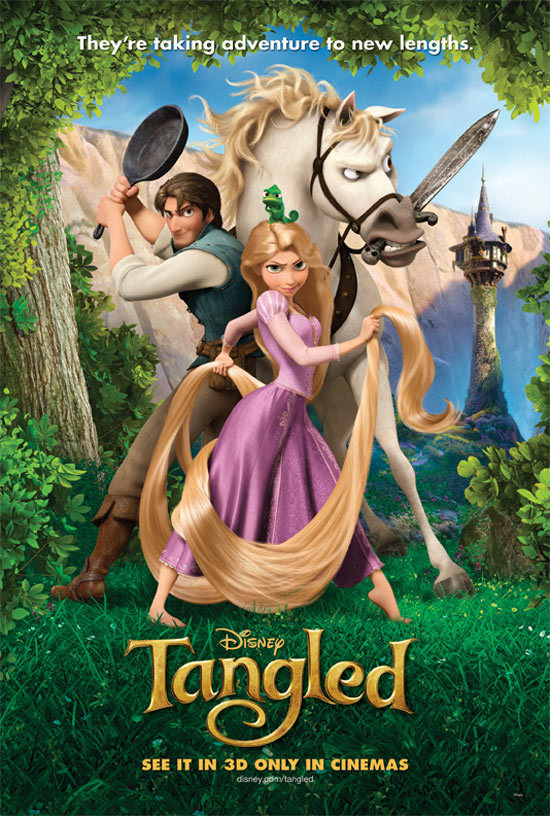
TANGLED - lovely!

So the first thing to do is forget the Brothers Grimm tale of Rapunzel, the peasant girl taken by the witch next door in exchange for the herbs that saved her mother's life. Locked in a tower as she reached puberty, Rapunzel was knocked up by a passing Prince, enchanted by her voice, but cast out by the witch in disgust. Of course, there was a happy ending. The Prince, blinded on thorns by the scheming witch, wanders into Rapunzel, who's tears of sadness heal his sight, and he takes her to be his princess.

Naturally, in Disney's version of the tale, we can't have a naive girl fall pregnant, and we can't have something as simplistic as true love conquering blindness. Moreover, in the post-modern, post-Shrek age of animation, we have to play up the modern social angle. Rapunzel is now a captured Princess who falls for a commoner (just as in SHREK and THE KING'S SPEECH - what is with it Hollywood's obsession with royals falling for commoners?) and while the teen rebellion survives, it is now cast less as a tale of hidden puberty than of fighting for independence from an over-bearing manipulative mother. Rapunzel is less a fairy-tale than an animated version of THE FIGHTER! (Not to mention the fact that she really can handle herself!) Every musical number borders on pastiche - from Riverdance style folk dances, to Mother Gothel's Big Momma Morton inspired "Mother Knows Best". There are quotations from cinema, there's teen-angst slang, there's "talk to the hand" attitude from the side-kick comedy chameleon. Basically, this movie may be a fairy tale about an innocent girl, but it's very very knowing indeed.

Still, for all that, I rather enjoyed it! Mandy Moore's Rapunzel is charming; Zachary Levi's handsome commoner, Flynn, is very witty; Donna Murphy's Mother Gothel is absolutely brilliantly manipulative, and I simply LOVED the blood-hound horse, Maximilian! There was annoyingly modern verbal humour, yes, but even better, good old-fashioned slapstick humour and a wonderfully old-fashioned visual look to the film. It may have been made on computers, but it feels a lot more painterly than recent films, and has the lush colours, deep woods and medieval castles of SNOW WHITE. The 3D added nothing, and some of the songs were soupy, but overall, TANGLED was well worth watching. I was genuinely engaged by the movie, and moved by its ending. So, after the serious mis-step with BOLT 3D, and the side-track into the American dream with THE PRINCESS AND THE FROG, I can honestly and gladly say that Disney is back to what it does best: fairytales. Beautifully drawn, moving, funny fairy-tales.

TANGLED was released last year in the US, Canada, Israel, Kazakhstan, Malaysia, Russia, Singapore, Indonesia, Italy, Mexico, Poland, Venezuela, Belgium, Egypt, France, the Netherlands, Switzerland, Hungary, Kuwait, Bulgaria, Austria, Germany, Portugal, Slovakia, Ukraine, Australia, Turkey and Chile. It was released last month in Croatia, Argentina, Greece, New Zealand, Brazil, Panama, Romania, Serbia, Peru, Estonia, Iceland, India, Slovenia, Ireland, Lithuania and the UK. It opens this weekend in Denmark, Hong Kong, Taiwan, Norway, Spain and Finland. It opens on February 11th in Finland and on March 12th in Japan. It has been nominated for an Oscar for Best Original Song.

Jumat, 14 Januari 2011

BLUE VALENTINE


BLUE VALENTINE is a justifiably praised indie drama about a young couple falling in and out of love. The stories of their meeting in the early twenties, and their disintegrating marriage six years later, and presented linearly, but inter-cut. Seeing the couple in their early heady romance juxtaposed so directly with their later frustrations brings an added pathos to what would have already been an incredibly affecting, brutally closely observed story.

Ryan Gosling (HALF NELSON) and Michelle Williams (WENDY AND LUCY) both give bravura performances as Dean and Cindy, perfectly rendering portraits of their characters at two stages of life. Gosling's Dean starts off as a charming, spontaneous, caring young man, stuck in a blue-collar job but apparently not asking anything more from life. No surprise then that Cindy - stuck in a loveless home - is drawn to his open-ness and warmth - so much so that when she falls pregnant she is willing to shelve her career ambitions to make a life with him. Six years later, and Cindy is tired and frustrated - a dutiful mother and working woman. Dean's spontaneity and charm now strike her as infantile, and though faithful to the idea of marriage, she has no desire for him. Meanwhile, Dean is seemingly so content with the idea of being a husband and father that he has no desire to push himself any further in life, or any real comprehension as to his wife's new-found coldness toward him. By marrying Cindy he has achieved more than he could have ever dreamed of - the pretty middle-class girl - and perhaps the greatest sadness of the film is that while Cindy can see more, has been raised to try for more, Dean has never been given that sense of possibility.

The bold performances are matched by documentary film-maker Derek Cianfrance's choices with the camera and editing. He shoots the couple in two very different styles in each period of their life - the courtship is in wide-angled Super 16 that always seems a little bright and grainy - like watching old cine-films of your childhood. It adds to the feeling that these are old memories. The present is shot with long lenses on DV, and it feels like the camera is always positioned to give us the feeling that the two characters are caught in a confined space, and yet never in the same focus when in the frame. It's as though the camera lens is literally entrapping them in a shared space but perpetual misunderstanding.

The overall effect is one of uncomfortable voyeurism. The movie is almost an endurance test. Because we are charmed by the couple's courtship - because they are both essentially good and charming and caring people - it becomes absolutely gruelling to watch them inflict hurt after hurt upon each other for no typically Hollywood-reason - no distinct cause - but just because they have grown up, or haven't in different ways.

BLUE VALENTINE played Sundance, Cannes, Telluride, Toronto and London 2010. It is currently on release in the US, Australia, Malaysia and Canada. It opens in the UK this Friday, in Portugal on February 3rd and in Sweden on April 1st. Both Ryan Gosling and Michelle Williams have been nominated for Golden Globes.

Rabu, 15 Desember 2010

Random DVD Round-Up 2 - HEARTBREAKER


French TV director Pascal Chaumeil makes his big-screen debut with the commercial hit, HEARTBREAKER. It's a whimsical romantic-comedy starring Romain Duris (THE BEAT MY HEART SKIPPED) and Vanessa Paradis (er...Chanel ads?). Penned by Laurent Zeitoun, Jeremy Doner and Yohan Gromb, the plot is driven by a conceit that is so palpably stupid that the film never really recovers from it. Duris plays Alex - a man who is hired by the friends and family of women who are stuck in awful relationships but can't see it. He comes along, charms them, and they, realising how crummy their current boyfriends are, dump them. Problem is that in this particular set-up, Vanessa Paradis' Juliette boyfriend Jonathan (Andrew Lincoln) isn't actually crummy. In fact, he seems to be genuinely in love with Juliette and vice versa. So, if Alex hadn't come along with his Patrick Swayze dance moves, all would've been well. This is a major problem for a romantic-comedy where we're meant to be rooting for a couple to get together.

The humour is sporadic, sometimes plain weird and lazy. The caper aspects - how the heartbreaker team set up the meet-cutes - are just silly. And call me pragmatic, but I was wondering why, if you had such good IT and general spy skills, you wouldn't be using them for something more lucrative and impactful. There's some attempted humour at the expense of Juliette's nympho best friend, but that seems discordant when the tone the director is trying to go for with the main plot is one of whimsical romance. And then, of course, there's the idea that Alex and Juliette fall in love over a shared passion for the film DIRTY DANCING. This could've been tremendous, but I found the pivotal dance scene somehow lacking in spark and fun. Romain Duris seemed to be putting his all into the role, but Paradis seemed rather cold and disengaged. That is, to be sure, part of her character, especially in the early scenes, but we should've seen more of a progression.

Overall, the film struck me a laughably silly but never so silly as to make me laugh. It looks like a hundred minute commercial for Monaco and has very little merit other than that. God help us for the remake. I predict some piss-poor Gerard Butler-Katherine Heigl set-up.

HEARTBREAKER opened in summer 2010 and is available on DVD and on iTunes.

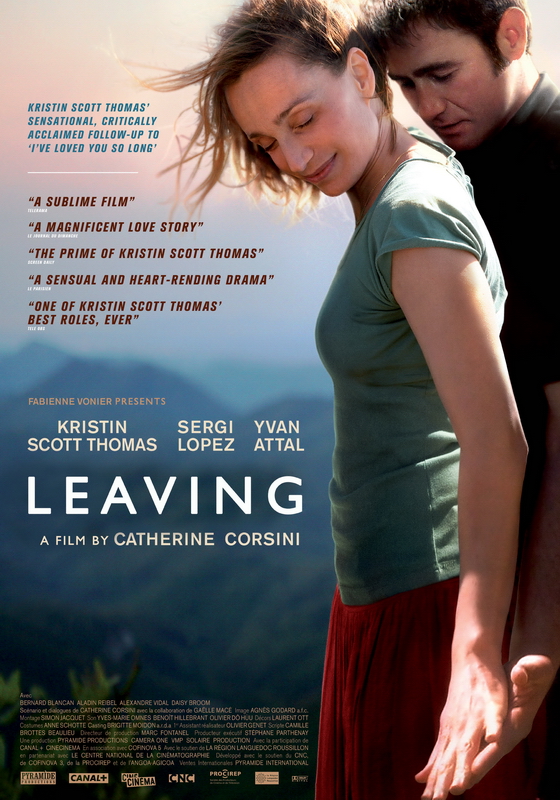
Random DVD round-up 1 - LEAVING

Kristin Scott Thomas has a cool hard beauty that has seen her cast in many a film as, well, a cool hard beauty - emotionally repressed and stolidly dutiful. How wonderful then to see her madly, wide-smilingly in love - almost fey.

In Catherine Corsini's LEAVING, Scott Thomas plays Suzanne, a middle-aged middle-class woman married to a financially successful medic and living in a beautiful house. She is rather taken for granted by her husband (Yvan Attal) and kids, and is trying to reclaim her career as a physiotherapist. She is, in many ways, wandering through life on auto-pilot with occasional outbursts where the rage erupts - as in the powerful opening scene. Suzanne's life changes when she meets and pursues a Spanish builder called Ivan (Sergi López). Their attraction is physical - for sure - but not as singularly as her husband tries to portray it. She isn't just a middle-aged woman who has discovered sex but rather, as in Lady Chatterly's Lover - a kind of freedom and self-knowledge. The second half of the film sees the erotic character study move into a sort of procedural thriller as the two lovers are forced to live cut off from the husband's money and Suzanne's children. The surprise is that it isn't Ivan who drives the narrative - neither as seducer nor as breadwinner. Pretty soon Suzanne's girlie happiness turns into a more brutal, steely survival instinct.

By putting Suzanne firmly at the centre of the film, writers Catherine Corsini and Gaëlle Macé have given Kristin Scott Thomnas a role of the kind that is rarely seen in cinema. A middle-aged woman is allowed to be multi-faceted and the driving force of the action and emotional content of the film. Scott Thomas is completely up to the task and this is further evidence of an actress at the top of her game. I also appreciate that Corsini doesn't feel the need to spin this movie out beyond a 80 minute run-time. Too many films nowadays are unnecessarily baggy. But, there is a big problem with this film - and that's the final act. The closing action is too predictable, too crude relative to what has come before, and the final scenes over the end credits, while presumably trying to be ambiguous seem rather off-tone.

LEAVING played London and Toronto 2009 and was released last year in Belgium, France, the Netherlands, Spain and Brazil. It was released earlier this year in Germany, Italy, Portugal, the UK, Argentina, Denmark, Sweden and the US.
 

reiview movies and books Copyright © 2012 -- Powered by Blogger