Tampilkan postingan dengan label psychological. Tampilkan semua postingan

Jumat, 21 Oktober 2011

London Film Fest 2011 Day 9 - MARTHA MARCY MAY MARLENE


MARTHA MARCY MAY MARLENE is a movie with a fascinating premise and a compelling central performance that is let down by a deeply non-credible plot and incredibly flawed cinematographer. It arrived at the London Film Festival fêted with praised and awards from the Sundance Film Festival, but sadly does not live up to the hype.


The central premise is to tell the story of a young girl in the immediate aftermath of her escape from a Charlie Manson like cult.  Day by day we see her struggle to adjust to normal society - her behaviour increasingly paranoid and aggressive - her family turning from accepting to irritated.  I really liked the novelty of taking this point of view. Rather than a lurid movie taking us into a cult in simple chronological fashion, it was far more fascinating to see the impact of the emotional manipulation in nightmarish flashbacks.  (That said, and to resist plot spoilers, I will simply say that I found the final scene to be needlessly "tricksy".)


Elizabeth Olsen plays the girl who has escaped - birth name Martha - but renamed by the cult leader Marcy May - a clever re-naming trick designed to alienate her from her former life and family ties.  I guess she'll forever be referred to as the "other" Olsen girl, but this performance should go some way to give her a name of her own.  Her performance is subtle, brave and deeply compelling - it's the backbone that keeps the movie together - and places her as a young talent to watch in the same peer group as Carey Mulligan and Evan Rachel Wood.


The tragedy is that her performance is undermined by a script by debut writer-director Sean Durkin that is utterly (and literally) incredible.  If your kid sister vanishes for two years, then suddenly calls you begging you to pick her up from the middle of nowhere, is in visible distress, covered in bruises, and starts acting really weirdly, wouldn't you ask what just happened?  Wouldn't you take her to a doctor immediately? Wouldn't you try to reach out to her?  I simply found the character of Lucy, Martha's sister, utterly unbelievable, and I wondered if this was deliberate on the part of Durkin or just a mistake, compounded by Sarah Paulin's icy, almost robotic, performance.  But even before that, I found the plot absurd. In the first scene, Martha escapes from the commune by running off into the woods, and then stops in the nearest town for some food.  One of the men from the cult tracks her down and looks menacing, but instead of hauling her ass back, simply let's her hang out in town assuming she'll come back of her own accord.  That just seemed laughably stupid.


Elizabeth Olsen (Martha) on the red carpet
for the UK premiere of  

MARTHA MARCY MAY MARLENE at 
the BFI London Film Festival 2011
The other major problem with this film is incredibly poor quality cinematography from DP Jody Lee Lipes. That's not to see each frame isn't beautifully composed - that there isn't brilliant work in creating trick shots - reflections.  But I really hate it when people use DV and create colour palettes where the blacks aren't true blacks but washed out greys. It muddies the picture, and reduces the intensity of emotion.  When Martha runs into the woods, for instance, the scene is less petrifying but the scene looks washed out.  


MARTHA MARCY MAY MARLENE played Sundance 2011 where it won the Directing Award - Dramatic. It also played Cannes, Sydney and Toronto. It opens today in the US. It opens on December 22nd in Sweden; on January 20th in Poland; on February 2nd in Russia; in Ireland and the UK on February 3rd; in Spain on February 24th; and in France and Germany on March 29th.

Selasa, 18 Oktober 2011

London Film Fest 2011 Day 7 - WE NEED TO TALK ABOUT KEVIN


Lionel Schriver's hugely successful novel "We Need To Talk About Kevin" is a powerful, intelligent and provocative novel about the mother of a boy who commits a high school massacre.  The framing tool of the novel is that the mother, Eva, is writing letters to her husband, Franklyn, trying to explain what her life has become, and how she rationalises their part in raising a son who would commit such acts. From the earliest years we see the conflict between good-natured but naive Franklyn who wants two kids and a house in the suburbs, and Eva, the bohemian travel writer and City girl who has a deep antipathy to giving that up to raise children.  And so we assume Franklyn and Eva are divorced.  Eva describes the lack of bond she felt for Kevin as a child, his tantrums, her frustration, and Franklyn's disbelief that Kevin was actually playing psychological games with them. And then, when they have another child, sweet little Celia - so crucial because it shows that Eva can be a loving mother - they have their most powerful disagreement on Kevin's role in an "accident" with some bleach.  The tension builds - we know the letters will take us through Kevin's adolescence to his gruesome act of murder, and we like Eva, want an explanation.  But Schriver is far too subtle and realistic to give us easy answers.  It's a stunningly well-written novel, and I can also highly recommend the unabridged audiobook read by Lorelei King - whose voice I thought was the definitive Eva.

In approaching the material, writer-director Lynne Ramsay (MORVEN CALLAR) and writer (and actor) Rory Kinnear have taken a free approach - after all, one cannot easily translate an epistolary novel to screen, and the audience is likely familiar with the "big reveals" at the end of the novel by now. They keep the idea of the framing device - Eva in post-massacre life, bearing the insults and shame - and the chronological telling of Kevin's childhood.  However, they begin with an almost impressionistic set of scenes giving us the atmosphere of the present and the past, hints at the suburban life that has been destroyed, and before that, of Eva's life of travel - all with a nightmare vividness. The screenplay is really a masterclass in how to translate a popular novel to screen, keeping all the thematic material in tact, but without being slavish.

The performances are likewise superlative.  Tilda Swinton really is as good as everyone says as Eva - depicting both the ambitious businesswoman and the broken, guilt-ridden mother.  John C Reilly, who I couldn't really see as Franklyn before I watched the film, perfectly captures his naivete and frustrating blindness.  But it's the two Kevin's who really stand out - Rock Duer as the young boy, and Ezra Miller as the teenager. The ability to go from pure evil, mocking stare to charming smile as the audience switches from Eva to Franklyn - truly superb and sadistic. 

On the technical side, DP Seamus McGarvey (ATONEMENT) does outstanding work, and  Jonny Greenwood's score is wonderful. (THERE WILL BE BLOOD).  But I had one massive problem with the direction, and that's the ham-fisted crude use of "blood" imagery - from Eva covered in crushed tomatoes; to over-filled jam sandwiches; to red paint thrown on a house; to Eva washing her hand's of aforementioned paint......Yes, we get it, there will be blood, and the blood, as for Lady Macbeth, will be hard to wash off, metaphorically speaking.  But please, enough already. Where is the subtlety of Schriver in this blood-fetishism?

<< Ezra Miller (Kevin); Lynne Ramsay (Director) and Lionel Schriver (Author) at the UK premiere of WE NEED TO TALK ABOUT KEVIN at the BFI London Film Festival 2011.


WE NEED TO TALK ABOUT KEVIN played Cannes, Toronto and London 2011. It opened in France earlier this month and opens in Ireland and the UK on October 21st. It opens in Greece and Hungary on November 3rd; in Australia on November 17th; in NYC and LA on December 9th and then on wide release in the USA on January 27th. It opens in Sweden on February 17th.

Minggu, 16 Januari 2011

BLACK SWAN - glorious trash


Darren Aronofsky's much-praised new film, BLACK SWAN, is beautifully-produced trash, and I say that with all respect and admiration. It brings an auteur sensibility to material that is basically a camp psycho-sexual horror flick, in the style of Polanski's REPULSION or Dario Argento's SUSPIRIA. While the material may superficially resemble Powell and Pressburger's seminal ballet melodrama, THE RED SHOES, BLACK SWAN contains none of that film's elegant framing or love for high-art. Rather, BLACK SWAN is the ultimate B-movie - a genre movie that wears its balls-out craziness on its sleeve. The result is beautiful and exhilarating, but I can't say that it affected me as emotionally and as profoundly as Aronofsky's previous film, THE WRESTLER.

In fairness to Aronofsky, the B-movie craziness of BLACK SWAN can be traced back directly to its roots - the ballet Swan Lake - a Gothic melodrama containing elements of body-horror, psychotic doubling and ending in transformative suicide. If that isn't the stuff of a Polanski horror flick, I don't know what is. In the ballet, an evil wizard transforms the innocent princess Odile into a were-swan. The love of the handsome prince should set her free, but her evil doppelgaenger Odette seduces the prince, with results varying depending on which version of the ballet you watch. In the film, Natalie Portman's Nina Sayer has been infantilised by an over-bearing mother (Barbara Hershey). Under pressure to be the perfect "sweet girl" and ballerina, Nina self-harms, is bulimic, has a pathological desire to please, and a psychotic fear of imperfection. When given the role of the Swan Queen, Nina has to bring her innate sexuality, so suppressed by her mother, out into the open, to inform her dancing of the Black Swan. She simply cracks trying to reconcile her mother's expectations of pre-pubescent innocence and her ballet director's (Vincent Cassel) aggressive demands that she be as instinctively sexual as her understudy (Mila Kunis).

What follows is a movie that creates a sense of building tension through the use of claustrophobic interior shots; invasive close-ups; visual trickery with mirrors; and sound editing that suggests an inner self trying to break through. The movie is never pure horror despite plenty of shots involving nail-clipping and skin-scratching.  After all, we never really doubt whether what we are seeing is real or imagined. Nina is shown to be an unreliable witness too early in the movie for that. What we do have is a powerful display of hysteria - but heightened to the point where it is sometimes unintentionally funny (an early scene bedroom scene, for example) and moves so far beyond realism that one feels almost disengaged from it. Nina is less a person to sympathise with than a delicate compendium of every single neurosis that can arise from intensely un-boundaried parenting.

The thematic material in BLACK SWAN is very similar to THE WRESTLER. In both movies we have individuals who are so dedicated to and defined by their profession, that they ultimately sacrifice their physical and mental well-being to it. The Wrestler staples himself and batters himself to entertain, just as Nina breaks her toes and punishes her body. The Wrestler and Nina may be extreme examples of self-destruction, but they hint at the systematic physical abuse that their professions entail. That's why Aronofsky's shooting style is so perfect. By taking the cameras on-stage, by using tracking shots that immerse us in their worlds, Aronofsky is making us look behind the costumes to see the grueling physicality. He wants us to see the sweat, the muscles, the bleeding toes and the broken bones. 

In a sense, Aronofsky is making a bigger point about the demands the entertainment industries make of its professionals, begging the obvious question of how far this applies to his profession, with its pressure to maintain youthful good looks with botox, plastic surgery and aggressive dieting. To that end, one can only view the casting of Mickey Rourke in THE WRESTLER and Barbara Hershey in BLACK SWAN - both self-mutilated by plastic surgery and injury - as provocations. By casting these actors, Aronofsky is himself blurring the line between actor and character - just as Nina can't separate reality from fiction. Similarly, the use of Winona Ryder to play the prima ballerina Nina supplants is inspired. Ryder was a beautiful young actress whose early success morphed into career stagnation and personal humiliation.  Who else better signifies crushing rejection in reality and on screen?

Still, for all the similarity in material, and in the vérité shooting style used in the apartment scenes, to my mind BLACK SWAN is at once a greater and lesser film than THE WRESTLER. It is a greater film insofar as it shows Aronofsky and DP Matthew Libatique in perfect command of vérité shooting style but also able to inter-cut this with its exact opposite - a super-heightened gothic horror shotting style using chiaroscuro and close-ups. It also shows that Aronofsky can do genre cinema with the best of them. But BLACK SWAN is a lesser film insofar as that willingness to leap into melodramatic horror is ultimately a distancing device. Nina Sayers is such a compendium of crazy - under such extreme pressure - that she becomes a device rather than a person. Accordingly, as the film moves into its final act, it is beautiful but it isn't emotionally arresting. Nina's self-destructive tailspin is transfixing, wonderful, crazy and all-consuming - but it never made me feel the visceral hurt that The Wrestler did. That is BLACK SWAN's only flaw - but it is a serious one.

BLACK SWAN played Venice, Telluride, Toronto and London 2010. It opened last year in the US and Canada. It opens this Friday in the UK, Australia, Denmark, Germany, Ireland and Poland. It opens on the 27th in Chile, Greece, Slovenia and Lithuania, It opens on February 4th in the Netherlands, Portugal, Brazil, Iceland and Norway. It opens in France, Singapore and Mexico on February 10th. It opens on February 17th in Argentina, Hungary, Israel, Russia, Estonia and Spain. It opens on February 24th in Belgium, Hong Kong, Malaysia, Finland and Turkey. It opens in Sweden on March 4th, Italy on March 11th and the Czech Republic on April 7th.

Sabtu, 20 Maret 2010

THE GIRL WITH THE DRAGON TATTOO - a faithful adaptation of a great thriller

Niels Arden Oplev's screen adaptation of the wildly successful Stieg Larsson thriller, THE GIRL WITH THE DRAGON TATTOO, is a sure crowd-pleaser. Though still coming in at two and a half hours, it is an admirably condensed and faithful adaptation of a complicated thriller. As fans will be well aware - and I'm assuming most people who see the film will have already read all three books - the movie is about two people who form an unlikely bond in order to investigate an old crime in one of Sweden's most prominent families. Years ago, a young girl disappeared from the wealthy island inhabited largely by her family - the Vangers. In old age, her grand-uncle hires disgraced investigative journalist Mikael Blomkvist to re-examine the case and the rogue's gallery of former Nazis and selfish old bastards that make up the Vanger family. Blomkvist is a like-able decent guy - and in his relationship with his long time mistress and best friend Erika, as well as with his new found aide, Lisbeth Salander, he proves that he is a "man who loves women". He enjoys their company, enjoys making love to them, treats them as equals and with respect. But Lisbeth Salander - the true star of the books and this film - is a prickly character - highly intelligent, gifted with computers, a victim of extreme abuse, and as uncomfortable in her skin as Blomkvist is at peace.


I found the direction to be workmanlike in all but the elegant way in which the IT hacking was depicted. What set the movie apart was, source material notwithstanding, the genuine sympathy between, and charisma of, the two lead characters. Michael Nyqvist is superb as the laconic Blomkvist, and Noomi Rapace commits physically and psychologically so fully to being Lisbeth Salander that you can feel the ferocity. And this is important, because inevitably, in order to compress the film, the side relationships - and the smaller characters at Millenium and Milton Security - have been stripped away. As a result, the film lives and dies by whether you are emotionally affected by an abused woman opening a small sliver of her life to Blomkvist. This is much more pivotal than solving the "whodunnit". After all, if there's any real message to Larson's novel, it's that the establishment in its entirety did it.

THE GIRL WITH THE DRAGON TATTOO was released in 2009 in Denmark, Sweden, Norway, Hungary, Finland, France, Switzerland, Belgium, Canada, Italy, Spain, Iceland, the Netherlands, Portugal, Germany, Greece, Austria, Poland and New Zealand. It opened earlier this year in Japan and Estonia. It is currently on release in the US and UK and opens next weekend in Australia. It opens on April 23rd in Brazil.

Additional tags: Jacob Groth, Jens Fischer, Eric Kress, Michael Nyqvist, Noomi Rapace, Lena Endre, Peter Haber, Sven-Bertil Taube, Peter Andersson, Ingvar Hirdwall, Marika Lagercrantz, Ewa Froling, Tomas Kohler, Gosta Bredefeldt, Niels Arden Oplev.

Selasa, 23 Februari 2010

SHUTTER ISLAND - the auteur's B-movie

SHUTTER ISLAND is a psychological horror film directed by Martin Scorsese and based on the popular 2003 novel by Denis Lehane. This faithful adaptation is a self-consciously old-fashioned sort of an enterprise, set in a maximum security prison for the criminally insane, in 1950s America. It deals very deeply in notions of personal and national guilt – denial and repression. The protagonist is a veteran soldier turned Federal Marshall called Teddy Daniels (Leonardo di Caprio). He has been three two traumas – being present at the liberation of Dachau, and having his wife die in an arson attack on their apartment. Nominally, he has come to Shutter Island to investigate the mysterious disappearance of a female patient/prisoner called Rachel Salondo. His real agenda is to investigate the whereabouts of the man who killed his wife though - he protests – not to take revenge – and to investigate what really happens in Ward C. The central puzzle of the film is what is the agenda of the employees of Shutter Island, not least the lead psychologists (the superbly sinister Sir Ben Kingsley and Max von Sydow.)

SHUTTER ISLAND is a profoundly odd film. Just as with THE SHINING it sees an A-list auteur apply his talent to a B-movie genre – the brooding psychological thriller. All the way through the movie, I found myself being brought out of the film by the sheer quality of Martin Scorsese’s framing or Thelma Schoonmaker’s editing. I was also deeply impressed by the sophistication of the intellectual material – the conflation of personal and political guilt. But somehow, the sheer quality of the thematic material and its production mitigated against the hyper-real construction of a sinister atmosphere, through Robbie Robertson’s careful use of Mahler and the fictively sombre grey clouds hanging over the eponymous prison island with its gothic central house and proto-fascist civil war prison fort. It also mitigated against my emotional involvement with the film. Thus scenes that should be downright petrifying or deeply emotionally moving were neutered by their subvention to the tricky plot.

The movie is thus, at times, deliberately bad – especially in its opening sequences – with its self-consciously over-the-top weather effects and ludicrously over-bearing score. It is also at times extremely good – so good that it breaks the B-movie veneer. In particular, I would cite the flashback scenes to Dachau, especially the mass execution, which plays like a sort of demented ballet. At other times, Scorsese seems to be reaching for something darker and more twisted than I have seen him wrestle with before, but basically fail in that task. The way in which he treats the hallucinations and warped memories of his protagonist is beautiful and bizarre. But it brings to mind comparison with BUG and David Lynch’s recent work – not least MULHOLLAND DRIVE. I couldn’t help but wonder what a less faithful and more free-wheeling treatment of the material might have looked like in the hands of someone like Lynch.

And this brings me to my final thought on SHUTTER ISLAND: it is, after all, a beautifully made but rather conventional treatment of the subject matter. Scorsese’s art is well-honed but he is somehow a prisoner of it. He hasn’t allowed himself to truly break free and show us something so unhinged as to utterly disturb us. Neither has he subverted the B-movie horror film in the way that a Quentin Tarantino did with World War Two films in INGLOURIOUS BASTERDS (a film which, by the way, looks better with each passing day).

SHUTTER ISLAND premiered at Berlin 2010. It was released last weekend in the US, Argentina, Argentina, Denmark, Georgia, Kazakhstan, the Netherlands, Russia, Bulgaria, Canada, Finland, Lithuania, Norway, Spain and Sweden. It is released this weekend in Belgium, France, the Czech Republic, Germany, Greece, Israel, New Zealand, Portugal, Romania, Slovakia, Austria, Estonia, Iceland, Taiwan and Venezuela. It opens on March 5th in Switzerland, Hungary, Brazil and Italy. It opens on March 12th in the UK, Egypt, Mexico and Turkey. It opens on March 18th in South Korea and on March 26th in Poland. It opens in April 9th in Japan and on April 15th in Singapore.

Jumat, 23 Oktober 2009

London Film Fest Day 10 - MOTHER / MADEO

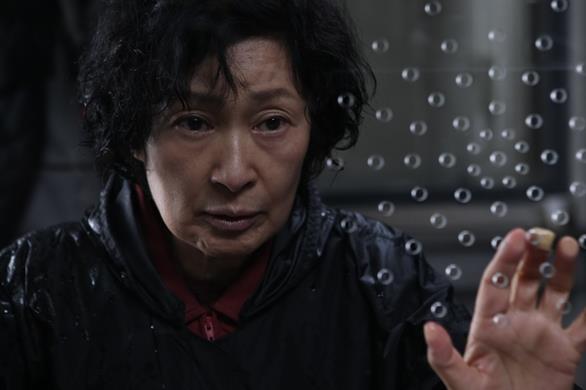
South Korea is not submitting Park Chan-Wook's superb THIRST as its entry for the Foreign Language Oscar this year. Rather, it is submitting Joon-Ho Bong's MOTHER. The absurdist tone of his horror flick, THE HOST, carries over into this bizarre take on the crime thriller, in which a devoted mother sets out to prove that her mentally disabled son did not murder a young girl. TV actress Kim Hye-a stars as the mother, and utterly convinces of her crazy devotion to her son, but the overwhelming tone of this film is comedy and absurdity. Unfortunately for me, this wasn't enough to sustain the two hour run-time. If you want me to sit still for that long, you either need to take this movie into the dark underbelly of bourgeois life in the manner of David Lynch, or take the absurdity to its extreme logical conclusion as in Almodovar or Park Chan-Wook himself. By contrast, this film starts promisingly but is essentially well-made but rather tame. Certainly, there is nothing in the main body of the film to match the compelling opening scene of the mother dancing in a field, her face fixed in a grimace. At that point, I was reminded of the dancing dwarf in Twin Peaks, and thought I was in for a wild ride. No such luck.

MOTHER played Cannes, Toronto, New York and London 2009. It was released in South Korea and Australia earlier this year and opens in Japan next week. There is no UK or US release date as yet.

Kamis, 22 Oktober 2009

London FIlm Fest Day 9 - CHLOE

Atom Egoyan's latest film, CHLOE, treads familiar territory - sexual jealousy, paranoia and the transgressive desires that rock mainstream marriages. Julianne Moore plays a successful gynecologist (of course!) who suspects her flirtatious husband (Liam Neeson) of cheating. As in the laughably dissimilar EXTRACT, she tests him by setting him with a beautiful young prostitute (Amanda Seyfried evidently trying to shake off that MAMMA MIA! wholesomeness). In contrast to the more simplistic French source film, NATALIE, Egoyan and screenwriter Erin Cressida Wilson (SECRETARY) keep us guessing as to whether the husband is really cheating, or whether he is the victim of his wife's insecurity. We also have a classic Egoyan relationship between the wife and the prostitute: is the wife really falling for the hooker, or is she just trying to get close to her husband in a really fracked up way? And is the hooker really falling for the wife, or is she just being emotionally or indeed financially manipulative?


I really loved this film. Moore gives a strong central performance as a woman d'un certain age in a crisis, and Seyfried is convincing both as seductress and vulnerable young girl. They sell their relationship, and that makes the film. I also love the very particular production design from Phillip Barker, and the locations chosen - in particular the marital home. The wife is, by virtue of architecture mirroring her psyche, a voyeur, condemned to look through picture windows and listen at doors and stare at reflections. It works wonderfully.

CHLOE played Toronto 2009 and will be released in France in March 2010.

Minggu, 13 September 2009

Overlooked DVD of the month - THE KILLING ROOM

Director Jonathan Liebesman followed up DARKNESS FALL and TCM: THE BEGINNING with a quiet psychological thriller called THE KILLING ROOM. It's an austere, tightly made, well-acted film that, while mining familiar material, still manages to hold our attention. The movie takes the same kind of approach as DAS EXPERIMENT - creating a fictional exploration of a real psychological experiment - in this case, the CIA's infamous MK Ultra programme. In the real life version, "volunteers" were subjected to mind-control experiments, often drug-induced, of the kind that led to Manchurian candidates. In this fictionalised version, four men have volunteered for a medical experiment run by the ruthless Dr Phillips (Peter Stormare) and the ambitious but morally uncertain Miss Reilly (Chloe Sevigny). They have to solve puzzles, and the man with the least correct guess is summarily executed. The prisoners try to outwit the system, and even escape, while the audience try to figure out what purpose such a sadistic experiment could serve. I liked the stark production design, gathering sense of claustrophobia, and Timothy Hutton's performance as one of the "volunteers". This movie is well worth a watch.

THE KILLING ROOM played Sundance 2009 and went straight to DVD.
 

reiview movies and books Copyright © 2012 -- Powered by Blogger