Tampilkan postingan dengan label politics. Tampilkan semua postingan

Sabtu, 26 Mei 2012

THE DICTATOR

THE DICTATOR is hands down the funniest, cleverest movie Sacha Baron Cohen has ever made.  I was always a bit uneasy at films like BORAT and BRUNO. I felt it was somehow exploitative to frame ordinary members of the public, and the humour too often descended to the most base level. I'm thinking in particular of the scene where Borat hands his charming Southern hostess a bag of what she thinks is his own shit. That isn't satire or even good physical comedy. It's just cruel and crass. Luckily, Sacha Baron Cohen is now so famous that he can't get away with that kind of stunt-movie. The result is his first fully scripted feature - a movie that I feel is more tightly written, better performed, and more politically on point than anything he's done to date. 

Cohen plays a dodgy African dictator in the mould of Gadaffi called Aladeen.  In the opening scenes we see him lording it up in his home state to great comic effect, before journeying to the USA.  His evil sidekick switches him out with his body-double, in order to get at the oil reserves, forcing Aladeen to live a "normal" American life until he can regain access to his entourage.  This allows Cohen to simultaneously take the piss out of Western greedy capitalists and hippie liberals.  The capitalists don't care who rules, or what promises of fake democracy are made, so long as they can get the oil rights. The hippie liberals are so busy being nice and not offended that they can't even take offence when they should, or recognise a fake offer of watered down democracy when they see it.  Everyone has a price.  Love conquers all but doesn't really.  And America is the biggest joke of all - "a country built by blacks and owned by the Chinese" where it's recent history of democracy - wealth redistributed to the rich through the developed world's only regressive tax system; a presidential election decided by judicial fiat; where its ethnic minorities are incarcerated at disproportionately high rates; and citizens are held indefinitely without trial. The skill is that Cohen can make all these subversive assertions but still keep the tone of the film light-hearted and have us consistently laughing out loud.  Kudos.

THE DICTATOR is on release in Australia, Belgium, Canada, Denmark, Iceland, Ireland, Latvia, the Netherlands, New Zealand, Norway, Sweden, the UK, the USA, Croatia, Germany, Hungary, Kazakhstan, Portugal, Russia, Serbia, Slovenia, Switzerland, Ukraine, Bulgaria, Estonia, Finland, Lithuania, Poland, Romania, Turkey and Armenia. It opens in Hong Kong on June 7th, Singapore, Brazil, Italy and Taiwan on June 15th, France on June 20th, Spain on July 13th, Argentina, Greece and Colombia on July 20th, Cambodia on July 26th, Mexico on August 10th and Japan on September 7th. 

Minggu, 22 April 2012

MARLEY


Kevin MacDonald (THE EAGLE) returns to the documentary format with this insightful, beautifully edited documentary about Bob Marley. MacDonald inherited this "troubled" project after Scorsese and Demme left, apparently during the editing process, but it's clear that MacDonald was able to go back and shoot extra footage because his voice is occasionally heard interviewing Marley's family and friends. As a result, this is a project very much in the style of TOUCHING THE VOID. MacDonald comes to the material with a clear, curious head, but stays in the background - letting Marley's contemporaries (to whom he has exceptionally good access) speak for themselves.  MacDonald does not flinch from emotionally and politically tough issues - Marley's multiple girlfriends - the difficulty his children had in breaking through the entourage to his get to their father - Marley's political naivete - often playing for the "people" but hijacked by nasty political factions, and African dictators. 

The documentary begins at Nine Mile - up in the verdant hills of Jamaica - far away from the cliched image of Montego Bay.  Marley grew up in rural poverty, doubly cursed by being of illegitimate and mixed race parentage.  An outsider, he becomes fiercely competitive (even with his own children), strongly disciplined about his music, his route to escape. He followed his mother to Trenchtown, the Kingston ghetto, and made his early forays into the music business with the Wailing Wailers - a kind of Motown clean-cut boy band influenced by local ska and mento music. After a brief excursion to the US, following his mother, frustrated at his lack of success, he returns to Jamaica and his musical style and philosophical self-confidence seems to turn on his becoming a Rastafari.  The documentary spends a good amount of time examining what this religion meant to Marley, and why an outsider might have felt drawn to a minority "cult", itself the subject of prejudice, which preached "one love". 

But for me, the movie really became compelling when it got to its final hour, and Marley's final years.  When Marley was such a potent icon that he was being used by politicians. When Jamaican politics descended into gang violence between crypto-Communists and crypto-Fascists.  When Marley ships equipment to Zimbabwe at his own expense to celebrate independence, but sees his audience tear-gassed.   I love that MacDonald manages to open out from a music documentary into a sad documentary about the tragedy of independence - so many former colonies descending into political chaos or tyranny. That for me, is what makes this documentary, and Marley's life and early death, tragic. (So much so that I wasn't the only person crying in the cinema.) This clash between his harsh experiences; his idealism; and the contested politics against which he had to operate. Even the images of Marley over the final credits are problematic.  Is his music an evangelical rallying cry that has touched people across the world, even today? Or has he become another icon exploited by the merchandising men, like Che Guevara - a face on a T-shirt?

MARLEY played Berlin  and SXSW 2012. It is currently on release in the UK, USA and Ireland. It opens in Belgium on May 9th, in the Netherlands on May 10th, in Germany on May 17th, in Portugal on May 24th and in France on June 13th. 

MARLEY has a runtime of 144 minutes and is rated PG-13 in the USA and 15 in the UK. 

Sabtu, 14 April 2012

iPad Round-Up 2 - TATSUMI


TATSUMI is a wonderful animated film that works on two levels.  Most obviously, it is the life story of Japanese manga artist Toshihiro Tatsumi, based on his award-winning graphic novel/memoir, "A Drifting Life".  It shows him growing up in war-torn Japan, making his name as a young Manga artist, and finally pioneering a new type of comic for adults, dealing explicitly with sexual frustration, ennui and social issues in post-war Japan - in sharp contrast to the Astro Boy comics of his idol Osama Tezuka. To that end, the movie works as biopic for manga fans, interspersing the impressively frank autobiography with short animated films of some of his most famous short stories. This was interesting, and elegantly done, but as a person who has never read a single manga story, I found the movie more compelling as a document of social history. Thanks to Tatsumi's keen eye and honesty, we learn a lot about the social, sexual, political and economic changes in Japan, from the horrors of the nuclear bomb, to deprivation, to the economic boom. There were all sorts of little facts that shocked me - I was shocked at my own ignorance - such as the fact that the Japanese couldn't travel abroad until 1964 and even then with only a dollar's worth of Yen. So, for me, this film was entertaining, moving and educational, and I would recommend it even to people who have no interest in manga at all.  The visuals are beautiful, elegant and powerful, and have prompted me to start reading "A Drifting Life".


TATSUMI played Cannes 2011 and opened last year in Singapore and Hungary. It opened earlier this year in Ireland and the UK and is currently on release in the USA. It is available to rent and own. 

Kamis, 01 Desember 2011

THE HELP - the Driving Miss Daisy de nos jours


Tate Taylor, director of the anonymous 2008 comedy PRETTY UGLY PEOPLE, somehow managed to get the studios to allow to write and direct THE HELP, a soupy drama based on the best-selling novel by Kathryn Stockett. Not having read Stockett's novel chronicling the travails in 1960s racist Mississippi, I don't know whether the emotional manipulation and superficial politics come from her of from the director.  Either way, the resulting movie looks handsome, and made me shed a tear in the final reel, but has all the genuine engagement with the issues of DRIVING MISS DAISY.  It's a bland feelgood movie about a topic that should make us angry and agitated.  It's a movie in which the main African American character's son is lynched and yet we come out feeling warm and fluffy.  Double plus not good.

The film makes the mistake of telling the stories of these African-American maids through the lens of a perky white wannabe journalist - Skeeter (Emma Stone) - a move that immediately tells us we're in a world where a harsh tale has to be made palatable for a mainstream audience.  Ironic, also, in a movie that makes such a big deal about going right to the source.  Skeeter serves as the vessel through which the maids will dish the dirt and get their story published.  The movie is scrupulous in telling us that Skeeter is sharing the royalties with her informants - but while she gets a cool job in New York out of it - they are at risk of being sacked, imprisoned or lynched. The risks and rewards are clearly completely asymmetric, but the film doesn't embrace and mine that fact - it would mess up the fluffy finale.

Worse still, there is no subtlety in the characterisation - no shades of grey. You're either a good-hearted liberal white (Skeeter, her shamed and reformed mother, Jessica Chastain's character Celia), or a nasty racist white (Bryce Dallas Howard's Hilly and her acolytes).  And as for the African-American women they are largely painted in tones of full-on heroism, with even the thief seen as a martyr to a mean mistress.   As for the subject matter, awful, horrible petty racism is seen on screen, but racial violence is referred to rather than shown.  Ditto the subject matter of domestic abuse.  And I couldn't help feeling insulted that the subject of vengeance against racism was reduced to a scatological joke. 

All this isn't to say that the production isn't handsome - with lush on location lensing from DP Stephen Goldblatt (JULIE & JULIA) and wonderful period costumes.  And the female cast is good quality and does the best with the narrowly written characters they are given.  In particular, it was a joy to finally see Jessica Chastain able to round out a character - rather than just being a virtuous icon, as in THE TREE OF LIFE and CORIOLANUS.  

But this movie, so hyped, so likely to win awards, is not a good movie. It's politics are dicey - it's reluctance to truly grasp the profundity of what it's tackling frustrating - it's emotional manipulation dishonest.  I have no time for it.  

THE HELP was released in the autumn in the US, Canada, Australia, Hong Kong and Sweden. It was released in October in Portugal, Finland, Norway, Lithuania, Singapore, France, Ireland, the UK and Spain. It was released in November in Spain, Hungary, Poland, Malta, Estonia, Denmark, Greece, Kuwait and India.  It opens on December 8th in Germany; on December 28th in Belgium; on Dcember 29th in the Netherlands; on January 20th in Italy; on February 3rd in Bulgaria and on February 6th in Brazil.  THE HELP is likely to be feted during awards season judging by the studio campaign and early indications from the New York Film Critics Circle and the Hollywood Film Festival.

Minggu, 27 November 2011

Overlooked DVD of the month - THE BLACK POWER MIXTAPE, 1967-1975

THE BLACK POWER MIXTAPE, 1967-1975 does exactly what it says on the tin.  It edits together footage found in the archive of the Swedish equivalent of the BBC - footage filmed by Swedish journalists interviewing key figures in the black civil rights movement in the US.  It takes us through the footage chronologically, allowing those icons to speak in their own words, with the occasional voiceover from contemporary figures to provide context.  We are given unprecedented access to Angela Davis, Stokely Carmichael, and Kathleen Cleaver.  And as modern commentators, we have the older Davis, Questlove, Erikah Badu, and others. We even see the original journalists become part of the story as the US authorities become concerned at the allegedly negative portrayal of the USA in Sweden. All of this adds up to an enriching, educational experience - the feeling that we have had a glimpse inside a movement, and rediscovered its relevance and potency.   This film is important, intelligently edited, and genuinely entertaining and insightful to watch.  I can't imagine why you wouldn't.

From a personal point of view, watching this film made me angry at the apparent intellectual poverty and political vacuity of the current Occupy movement.  Where is the charismatic articulation of a clear set of aims - the clear exposition of injustice?  Where is our Stokely Carmichael? Where is our Angela Davis?

THE BLACK POWER MIXTAPE played Berlin, London and many other festivals in 2011. It was released in Sweden in April; was released in the US in the autumn, and is currently on release in Greece and France. It opens in Germany on December 14th.

Senin, 24 Oktober 2011

London Film Fest 2011 Day 13 - W.E.


It would be all too easy to write off W.E.  - a biopic of Wallis Simpson and King Edward VIII - as a self-financed vanity project from Madonna, a highly successful musician who has serially failed to translate that success to celluloid.  However, if one is able to forget who has directed the film, and review it on its own merits, a far more nuanced and fair-minded discussion can ensue.  Because, much to my surprise, W.E. is a beautifully photographed, acted, and directed film, let down only by the concept of intertwining the story we all care about with the story of a modern bored housewife called Wally Winthrop.  This unnecessary, unenlightening contemporary drama frustrates us - it comes off as an hour long PR stunt for Sotheby's New York - and takes precious time away from Andrea Riseborough's charismatic and sympathetic portrayal of Wallace Simpson.  If this movie had just had the courage to stick to the source material, it could've been truly great.

The contemporary story is bland and predictable.  Abbie Cornish plays the bored and abused houswife of a financially successful but cheating husband.  She obsessively visits an exhibition of Wallace Simpson's personal artefacts, envisioning Wallace's life and desperate to know what it feels like to be loved that much.  It is a "way in" to the story that is completely unnecessary and not helped by a completely cliched "rich woman meets poor man with a soul" love story between Wally and the security guard Evgeni (Oscar Isaac).  

The Wallace Simpson-King Edward story is told in a far more balanced and sympathetic manner than most retellings.  Madonna briefly and deftly essays her unhappy first marriage in Shanghai, with a powerful bathroom scene.  Wallace (Riseborough) then turns up in London, breaks into the royal circle, and we see her evident intelligence and wit win over the less impressive but again, sympathetically portrayed, King Edward VIII (James D'Arcy).  Once again, with elegance and economy, Madonna shows Wallace's talents for throwing parties, refusing to pander to the King - her complete understanding of her own limitations and attractions - and her foreboding at the life she would lead post-abdication.  She does not come across as grasping or materialistic but as a vibrant woman hoist by her love affair -  a truly tragic tale. These scenes beautifully portray her dilemma, and give the low budget of the film, are stunningly well produced.  The costumes, hair, the very look of that era is brilliantly captured, and DP Hagen Bogdanski (THE YOUNG VICTORIA, THE LIVES OF OTHERS) captures the crisp light of the Cote d'Azur as well as the dank, claustrophobic interiors of the royal palaces.  In the supporting roles, Natalie Dormer is particularly waspish as the jealous and manipulative future Queen Mother. I wanted to spend far more time in this story, and particularly to know more about Wallace's life post-abdication.  But sadly, that was not to be.


Andrea Riseborough (Wallis Simpson); Madonna (Writer-Director) and 
James D'Arcy (King Edward VIII)at the UK premiere of W.E. 
at the BFI London Film Festival 2011.

W.E. played Venice, Toronto, Hollywood (where Andrea Riseborough won the Spotlight Award) and London 2011. It will be released in the US on December 9th; in the Netherlands on December 22nd; in the UK on January 20th and in Sweden on March 16th.

Kamis, 20 Oktober 2011

London Film Fest Day 2011 Day 8 - REBELLION

French writer-actor-director Matthieu Kassovitz (LA HAINE) returns to his French art-house roots with an uncompromising political docu-drama based on the Ouvea hostage crisis of 1988. The action takes place in the French overseas territory, New Caledonia, where a group of amateur freedom-fighters had taken a bunch of French policeman hostage, hoping to win independence for the Kanaks. The resolution should've been straightforward - send in the police force's GIGN negotiators and get the hostages out. But the situation was complicated by the fact that the crisis took place in the middle of the French Presidential election - a fight between the incumbent President Mitterand, a a left-wing advocate for negotiation and compromise - and the incumbent Prime Minister Chirac, a right-wing advocate of armed intervention and restoring "l'ordre et la morale" - the Order and Morality of the movie's French title. Thus the central conflict is established. The police are put under the authority of the army - the stakes escalate - a massive attack is launched - and many hostage takers executed and their leader left for dead. (No spoilers here, for even if you hadn't been aware of the events, as I hadn't been, the final tragedy is established in the opening shots.)


Kassovitz chooses to tell the tale in a straightforward manner, moving through the events with a strict timeline, chronologically, moving between the hostages in Polynesia and the politicians in Paris. He also takes a single and definite position on events, both playing and sympathising with Capitaine Philippe Legorjus, the GIGN negotiator hamstrung by politics and gung-ho army officers. Kassovitz is firmly on the side of the liberals, seeing the attack on the hostage takers as clumsy, the violence unjustified, and the results as a scandal. Stylistically, the movie is similarly straightforward - the only innovation a very elegant and subtle flashback scene where a hostage explains to Philippe how the initial kidnapping took place. 

All that seeming straightforwardness should not detract from the genuine power of the film. It was utterly compelling - had me on the edge of my seat - even though I had been forewarned of the conclusion. Even when it turns into a military thriller in the final segment, the movie never looses its profound concern with the politics of imperialism and the expediency forced by the electoral cycle. 

REBELLION played Toronto and London 2011 and opens in France on November 16th.

Sabtu, 15 Oktober 2011

London Film Fest 2011 Day 4 - BERNADETTE: NOTES ON A POLITICAL JOURNEY

BERNADETTE: NOTES ON A POLITICAL JOURNEY is a simply brilliantly made documentary about a simply amazing woman. A woman, mind you, that I hadn't heard of before I sat down to watch the movie, but that I am now convinced is a deeply important figure in British and Irish political history - the kind of woman we should be taught about in school. The sad thing is that while I think this movie should be seen by all, it doesn't yet have a commercial release date - in fact it doesn't even have a page on IMDBPro! - something I hope will be rectified by the end of the festival.

Bernadette Devlin's story begins in an impoverished large Catholic family in Northern Ireland in the 50s and 60s. Orphaned early, raised by strong women - grandmothers, nuns - she became a radical politician in university, battling for Irish civil rights. She was the youngest elected MP in decades; served time for her actions at the Battle of the Bogside; witnessed Bloody Sunday; and punched Reginald Maudling in the House of Commons when he claimed the police shooting of unarmed civilians was in self-defence. In the 1970s she suffered an assassination attempt by the UFF - an attempt the police did nothing to present - and was a powerful voice during the early 80s hunger strikes. And in the 1990s she was effectively blocked from opposing the peace process when her daughter was dragged through the courts. Throughout, she comes across as fiercely intelligent, full of integrity, and inspiring.

Director Lelia Doolan brilliantly fillets the historical record - TV footage, newspaper headlines - in support of her candid interviews with Bernadette over the past decade - the real strength and heart of the film. The resulting film feels well-researched, economically told, and full of genuine insight. Bernadette's voice feels unmediated, full of integrity and compelling. And I didn't miss talking head interviews with her contemporaries - because of the way in which the archive footage was used. 

Earlier this week, I was listening to a Radio 4 programme where an author reminded us that the "first" British Empire, was the Empire at home - the conquest of Wales, Scotland and Ireland. It's something that is easy to forget. It's also easy to forget how recently that political entanglement was causing violence - from the hunger strikes in the early 80s back to Bloody Sunday and before. It's also easy to forget that while our civil liberties were massively eroded in the post 9/11 period - and we were horrified about detention without limit in Guantanemo - that these policies were all in action in Northern Ireland long before - with internment camps and the brutalisation of the Catholic population. I guess what I'm trying to say is that it is unforgivable not to try to understand the Irish conflict better, and that this documentary is a crucial and valuable part of that process. It deserves to be seen as widely as possible. 

BERNADETTE: NOTES ON A POLITICAL JOURNEY has no commercial release date yet.

Jumat, 14 Oktober 2011

London Film Fest 2011 Day 3 - SARAH PALIN: YOU BETCHA!


SARAH PALIN: YOU BETCHA! is a really bad documentary.  Risibly, embarrassingly so.  And here's why.  1) There's no balance. 2) There's no insight.  3) There's no context and therefore no relevance. 4) Cheap stunts undermine the purported aim of the project.  

1) There's no balance.  Directors Nick Broomfield (AILEEN: THE LIFE AND DEATH OF A SERIAL KILLER) and Joan Churchill (BATTLE FOR HADITHA) claim that they're going to Wassila, Alaska to discover the true Sarah Palin.  They claim they aren't making a "hit movie".  But that's bollocks.  They clearly had already made up their mind about Palin  before they made their movie. They are evidently delighted that it turns out to be a character assassination.  There is no balance.  No attempt at context.  No real seriousness. Where are the interviews with her supporters? If no-one in Alaska would speak to them, why not talk to her supporters in other states - ordinary folk and political operators. Why not attempt to understand her appeal, beyond her charisma? They claim that they want to take her seriously as a political threat, so why not do just that?  But no, this isn't that kind of film.  This isn't serious engagement with the rise of the evangelical right wing, but a cheap National Enquirer type story.

2) There's no insight. One has to assume that anyone who wants to see this movie knows who Palin is and follows US politics. And if that's the case - if you already know about Troopergate; watched those Tina Fey impressions; saw Palin on Fox and watched her popularity plummet after the shooting of Gabrielle Giffords - this movie really doesn't add anything to your knowledge.  I mean, we all know that Palin is ill-educated and ill-qualified for office - that she abhors scholarship, has anti-diluvian anttitudes toward homosexuality, and has used power to pursue personal vendettas. That's why she's know so unpopular that she isn't standing for the presidency.  The only genuine coup is an interview with Trooper Mike Wooten, Palin's ex brother-in-law who she got fired from his job.

3) There's no context and therefore no relevance. The tragedy for Broomfield and Churchill is that their subject matter was crumbling beneath them during production.  Palin had already been eclipsed by Michelle Bachman during filming and during editing not only did Palin's star fall, but by now even Bachman looks irrelevant. Even Rick Perry's numbers have gone South.   The film-makers delude themselves into believing that their documentary contributed to Palin's decision not to run but one suspects that they have come woefully late to the game. The film-makers could've made their movie still seem relevant if they had made more of an attempt to look at the wider movement Palin helped create - The Tea Party - and rise of popular evangelical politics.  Palin's particular character failings have made her unlikely to hold office again, but she remains a kingmaker, and if that's her continued threat, then it needed to be explored. What precisely is her continued power?  Why do ordinary people respond to her? It isn't enough to say personal charisma. We need to understand what she says.  Sadly, this just isn't that kind of film.

4) Cheap stunts undermine the purported aim of the project.   The film-makers claim that while most British people treat Palin as a joke, they wanted to treat her seriously, reflecting the threat that her presidency would be.  But that's belied by Broomfield's trademark, semi-Michael-Moore penchant for cheap stunts and putting himself in the frame.  It starts with shooting fish in a barrel - anyone can, after all, find video footage from Christian fundamentals showing rapture that looks ridiculous to liberal eyes. And continues with cheap tricks: Broomfield getting up with a megaphone at a Palin speaking engagement - or chasing her down at book signings.  Hardly dignified, and not even that funny - just rather pathetic.

Let me be clear. I hold Palin in contempt. But she was for a time a serious political threat, and the movement she represents still is.  This documentary was a valuable opportunity to explore that threat - but instead it looks cheap, nasty, and given it's narrow focus, sadly irrelevant. I suspect that Palin's decision not to run will seriously affect its chances of distribution. 

SARAH PALIN: YOU BETCHA! played Toronto and London 2011 and was released in the US on September 2011.

Senin, 19 September 2011

Late review by Sikander - THE DEVIL'S DOUBLE- a schintzy, duplicitous tale


The 80's were brilliant. If you were in charge.
There are echoes of classical themes such as Dr Frankenstein and his monster and Dr Jekyll & Mr Hyde in THE DEVIL'S DOUBLE, a portrayal of moral dilemma by director Lee Tamahori (Die Another Day, Mulholland Falls, Once Were Warriors). Decorated and patriotic soldier Latif Yahia is chosen by Uday Hussein, Saddam’s eldest son, to become his body double. He is reluctant, but a spell in Abu Ghraib soon convinces him that the choice is not his to make.
In order to begin his new life afresh in the Hussein household, he is forced to allow his family to think he has died in battle. Making things even worse, in doing so, the deeply moral Yahia becomes an enabler for the psychotic and paranoid rapist Uday.

This predicament is about as nuanced and complex as Tamahori’s kitsch study in 1980’s opulence and corrupt dictatorship gets. Full of marble and gold plating, disco balls, it boasts an impressive soundtrack, including Depeche mode’s excellent “Personal Jesus”. There are obvious nods to De Palma’s Scarface in the machine guns, Cuban cigars, decadence and overactive thyroid glands which abound. Violent and unsubtle, it is nevertheless fun to watch (partly because of the aforementioned bold production values) and the main cast are convincing.

The mercurial Dominic Cooper plays both lead characters very well, switching between both contrasting personalities with ease. I’ll admit to a slight man-crush on our leading man, and Cooper is at his best, a charismatic uber-mensch in one breath and a spineless, Oedipal and repellent sociopath the next. This is Cooper in Band of Brothers, AN EDUCATION, and THE HISTORY BOYS, not TAMARA DREWE or MAMMA MIA. Revel in it.Ludivine Sagnier has smouldered since THE SWIMMING POOL and does not disappoint as Uday’s Lebanese mistress Sarrab. Sadly, the love affair between her and Yahia spoils an otherwise crisp and on-message story, but then it wouldn’t be the first time that a romantic sub-plotline has spoilt a film.

THE DEVIL'S DOUBLE is hardly a contemplative analysis of Iraq’s descent from the educated, professional and middle-class country it was in the 1970’s, a leader amongst Arab nations, to the pariah state it became after the first Gulf war, however there is a subtle point to be made in Yahia’s principled, everyman who feels feisance to his country but revulsion at the family which have styled themselves as it’s benevolent master whilst defiling it.Consider this movie an amuse bouche for Charles Ferguson’s excellent investigation into the failing of Operation Iraqi Freedom and its aftermath NO END IN SIGHT, and the equally impressive documentary THE FOG OF WAR.

THE DEVIL'S DOUBLE played Sundance, Berlin and Toronto 2011. It opened earlier this year in the US, UK, Kazakhstan, Russia, Ireland, Malta, Iceland and the Netherlands.

Sabtu, 02 Juli 2011

iPad Round-Up 5 - MADE IN DAGHENHAM


History is written in broad brush-strokes, with the industrial revolution depicted as a battle between capital and workers.  But as an early scene in MADE IN DAGENHAM shows, by the late 1960s - a period we can now see as the dying breath of the British union movement - both capital and workers had settled into cosy set-pieces and horse-trading with white men on either side.   In this film those roles are played by Kenneth Cranham as the Union boss and Rupert Graves as the Ford boss. They are meeting to discuss equal pay for women, and both presume that the women's token representative, played by Sally Hawkins, should simply shut up and let the men decide what's what. That calcified system was ultimately dismantled by a woman - Margaret Thatcher - but she only got the political mandate to do so after the country had been brought to its knees in the mid-70s.  This movie takes place earlier, but still gives us three women bucking the system.  The first - our heroine - is Sally Hawkins' Rita - is a machinist working in Ford's Dagenham factory. She finds empathy from her boss's trophy wife/domestic slave, Lisa (Rosamund Pike) and support from Miranda Richardson's brilliantly spiky Barbara Castle. 

The film is a very easy watch, glorying in its period costumes and kitschy interiors, and rarely showing the true  hardships of a strike. It's all rather day-glo and, worst of all words, "feel-good". Still, insofar as it does make you feel good while teaching you something about the fight for equal pay (a fight still not yet won), that can't really be a bad thing, can it? That said, one might have hoped for a movie painted in less broad strokes and with less of a simplistic moral stance.

MADE IN DAGENHAM played Toronto 2010 and opened in Norway, the UK, Finland, Israel, the USA and Italy last year. It opened earlier this year in Germany, Austria, Switzerland, Spain, France, Portugal, Greece, Singapore, Kuwait, the Netherlands, Mexico, Denmark and Turkey. It is available to rent and own.

Selasa, 22 Maret 2011

Random DVD Round-Up 4 - BURIED


Ryan Reynolds plays Paul Conroy - a man buried in a coffin - running out air, and running out of cellphone battery life. He frantically tries to call his employers, his wife, the emergency services - he is frustrated, put on hold, given the run around.  It's the perfect horror movie set-up. Claustrophobia - a truly hard deadline - and the frustration that comes of dealing with an invisible enemy and supposed helpers unwilling to realise what's at stake. The concept is brought to screen with absolute perfection: director Rodrigo Cortes and DP Eduardo Gau (A SINGLE MAN) create a sense of true horror by never letting us leave the coffin. We are trapped with Paul, only seeing by the light of his Zippo and only hearing the voices on the other end of the cell. I don't suffer from claustrophobia but I was squirming in my seat by the end of the flick. 

You can take BURIED as a high concept horror flick and leave it at that, but it's so much more. Arguably much of the best horror has a political or social agenda - all those Fifth Columnist body-snatchers, for example - and BURIED is firmly in that tradition. For Paul Conroy is a military contractor working in Iraq, paid by the US government. His captors are angry that he has come to their country and wrought war, but he comes off as naive and deluded - denying that he is a warmonger because he is not actually, technically a US soldier. As the movie develops, we see Paul disabused of that naivete, most brilliantly - not because his captors treat him badly but because his employer does! And, politics aside, who doesn't sympathise with being passed around a phone loop being forever put on hold by ignorant, underpaid, idiots at call centres? 

BURIED is, then, a perfect film. It satisfies both as horror and as political satire. The crew deserve mad props for pulling off the technical feat and for having the good sense never to show a flashback or the face at the other end of the line. Ryan Reynolds deserves props for making his character believable and go on a genuine narrative journey despite the fact that he can barely move. But most of all, praise to the screenwriter Chris Sparling for combining fear, wit and intelligence in equal parts. 

BURIED played Sundance and Toronto 2010 and went on global release last October. It opens in Hungary on April 21st.

Sabtu, 12 Maret 2011

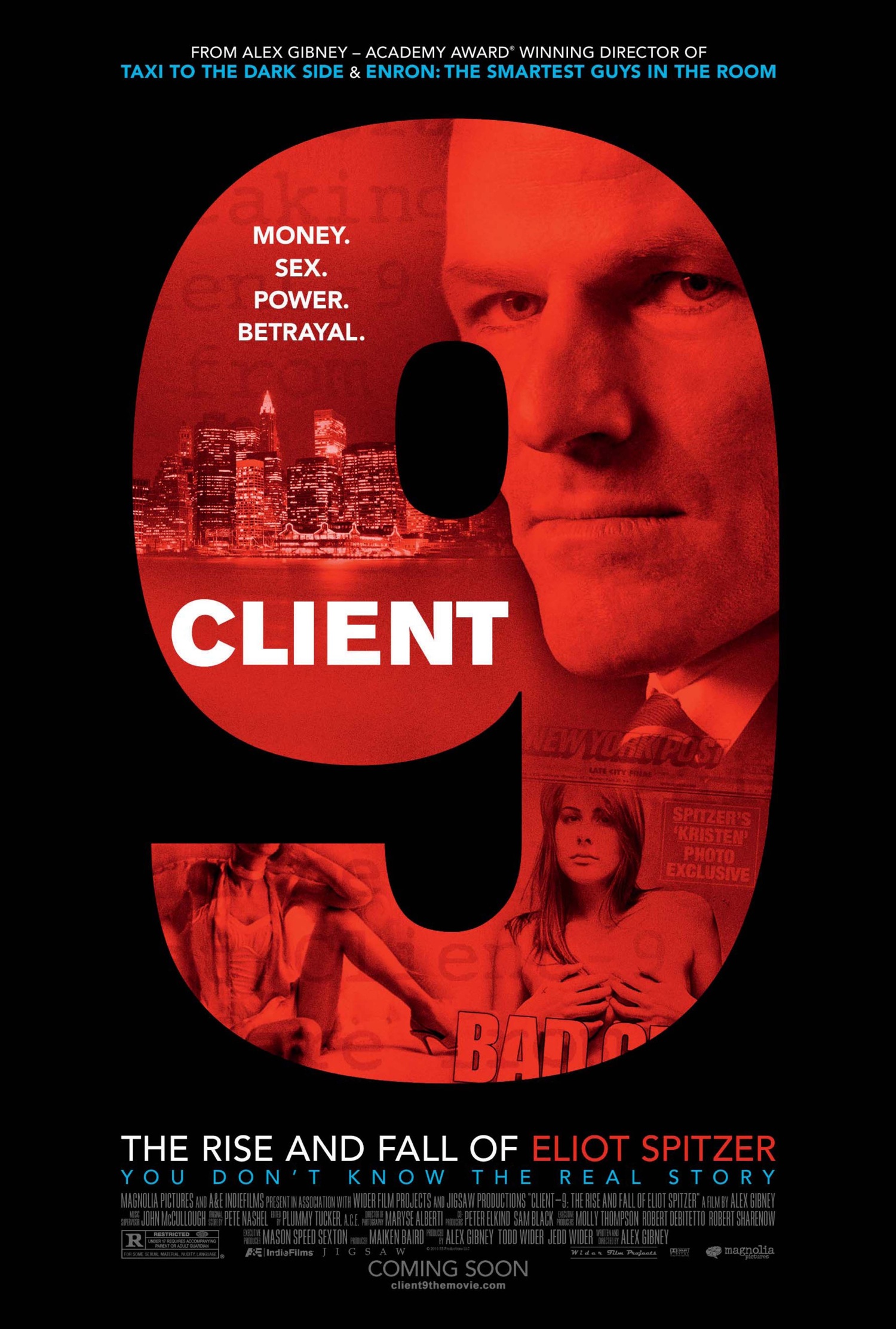
CLIENT 9: THE RISE AND FALL OF ELIOT SPITZER

Documentarian Alex Gibney (ENRON: THE SMARTEST GUYS IN THE ROOM, TAXI TO THE DARK SIDE) has a convincing but controversial thesis. That the enemies Eliot Spitzer made on Wall Street as New York Attorney-General, and in Albany as New York State Governor, combined to bring him down - exploiting his use of prostitutes with a FBI inquiry that was maliciously leaked to the press. Spitzer himself comes across as less melodramatic. He takes ownership of his mistakes, though unwilling to be drawn on the psychology behind them. He is also less than candid about how pugnacious he truly was as Attorney-General and State Governor. He comes across as an idealistic man who resorted to a thug-fight, and naively seems surprised that the people he bruised would resort to the same vicious tactics to exploit his mistakes. Spitzer is not a man one necessarily warms to, but was essentially right to throw a searchlight on Wall Street. And it says something that he was willing to give Alex Gibney an interview. 

The people who come off far worse than Spitzer are those Spitzer opposed - notably Frank Langone and Hank Greenberg - titans of Wall Street who resented Spitzer's legal cases against their fraudulent behaviour - fraud that has since been exposed in the 2008 financial crash. They come across as venal, smug, and crowing over his defeat. By comparison, Spitzer's political opponent, New York Senator Joe Bruno, since convicted of fraud, comes across as a mere second-tier fraudster. The prostitute, "Kristen" or Ashley Dupree, also comes off as a slick media-manipulator, eager to cash in on her new-found fame, enabled by the right wing media who love nothing more than to keep her in the public profile and thus keep Spitzer's name tarnished. 

The biggest surprise of the documentary was the prostitute that Spitzer sought out most frequently and who appears in the doc played by an actress to protect her identity. She comes across as smart, empowered, with enough integrity to spurn the media and just get on with her life. I guess it says something about the modern-day corruption of the politico-economic establishment when a whore is the most sane, selfless and intelligent voice in the room. 

The resulting documentary is an even-handed tale of hubris and nemesis. Spitzer made his own mistakes, but the people he pissed off took full advantage. Does it need to be two hours long? It certainly lost pace in the second hour. Does it need to be seen on the big screen? No. Gibney produces very high quality work, but this could easily be seen on the small screen. But for all that, this is a film that tells its story meticulously, has the air of truth about it, and educated me about the intricacies of Spitzer's downfall. Although I had followed his case closely at the time, it was fascinating to see a well researched documentary take us through the planted media stories and behind the scenes. 

CLIENT 9: THE RISE AND FALL OF ELIOT SPITZER played Toronto 2010 and went on release in the US and Canada last November. It is currently on release in the UK and has been released on Region 1 DVD.

Jumat, 11 Maret 2011

FAIR GAME


True story. Valerie Plame was a CIA operative, building networks to fight terror in the Middle East. Her husband, Joe Wilson, was a pugnacious ex-diplomat, and mediocre businessman.  When the Bush administration misquoted his research, and used it as casus belli for a "pre-emptive" war in Iraq, Wilson went public, explosively. In an act of miscalculated vengeance, Dick Cheney's aide, Scooter Libby, outed Wilson's wife as a CIA agent, exposing her network in the process.  Plame and Wilson had their reputations slandered in the press, suffered the stress of intrusive paparazzi, but ultimately history will see them as on the side of truth. Scooter Libby went to prison for obstructing justice but Bush soon commuted his sentence. And, of course, on the larger issue, the war in Iraq, it was too late to put the genie back in the bottle.

FAIR GAME is a new feature film based on this political and family drama, directed and shot by Doug Liman (MR AND MRS SMITH, THE BOURNE IDENTITY) and written by John-Henry and Jez Butterworth (THE LAST LEGION).  The movie drips in earnest good intentions. It wants us to be utterly repulsed by the dinner-party ignorance in Washington; by the brazen exploitation of Plame by the Bush administration; and the manipulation of intelligence in the run-up to the Iraqi war. It wants us to share in Joe Wilson's outrage and see his journey as one of vindication - from puffed-up has-been to inspirational public speaker. It wants us to admire Valerie Plame's loyalty, and sympathise with her disillusionment.

I think the problem with the film is that for those of use who share its political stance, none of this is new, and for those who don't - well, they are hardly going to pay to watch it. I was shocked at the time, but too much time has passed - too much nefarious wrangling has been exposed - for the shock factor to still exist. And as for the mechanics of cooking up a war, there is no better exposition than Armando Iannucci's IN THE LOOP.  And, suffice it to say, IN THE LOOP managed to be unbelievably entertaining, while at the same time expository. In contrast, FAIR GAME where it's mission very heavily indeed.  All that is not to say that the film isn't handsomely acted and technically well-made. It just fails to spark up.

FAIR GAME played Cannes 2010 where it lost to OF GODS AND MEN for the Palme D'Or.  FAIR GAME was released in 2010 in Italy, Norway, Belgium, France, Canada, Finland, Spain, Sweden, the USA, Bulgaria, Greece, Israel, the Netherlands, Thailand, Australia, Germany, Hong Kong, Switzerland, Austria, Taiwan, Portugal, Denmark, Kuwait, Lebanon, Malaysia and the UAE. It was released earlier in 2011 in Iceland, India, Egypt, Croatia, Singapore, New Zealand, Estonia, Indonesia, Ireland and Latvia. It is currently on release in Serbia, the UK and Brazil. It opens later in March in Brazil and Mexico. It opens in May in Argentina and Poland; in June in Chile, Kazakhstan, Russia and Uruguay; and it opens on July 14th in Ukraine.

Jumat, 17 Desember 2010

Random DVD Round-Up 8 - WAR INC.

WAR INC. is a lo-fi but high concept political satire set in a fictional post-Soviet Islamic republic. Focussing on the key differentiator of the wars in Iraq and Afghanistan, the country isn't occupied by the US Army but by a Blackwater style private mercenary organisation run by a Cheney like former US Veep (Dan Aykroyd). He hires John Cusack's assassin to kill a Middle Eastern oil minister in order to provide further money making opportunities. So, Cusack's character goes undercover as a...er...wedding organiser for a local pop star (Hilary Duff, sending herself up brilliantly).

Written by Cusack and the guy behind the Warren Beatty political satire BULLWORTH, WAR INC. has its moments of visual and verbal humour and I love the over-arching concept. But the humour just isn't well enough developed or sustained to create a truly funny or insightful movie. Somehow the movie just doesn't cohere. This confirms my belief that good satire is one of the most difficult genres to pull of in any medium let alone film. One has to work hard to make it subtle and sharp and one has to resist the temptation to go for broad-brush sending up of obvious targets. Moreover, satire is ultimately an alienating form of humour, and it is hard to do well while also engaging us emotionally - as in the final scenes of this movie.

So, WAR INC. is a failure, but a noble failure.

WAR, INC played Tribeca 2008 and was released that year in the US, Israel, Russia, Taiwan, Italy, the Netherlands and Portugal. It is available on DVD.

Rabu, 15 Desember 2010

Random DVD Round-Up 4 - EDIE & THEA: A VERY LONG ENGAGEMENT

Edie and Thea are two young women who came to New York in the 1950s and found love. They shared their lives together, became engaged, travelled, loved, grew old, marched for gay rights, and suffered from homophobia. Eventually, with Thea in a wheelchair, dying, and Edie a still beautiful 80 year old, they got married. Susan Muska and Greta Olafsdottir (THE BRANDON TEENA STORY, later fictionalised as BOYS DON'T CRY) have created a moving and powerful hour long documentary about the couple, and through them, the political times they lived through. The women are refreshingly frank about sexual attraction. They speak candidly about setbacks - familial disapproval - getting kicked out of Sarah Lawrence - being kicked out of anti-Vietnam protests for making the war marchers "look bad". But they also speak candidly about dancing together, good sex and love. By asserting their normality - by making them rounded and human, the film-makers give greater power to the question of why Edie and Thea weren't allow to take their love to its "normal" conclusion - marriage. And this makes for a far more affecting argument that any barnstorming polemic could've been. This sort of insight and subtle investigation is exactly what documentary film-making is all about.

EDIE & THEA: A VERY LONG ENGAGEMENT played a couple of festivals including the BFI LESBIAN AND GAY FILM FESTIVAL 2010. It was released on DVD in November 2010.

Random DVD Round-Up 3 - THE LOTTERY

THE LOTTERY is a deeply partisan piece of documentary film-making, advancing the case of publicly funded but privately managed Charter Schools over the old established Zone schools. The argument is advanced with a dazzling array of statistics quoted on screen, calm and dignified talking heads, and seemingly evangelical teachers and parents. The basic thesis is that the monopolistic provision of publicly funded, publicly controlled primary school education in America's deprived inner cities is failing its typically second-generation immigrant and African-American students. Inept teachers are protected from accountability by strident unions and politicians, dependent on the union vote, are reluctant to act. The alternative is the Charter School - schools publicly funded but managed by private sector bodies that stand to lose their charter if they don't achieve results. Charter Schools apparently get those results by Taking Education Seriously - longer school days, longer terms, obligations on parents to read to their kids and make their kids show up. They are championed by eloquent and passionate teachers and politicians who are given ample time in this documentary to state their case for empowering parents and giving children a chance to succeed. And what could be better evidence of the Charter School's success than the fact that so many parents are desperate to get their kids accepted that they subject themselves to an annual lottery for scarce places? It is this lottery - and the journey of four Harlem families through it - that provides the hook for this political film.

I have a lot of sympathy with the provision of multiple education choices, and with the idea of ambitious parents wanting to lift their kids out of public education. After all, my parents worked hard to put me through a private prep school and I was a scholarship girl in a private secondary school. If I have kids, and I can afford it, I'll be sending them to the best private school I can afford. So, be assured that what follows is not politically motivated.

THE LOTTERY is a very poorly made documentary because it makes no attempt to present a balanced case. Rather it is pure political propaganda. The proponents of Charter Schools are given plenty of time to calmly state their case. They are portrayed as earnest, articulate and rational. Their opponents - the teaching unions - are portrayed as a loud, irrational, selfish rabble, photographed shouting on the streets but not given the same calm talking head format to explain their position. The statistics quoted are also very selective, and there is little attempt to interrogate either the numbers or the people advocating Charter Schools. Nowhere does director Madeleine Sackler point out the political ambitions of the head of the Charter School movement, Eva Moskowitz, for instance.

The issue of whether Charter Schools work and how they impact local public schools is absolutely critical, not just in the US, but also in the UK where the new Conservative-Lib-Dem government is keen to introduce them. Unfortunately, THE LOTTERY gives us just one side of the coin, making it of little real use in addressing the issues. If you want to find that balance, you can look at a recent edition of the New York Review of Books. Diane Ravitch reviewed the Davis Guggenheim documentary, WAITING FOR SUPERMAN, which covers similar territory to THE LOTTERY, but garnered more attention, presumably because Guggenheim's previous film, AN INCOVENIENT TRUTH, was so very commercially and critically acclaimed. Ravitch is a Professor of Education at NYU and a Brookings Institution fellow, and her more nuanced and balanced assessment of the successes and failures of Charter Schools relative to Zone schools can be found here.

THE LOTTERY played a bunch of festivals including Tribeca and went on limited release in the US in May 2010.

Minggu, 05 Desember 2010

Late review - London Film Fest 2010 - HORS LA LOI / OUTSIDE THE LAW


This review is brought to you by guest reviewer, Alex:

Director Rachid Bouchareb’s story of a family of Algerian immigrants to France and their lives from 1945 to 1962 has been likened to “The Godfather” or “Once Upon A Time in America”. Like the excellent “La Haine” which touched on the same themes, the movie provoked protests and high security when it played the Cannes film festival and right-wing French politicians labelled it historically revisionist and "anti-French".

Bouchareb’s previous Oscar-nominated 2006 movie “Days of Glory” shamed the French government into supporting Algerian veterans who fought for the French state against the Nazis in World War Two. “Outside The Law” reunites many of the previous film’s cast. Brutal, real and enjoyable, “Days of Glory” had me slavering at the chops for more. After all, a well-made action movie with a social message is the best of both worlds – the equivalent of Saturday night in the pub and early Sunday morning mass rolled into one. Sadly, I was disappointed.

“Outside The Law” limps prosaically through over two hours chronicling the brothers varied involvements in the cause of the arm of the FLN, a terrorist group whose premise was to campaign for Algerian independence, from within French borders. One leads it, asserting control first over the organisation’s French chapter and then over rival groups, the other, a veteran of the doomed Indochinese war, is the violent facilitator of the FLNs’ ends, and the last distances himself from the group until forced to participate.

The irony of this premise is little explored, except in the film’s intellectual denouement when arch-nemesis police inspector Colonel Faivre (Bernard Blancan) is forced under duress to meet with our boys in a posh Parisian in private club. Abdelkader’s comparison, and the ironic synchronicity, of his own political and armed struggle for Algerian freedom with the Colonel’s previous decoration for his role in the French Resistance to Vichy regime is well-made.

Bouchareb has used the family tale as metaphor for French immigrant experience; represented by brothers Abdelkader (Sami Bouajila), educated and politicised; Roschdy Zem as Messaoud, the brutal bag-man and assassin, and Jamel Debbouze (of “Amelie”) as Saïd who is amoral, entrepreneurial and secular. Stoic and grim, the boys’ mother (Chafia Boudraa) is the patriotic conscience and maintains the family’s religious and traditional practices; she is also the most vibrant of the female cast members, although that’s not saying much. Messaoud’s wife is dutiful and introverted and Sabrina Seyvecou as Hélène, a white French sympathiser and financier to the FLN cause is anaemic and obsessed with unfulfilled desire for Abdelkader. His rejection of her advances in favour of total devotion to the cause is clumsily portrayed and represents a token attempt at character development.

Better handled is the conflict played out between the brothers. Saïd’s dream of creating the first French boxing champ of Algerian origin, representing ideas of assimilation, is opposed by the very real threats he faces from his ideologically torn brothers who see his fighter as a courtesan of the despised French state. Given that we already know how violent the group’s measures can be, how far will they go to stop the fight, we wonder?

Action scenes such as the opening recreation of the infamous Sétif massacre in 1945 were well made (Bouchareb admits he was trying to create "a sort of western") but the plot develops falteringly and there’s a sense that in trying to popularise the movie beyond its natural audience, an action scene has been added every so often to cattle prod us awake again between the characters’ soap opera-like vacillations.

Telling the story of a 20th century conflict from the underdog (and ultimately winning) perspective is undoubtedly a rich, unmined cinematic vein; Vietnamese Bảo Ninh’s novel “The Sorrow of War” would be an interesting antidote to the abundance of Hollywood movies on the same topic. Arguably “Outside The Law” is another take, from a different angle, on the much better “Battle of Algiers”.

If Bouchareb wished to again provoke social change and political action he has succeeded. There is even some similarity in his film in this respect to Visconti’s “Rocco and his brothers”. If he wished to entertain, he has fallen short of the mark, but not failed entirely. Add to your Lovefilm rental queue but don’t pay good money to watch at the cinema.

HORS LA LOI / OUTSIDE THE LAW played Cannes, Toronto and London 2010 and opened in France, Switzerland and Belgium in September. It opened in the US in November.

Senin, 29 November 2010

Late review - London Film Festival 2010 Day 16 - INSIDE JOB


This is a guest review written by Alex, who can normally be found lurking in the shadow banking system.....

I feel roughly the same way about Capitalism that Churchill felt about Democracy; “it’s the worst form of [economic system] except all the others that have been tried.” In fact, I wouldn’t be writing for this aptly titled blog if I didn’t feel some sympathy for what Al Capone called “the legitimate racket of the ruling class”, if only because I fear the alternative. Furthermore history, albeit always written by the winners, is on my side.

It’s fair to say that Capitalism hasn’t done well out of the past few years. Its excesses are much more likely to be debated and analysed than its successes.

Narrated by Matt Damon, Inside Job aims to do just that, with a methodical and structured post mortem on the Credit Boom and the global recession which has followed. The interviewers are, overall, incisive and ferocious in their questioning of an impressive cadre of financiers (the internecine tribes which have emerged from the Credit Crunch; “the ones who were proved right” and “those who were wrong but are still rich”), academics, regulators, politicians and investors.
Despite this fine premise, Inside Job is often pantomime-like: France’s Finance Minister Christine Lagarde is vitriolic in her criticism of those evil bankers (the producers omit to mention that she herself is a former corporate lawyer for an Anglo-US law firm), and Elliott Spitzer, former New York State Attorney General and Governor, offers similarly stern invective – “hooray!” Lloyd Blankfein (current CEO of Goldman Sachs) appears – “boo!”, we are almost invited to holler.

Ironically though, often the most damning evidence came from the bankers themselves and their shills. One could wile away hours on Youtube watching film of Goldman’s executives crucifying themselves in front of the US Senate Panel. The film-makers have merely hand-picked some of the edited highlights.

There are some surprising critics; George Soros for example, billionaire financier and a great example of a speculator if ever there was one after he made millions, and cemented his reputation in the investment community, betting against Sterling. The documentary doesn’t seem bothered with these nuances.

Nevertheless there are several genuinely salient and insightful points – one being that this generation is probably the first time that Americans have been both less well-educated and less well-off than their parents.

The left guard give away their limited knowledge of finance, and it’s not just that they mis-pronounce the names of large and well-known investment banks whilst they describe their folly and hubris. Was pronouncing Lehman Brothers, “layman Brothers” a Freudian slip? One interviewer confidently asserts that derivatives were created in the early 1990’s whereas farmers in Illinois were using futures contracts to hedge their production over a hundred years before that decade. Again and again I found myself thinking “if you’re going to tell a story, tell it right!”.

Other documentaries in a similar vein include Michael Moore’s “Capitalism, a Love Story” and the excellent if lengthy “The Corporation” by Canada’s Mark Achbar. The former was more sensationalist, and therefore entertaining, and Achbar’s was more thorough. Since this has been done before, I was a little disappointed that Inside Job didn’t build on or add anything new to the body of similar work.

From the audience’s reaction throughout I sensed that, politically, I was in a minority of one in the screening of this well-made but flawed documentary, and yet overhearing two womens’ conversation on the way out I couldn’t help thinking that deep down the audience understood the limited value in demonising bankers. Despite Inside Job’s propagandising two-hour polemic, everyone knows that the money men, albeit whilst extracting a heavy price, were only the enablers for you and I to buy our dream house, max out our credit card for that luxury holiday we couldn’t afford or otherwise sink deeper in hock. Maybe somebody should have told the film-makers this.
I’ll leave you with another quote from The British Bulldog:

“The inherent vice of capitalism is the unequal sharing of blessings; the inherent virtue of socialism is the equal sharing of miseries”.

INSIDE JOB played Cannes, Toronto and London 2010, and was released earlier this year in Belgium, Portugal, the US and France. It opens in the Netherlands on December 2nd and in the UK on February 18th 2011.

Sabtu, 27 November 2010

Late review - London Film Fest 2010 Day 5 - UNCLE BOONMEE WHO CAN RECALL HIS PAST LIVES


UNCLE BOONMEE WHO CAN RECALL HIS PAST LIVES is a much-feted Thai film that won the Palme d'Or at Cannes this year and has been almost-universally lauded as a kind of magical, whimsical, poetical take on love and death.

Uncle Boonmee is a humble man dying of kidney failure in a Thai village where he is cared for by his sister-in-law Jen and shiftless cousin Tong. One night, the ghost of Uncle Boonmee's dead wife fades into the picture, in an entirely unassuming, matter-of-fact way, and simply becomes part of the household. It's as though these characters, in this culture, live in a philosophical world where the separation between the living and the dead is miasmic and we shouldn't be at all surprised to see either side break through to the Other. Indeed, there is no Other - but rather different layers of reality for those that have the seeing of them. So, once you settle into this strange way of perceiving reality, it should come as no surprise to see Uncle Boonmee's son, who disappeared years ago, return as a Chewbacca-like Monkey Spirit with flashing red eyes, or for Cousin Tong to go on retreat and be in the same room with another version of himself. Nor should you be surprised to see a princess-spirit mate with a fish, or for the quixotic director decide to break off for a few minutes to make a political point by showing stills of guerilla fighters in the Thai jungle.

For many reviewers, this strange, exotic mix of magical realism and sheer left-field craziness casts a powerful spell. For then, UNCLE BOONMEE is that rare of rare things - a truly original and Fantastic movie. But for me, the whole thing was a case of the Emperor's New Clothes, where directorial self-indulgence and piss-poor special effects (still photos, Monkey Spirit) undermined the flashes of poetic brilliance (a intimate scene where Uncle Boonmee, on dialysis hugs his ex-wife, as though accepting death; the beatiful fish-fucking scene). It was a movie where individual scenes left me breathless at their audacity and beauty, but which frustrated me with its obliqueness and randomness. Ultimately, I'm glad I saw it for those flashes of brilliance, but god I wish I'd had a remote control fast forward button for the rest.

UNCLE BOONMEE WHO CAN RECALL HIS PAST LIVES played Cannes and Toronto 2010 and was released earlier this year in Thailand, Belgium, France, Canada and Germany. It is currently on release in the UK, Denmark, and Spain.  It won the Palme d'OR beating BIUTIFUL, ANOTHER YEAR, CERTIFIED COPY, POETRY, ROUTE IRISH....
 

reiview movies and books Copyright © 2012 -- Powered by Blogger