Tampilkan postingan dengan label sexually explicit. Tampilkan semua postingan

Sabtu, 30 Juni 2012

KILLER JOE - some thoughts from reviewsmoviebook


KILLER JOE is a visceral and provocative trash-noir film from director William Friedkin - most famous for THE EXORCIST - but more similar in tone to his more recent tour-de-force examination of mutual psychosis, BUG. Shot in three weeks on a $10m budget, KILLER JOE has a similarly creepy, violent, sexually tense, sleazy atmosphere, and is similarly tightly written - and it comes as no surprise that both movies were based on plays written by Tracy Letts, of Steppenwolf Theater fame. 

The movie focusses on a messed up southern family - dumb naive father Ansel (Thomas Haden Church); sexually provocative stepmother Sharla (Gina Gershon); failed drug-dealer son Chris (Emile Hirsch) and the apparently mentally disturbed daughter Dottie (Juno Temple).  The family live in a trailer, want to bump off Ansel's first wife for the insurance money, and hire Matthew McConaughey's Killer Joe to do the job. Trouble is, he wants more than money - he wants the sexually naive Dottie.

The resulting thriller is both a film of double crosses in the standard style, but also a psychological drama about Dottie (Juno Temple) - her violent childhood; her twisted virginity; her seduction; her escape.  More widely, it's about Killer Joe bringing the entire family under his control, resulting in the two set piece scenes of sexual power - the aforementioned with Dottie, that's really at the centre of the film - and the second, likely to become the film's notorious calling card, involving Sharla and a piece of fried chicken.

It's no surprise to find that these scenes have provoked unease in viewers, and in its final reel, the movie really does just go crazy with the violence.  But what I found most disturbing wasn't the movie's violence (particularly toward women) but its humour. Because, make no mistake, this film is funny, particularly in its depiction of caricature  tuna-casserole-eating white-trash.  The genius of the film is, then, Friedkin's ability, to walk the tight-wire between dark comedy, and genuinely horrific violence, in a way that, say, Werner Herzog's BAD LIEUTENANT: PORT OF CALL NEW ORLEANS, didn't.  I also rather like the casting - Juno Temple is particularly impressive as Dottie, but the real genius move is the casting of McConaughey.  Friedkin has realised that McConaughey's too perfect, too manicured beauty is slightly unnerving and creepy, and harnessed that for the Killer Joe persona - the knowing, sleazy, seductive bad cop.

KILLER JOE is on release in the UK. It opens in the USA on July 27th; in Finland on August 10th; in Russia on August 23rd; in France on September 5th; in Belgium on September 26th; and in the Netherlands on November 8th.

Sabtu, 14 April 2012

iPad Round-Up 7 - SLEEPING BEAUTY

Deeply dull, pretentious art-house flick about a bored young girl who gets paid by fetishists to sleep, drugged, while they do anything they want to her except penetration.  The debut feature from writer-director Julia Leigh, the movie never explores the full creepiness of what is happening, or even who is exploiting whom. It wants to be subversive and provocative but is more uncomfortable because of the amateur-ish acting that because of any explicit content. This is a movie without about as much understanding or interest in sexual fetish as Kubrick's EYES WIDE SHUT. And one can only be thankful that promising young actress, Mia Wasikowska, dropped out before this piss-poor indie hit besmirched her career.

SLEEPING BEAUTY played Cannes 2011 and opened in 2011 in Australia, Kazakhstan, Russia, Estonia, Hong Kong, the UK, Japan, France, the USA and Philippines.  It opened earlier this year in Belgium, Singapore and Brazil and opens in the Netherlands on July 12th. It is available to rent and own.

iPad Round-Up 2 - TATSUMI


TATSUMI is a wonderful animated film that works on two levels.  Most obviously, it is the life story of Japanese manga artist Toshihiro Tatsumi, based on his award-winning graphic novel/memoir, "A Drifting Life".  It shows him growing up in war-torn Japan, making his name as a young Manga artist, and finally pioneering a new type of comic for adults, dealing explicitly with sexual frustration, ennui and social issues in post-war Japan - in sharp contrast to the Astro Boy comics of his idol Osama Tezuka. To that end, the movie works as biopic for manga fans, interspersing the impressively frank autobiography with short animated films of some of his most famous short stories. This was interesting, and elegantly done, but as a person who has never read a single manga story, I found the movie more compelling as a document of social history. Thanks to Tatsumi's keen eye and honesty, we learn a lot about the social, sexual, political and economic changes in Japan, from the horrors of the nuclear bomb, to deprivation, to the economic boom. There were all sorts of little facts that shocked me - I was shocked at my own ignorance - such as the fact that the Japanese couldn't travel abroad until 1964 and even then with only a dollar's worth of Yen. So, for me, this film was entertaining, moving and educational, and I would recommend it even to people who have no interest in manga at all.  The visuals are beautiful, elegant and powerful, and have prompted me to start reading "A Drifting Life".


TATSUMI played Cannes 2011 and opened last year in Singapore and Hungary. It opened earlier this year in Ireland and the UK and is currently on release in the USA. It is available to rent and own. 

Selasa, 06 Desember 2011

George Ghon comments on MARGARET


Kenneth Lonergan’s long-awaited follow up to YOU CAN COUNT ON ME has – after a four-year-long editing squabble, and a final edit by Martin Scorsese and Thelma Schoonmaker – finally been released. It seems to attract considerable attention among a British audience - a diverse crowd filled the outdated screening room at the Odeon Panton Street just off Leicester Square on a recent Sunday afternoon to watch the GANGS OF NEW YORK writer’s contemporary take on Upper West Side city life. MARGARET is a daring coming-of-age tale that lets the 17-year old Lisa (Anna Paquin) become witness of a traumatic accident that proves to be formative on her young life. During the 2.5 hours of the final edit we watch the different emotional states the troubled teenager goes through during her rite de passage of becoming an adult. The woman who got rolled over by a bus after a quick meeting of the eyes by its driver with Lisa, is a sacrificial victim to the development of the main character, who, in turn, is searching for different ways to overcome her guilt.

Differing from an American school of teenage drama (Larry Clark & Harmony Korine) that almost solely relies on casual sex and the abuse of illegal substances within a culturally impoverished environment, Mr Lonergan’s MARGARET aims high and interweaves the quotidian, classroom life and family trivia with high brow references. The title is referring to Gerard Manley Hopkin’s poem spring and fall, dedicated to a young child. The outlook therein is bleak:

‘...Ah! As the heart grows older
It will come to such sights colder
By and by, nor spare a sigh
Though worlds of wanwood leafmeal lie;
And yet you will weep and know why.…’

Growing up is not an easy business; plenty of tears will need to flow before a certain level of emotional maturity can be reached.

My take on this film is, furthermore, that it aims to assert the role of so called high culture and allows a largely disenfranchised society to rebuild its values according to those guidelines drawn out by classic drama and poetry, to some extent. The Met plays an important part in the movie. Bellini’s Norma opens her heart to Ramon (Jean Reno), which has a profound effect on his relationship with Lisa’s mother Joan (J. Smith-Cameron). La nuit d’amour in Offenbach’s Tales of Hoffmanntriggers the cathartic reunion of mother and daughter. The classroom is a frequent topic, where contemporary politics in the aftermath of 9/11 are juxtaposed with the musings of King Lear. Avoiding the pitfalls of intellectualization, Mr Lonergan does not use those references to show off, or distract from the story he is telling, but just melds them into his trope of big city life.

An ode to New York and its culture it is, but not an unambiguous one. 

MARGARET went on limited release in the US in September and in Canada in October.  It is on such limited release in the UK that it's only playing on one screen in Central London! Catch it while you can, or wait for the French release in August 2012.

Sabtu, 12 November 2011

iPad 5 Round-Up - 4.3.2.1.

From the laughs, authenticity and social relevance of ATTACK THE BLOCK to the turgid, sexually exploitative own-goal that is 4.3.2.1.  Tragic that promising young writer-director-actor Noel Clarke, who started off with material like KIDULTHOOD that was a serious look at modern British youth culture, should descend into directing a piss-poor genre flick.  Because 4.3.2.1. is essentially a derivative caper movie, complete with MacGuffin (bag of crisps stuffed full of diamonds), and a "high concept" that sees the same day replayed through the point of view of four above-average pretty and under-dressed young girls.  The movie wants to have the tight pace and clever interlocking plot of a Guy Ritchie flick, itself derivative of Tarantino, but ends up looking brash, weak and ordinary.  Not helped by fairly anonymous performance from the four lead girls (Emma Roberts, Ophelia Lovibond, Tamsin Egerton and Shannika Warren-Markland).   Still, I pity them the leering lads mag treatment they get from Clarke, unhappily veering away from what he knows about to a sort of teen boy fantasy of guns, girls and heists, that is an embarrassment to all involved, including, inexplicably, Kevin Smith.

4.3.2.1. was released in the UK, Ireland, Australia, and Greece in 2010 and in Kazakhstan and Russia in February 2011. It is available to rent and own, but why bother?

Sabtu, 22 Oktober 2011

London Film Fest 2011 Day 10 - TRISHNA

Freida Pinto stars as Trishna in Michael Winterbottom's loose
adaptation of Hardy's Tess of the Durbevilles.

TRISHNA is a fascinating, intelligent film about a relationship turned sour on the back of withheld secrets and unequal material power, centred on Freida Pinto's first performance of real merit. 

She plays a poor, naive village girl called Trishna - who in her society is simply a commodity to earn to support her family, and conditioned to obey. A chance meeting with a rich young man, Jay (Riz Ahmed, FOUR LIONS), prises her away from her family and strict values. They approximate the life of two lovers in the freeing atmosphere of big city Mumbai. Given the differences in their social status, it is a measure of Jay's belief that he loves Trishna, that he's willing to broach the subject of marriage, but the revelation of secrets and the return to a cloying small-town hotel serve to subtly alter their relationship, step by step, into one of master-servant, and sexual exploitation, with alarming results. 


What I loved about the film was how it was able to show the drastically increasing imbalance of power in the relationship with a few elegant, economical scenes. There is very little straightforwardly scripted dialogue. Characters' actions, positions, tell us everything. Jay is rarely shown other than supine on a chair or bed, waiting for his dinner to be served to him. Trishna seems to turn within herself, visibly shrinking as the film progresses, trapped in her material dependence on Jay and her shame at her sexual history. I also loved how writer-director Michael Winterbottom didn't feel the need to show Trishna's accusers as a gaggle of villagers or hotel workers scandalised by her situation. Her emotional distress, her shame, her sense of betrayal and entrapment, is all in her own mind, and expressed by Freida Pinto in a quiet, sensitive performance. I also loved Winterbottom's willingness to simply observe everyday Indian life - a side of India rarely shown in glitzy Bollywood movies. DP Michael Zyskind's (28 DAYS LATER) evocative images of Rajasthan and Mumbai show what can be achieved with high quality DV (in sharp contrast to yesterday's MARTHA MARCY MAY MARLENE).

That said, there are some small quibbles. In the Mumbai section, I'm not sure what the cameos of director Anurag Kashyap and actress Kalki Koechlin really add. Also, I'm not sure this film should be marketed as an adaptation of Hardy's "Tess of the Durbervilles". I spent the whole film being teased into believing that a Hardy character or situation was being introduced only to realise that Winterbottom wasn't going to take the film in that direction. His adaptation contains clever elisions and contemporarises the story intelligently. But what you end up with is a quite different beast - particularly in the character of Tess/Trishna. I would suggest that by far the best way to enjoy and appreciate this film is, then, to take it on its own terms.

TRISHNA played Toronto and London 2011.

Kamis, 20 Oktober 2011

London Film Fest 2011 Day 8 - TERRI


TERRI is a movie that is so unique, goes so much at its own pace and with its own concerns, that it's hard to characterise and hard to know what to make of it. What I can say is that it is beautifully observed, well-acted, causes moments of genuine un-ease but also genuine human warmth.....It is perhaps the most idiosyncratic movie of the festival and none the worse for that. 


Essentially, this is a movie about a group of misfits - the odd kids, the marginalised adults - that make up society but rarely make it onto the big screen. Chief among them is Terri (a fearless performance by Jacob Wysocki), an obese kid who lives with his ailing uncle in a ramshackle house, wears pyjamas to school, gets teased as a result, and yet has a Good Heart. He forms unlikely friendships with another troubled kid, Chad (Bridger Zadina) and is mentored by the bizarrely intense assistant principal, Mr Fitzgerald (John C Reilly). Perhaps most bizarrely of all, he ends up on a weird night of drinking and intimacy with the school's hottest girl (another fearless performance from Olivia Crocicchia) after he unintentionally precipitates her near-expulsion.

What I love about this film is its refusal to sentimalise or smooth over the strange weirdness of these people and their relationships, but also it's evident fondness for them. The subject matter is honest, brutally so, but as Roger Ebert has pointed out, this film in no way deserves its US "R" rating. One can only hope the BBFC is more mature, if and when this film gets a UK release. That's not to say that there weren't passages in the first half hour when I was wondering where the film was going. But if you stick with it, this really is a wonderful film, full of humanity, insight and beauty, as encapsulated in a truly memorable speech by Mr Fitzgerald on frailty and trying to do the best we can.

TERRI played Sundance 2011. It opened in the US in July and in Canada in August.

Minggu, 16 Oktober 2011

London Film Fest 2011 Day 5 - ALPS


That's it. I'm calling it.  ALPS is a case of the Emperor's New Clothes.  I don't care if writer-director Giorgos Lanthimos became the darling of the indie cinema with his movie DOGTOOTH - a supposedly hilarious black comedy and social satire on contemporary bourgeois Greek society. I don't care if ALPS is being called one of the festival's best - the "cinema of the absurd" - that deliberately uses shitty cinematography to portray that "unknowability" of its protagonists - a movie who's big idea is never really developed - never convincingly explored.  ALPS isn't blackly funny - yes there is one lines delivered in such a bald monotone that it's funny - the one line reviewers cling to in describing the movie as a black comedy - but it isn't consistently scabrous in the way that truly great social satire or absurd cinema should be.  And it doesn't earn the right to portray events as gruesome as an attempted suicide.  I know writers Giorgos Lanthimos and Efthymis Filippou are trying to make "big" points about modern society.  I know they are trying to depict a society and people so messed up that women wilfully submit to tyrannical, violent men; that grieving families would pay a stranger to imitate (badly) their loved ones; that a lonely girl would lose herself in the illusion.  But it's all done in such a deliberately lo-rent, poorly written, ambiguous manner that it's impossible to truly connect with it. Maybe Lanthimos wants to distance us? Maybe this is the effect he's looking for?  But at the end of the day it created, for me, a very boring, unrewarding film-watching experience.  I really just didn't care.

ALPS played Venice, where Giorgos Lanthimos and Efthymis Filippou won the Golden Osella for Best Screenplay. It also played Toronto and London 2011. It opens in Greece on October 27th.

Sabtu, 15 Oktober 2011

London Film Fest 2011 Day 4 - STATELESS THINGS

STATELESS THINGS is a movie I admired rather than enjoyed. Indeed, so little did I enjoy it, so long did it drag, so obscure was its meaning, that I considered walking out. But I'm glad I persevered to understand the overall architecture of the film and something of its purpose. 

Kim Kyung-Mook's follows his FACELESS THINGS with another movie set on the fringes of contemporary South Korean society. The first forty-five moments focus on Jun - an illegal immigrant from North Korea who is exploited by his employer, forms a tentative relationship with a sweet girl - another immigrant - but eventually finds himself forced to trick for cash. The second forty-five minute segment moves to a more luxurious but no less sexually exploitative situation. Hyeon is a kept in a nice apartment by a closeted homosexual, tricking in his spare time, and caught in a deeply obsessive relationship. As the movie reaches its conclusive segment, I became very confused about what was going on. Jun and Hyeon clearly meet, there's a confused, suffocating finale, are they two aspects of the same man? Figuratively? Literally?

The directorial style goes from social realism in the first half, to showy and quirky in the romance sequence, to almost Lynchian in its obscurity in the final segment. All of which is unsettling. There is also a lot of very explicit homosexual sex, and perhaps one of the most interesting aspects of my day of screenings was to watch couples walk out of the homosexual sex scenes in STATELESS THINGS but not during similarly explicit but heterosexual scenes in SHAME earlier in the day. I guess it's still a sad indication of the world we live in.

STATELESS THINGS played Venice, Vancouver and London. It doesn't yet have a commercial release date.

London Film Fest 2011 Day 4 - SHAME - One of the best films of the year

Michael Fassbender (Brandon) and Steve McQueen (Director) at the
photocall for SHAME at the BFI London Film Festival 2011.


SHAME is a movie that is so brutally honest and achingly sympathetic about sex and love addiction that I can't help but believe that someone in the production is or knows someone with the disease, as I do.  It leaves you profoundly thankful that someone had the balls to go where few mainstream film-makers would dare to go, and had the wit, style and empathy to depict highly sexually explicit material without one iota of leeriness or mockery.  

The movie centres on a brother and sister called Brandon and Sissy (Michael Fassbender and Carey Mulligan).  They have clearly suffered some kind of childhood trauma that has resulted in deeply disturbed attitudes toward sex and love, as well as behaviours of literal self-harm and suicide on the part of Sissy.  Brandon has created a successful, almost pathologically clean life in New York, but secretly feeds his compulsion for sex with whores, cyber-sex, one-night stands and compulsive masturbation. He takes no joy in these activities but is maintaining his dual existence comfortably until Sissy arrives.  She is less a sex than love addict, craving the attention of her brother - a relationship that hints at a dangerously unboundaried sexual tension - then his boss - she uses sex to get what she really wants, which is an approximation of a genuine emotional closeness - and self-harms when she can't get it.

Sissy's arrival and exposure of Brandon's double life leads to a moment of deep shame and purging, and an attempt to have a normal sexual relationship with an office worker. It's a relationship we know is doomed given Brandon's condition - and which precipitates a backlash that culminates in a scene of profoundly explicit sex that is also perhaps the most moving and despairing piece of acting I've seen in quite some time.  Particular credit to DP Sean Bobbitt and director Steve McQueen for capturing Michael Fassbender simulating orgasm in a manner that looks completely desperate, horrific, horrified and pained. One could almost have ended the movie on that scene and perfectly captured the tragedy at its heart.  

It should be clear by now that I am full of admiration for this bold, brave, painful movie.  Fassbender once again displays his complete courage and Steve McQueen his ability to use visuals and silence to create scenes of quiet power. But perhaps the biggest revelation was Carey Mulligan, who takes on an extremely challenging role - exposing herself physically and emotionally - and is utterly convincing.  Admittedly, SHAME is in some respects less pure than HUNGER, given that it plays with a wider cast of characters and a less austere colour palette.  But what it looses in purity and visceral power it makes up in its deep humanity.

SHAME played Toronto, Venice and London 2011. It goes on release in the US on December 2nd; in the  UK on January 13th; in Germany on March 1st and in the Netherlands on March 15th 2012.


For those wishing to seek more information about recovery from sex addiction please use the following link: http://saa-recovery.org.uk/materials/79-leaflets.html. It gives useful information and advice to anyone wanting to learn more, as well as for health professionals.

Jumat, 09 September 2011

George Ghon comments on THE SKIN I LIVE IN


Art keeps you free.
George Ghon, fashion writer, stylist, editor of ALPHA magazine, and cinephile, comments on THE SKIN I LIVE IN.......

Pedro Almodóvar’s THE SKIN I LIVE IN is a multi-faceted film, an experiment that combines the tradition of Greek drama with a modern, slightly surreal medical thriller. The central character, a brilliant Antonio Banderas as Robert Ledgard, is the contemporary equivalent to a doomed ancient king. He attempts to transcend his own human powers, plays god, and is bitterly punished for his hubris. He is an enormously talented surgeon that has pushed the boundaries in transplantology, scion of a wealthy family, and yet, his life is not a happy game. He tried to save his wife after she burned in a car crash, on the run with her lover. He tried to save his daughter, after the fragile girl got abused and raped in the scenic setting of a lush garden party. Both those women, for whom he had so much affection, took their own lives and found a sudden, unexpected death when jumping out through an open window. These bitter experiences, as well as his talent and money, make for an ambivalent character. On one hand brutal and powerful, but at the same time sensitive and almost loveable in his passion.

He finds his victim and, like Pygmalion, uses his skill to shape it into his perfect partner. In Ovid’s metamorphoses Venus grants the sculptor’s wish and the ivory statue becomes alive. In the Spanish town of Toledo, set in the year 2012, the surgeon also hopes for divine intervention. From the wall of his staircase lurks an oversized Venus d’Urbino, the renaissance painting originally conceived by Titian. It can (re-) ignite love and passion in its spectators, but it has also been seen as marriage picture, as object that was deliberately made to affirm and save the relationship of a couple. 

None other than recreating his lost love is Robert’s aim. But he reverts to dubious practises in order to achieve his goal, and fails miserably in the end. During the opening shots, we can see a beautiful, slightly androgynous girl practising Yoga in a locked room (Elena Anaya as Vera). Guarding her perfect body in a tightly fitted suit, she is completely shut off from the outside world. The only solace she can find, except from physical workout, is engaging with the art of Louise Bourgeois, which she learns through books coming up in a little elevator. She tears apart swatches of fabric and re-uses them to form little sculptures. 

First this seems unusual, but not utterly bizarre. Yet. The real story we only learn later in the film. It then becomes clear that Vera is searching for a new identity and delves into sculpture to overcome an existential angst that results from traumatic surgery. She is Robert’s chosen one, the one he experiments on and tries to find love for. By and by, she comes to terms with her fate and accepts the lover’s role, before finally encountering a reawakening reminder of her past. 

This movie deals with the big themes of classic tragedy, with love, loss, and redemption. Shot in beautiful locations and executed with superb cinematography, it is a feast for aesthetes. But the picture goes deeper than just touching the beautiful surface of things. It deals with the skin of bodies, but also affects the lives beneath it. There is a lot to consider about this new Almodóvar, no matter that the story might have its flaws. 

THE SKIN I LIVE IN played Cannes 2011 and was released in August in France, Ireland and the UK. It was released earlier this month in Spain, and is released today in the Czech Republic and Hungary. It played Toronto 2011 next week and opens in Russia and Poland. It opens on September 23rd in Argentina and Italy. It opens in Brazil and the US on October 14th and in Germany on October 20th. It opens in Hong Kong and Sweden on December 2nd.

Minggu, 05 Juni 2011

Overlooked DVD of the month - CHICO & RITA


CHICO & RITA is an absolutely wonderful movie - beautifully animated; honest in its depiction of sex; centred on a timeless story of love; and wrapped around Bebo Valdez' jazz score that takes in some of the greats of the post-war jazz scene - Thelonius Monk, Woody Herman, Dizzy Gillespie and Charlie Parker. It's a crying shame that the flick hasn't had the crossover success of a film like BUENA VISTA SOCIAL CLUB (a movie it elegantly references in its final act, thanks to a cameo by real-life chanteuse Estrella Morente) - but hopefully the constraints of a limited release (narrow-minded distributors unsure about an R-rated animated flick?) will be broken by DVD popularity.

Chico is a gifted piano player, looking back from a run-down 1980s Havana to his "glory years" in the 50s and 60s. He meets the beautiful singer Rita and falls in love - or erotic/musical fixation - at first sight. The two lovers are destined to be together and not together - kept apart by pride; fiery tempers; betrayal; and an entertainment business happy to give a contract to a pretty singer but not her piano player. Their journey starts in Havana, but soon Rita achieves success in New York before making a Hollywood movie and ending up in Vegas. Chico crosses paths were her, often acting as her voice of conscience - reminding her of what she is giving up - how inauthentic she is having to be - to achieve success in America.

The three directors - Tono Errando, Javier Mariscal and Fernando Trueba - deserve big props for daring to produce an adult-themed animated movie; for the ambition of their scope - across continents, musical styles and forty years; not to mention delicate references to post-war racial politics. One might argue that the genius of Ignacio Martínez de Pisón and Fernando Trueba's script is that the movie Shows rather than Tells us about the changing political climate - and wears its profundity very lightly.  That said, when the political themes culminate in a moving, half-drunken, outburst by Rita - the movie really does pick up notch - and I defy anyone not to glow with good-will during the final scenes.

CHICO & RITA played Telluride and Toronto 2010 and was released in the UK in 2010. It was released earlier this year in Spain and Greece. It will be released in Poland on July 1st and in France on July 6th. It is available to rent and own in the UK.

Sabtu, 30 April 2011

UNCLE KENT - Mumblecore, softcore, borecore


While kicking up a riot at Scoundrels Chicago, I managed to break out and detox for a little over an hour in the mecca for all film reviewers - The Gene Siskel Film Center. I wandered in to the first film showing - which happened to be Joe Swanberg's mumblecore flick, UNCLE KENT. Just as its genre conventions require, UNCLE KENT is a low-budget lo-fi drama basically consisting of a bunch of financially comfortable but emotionally illiterate twenty and thirty somethings whining about their personal problems and jacking off. That might sound dismissive and I think the genre does have a tendency toward self-indulgence and baggy-narratives. However, when in the right hands it has managed to throw up movies of real warmth, depth and honesty. Think Alex Holdridge's IN SEARCH OF A MIDNIGHT KISS and the Duplass brothers' CYRUS - both of which made it to my Best Of lists.

Unfortunately, UNCLE KENT is no CYRUS. In fact, at a 72 minute run time including credits, it's barely a feature length film. It stars Kent Osborne (real-life animator on Spongebob Squarepants as "Kent" - a commitment-phobe jack-ass in the body of a forty-year old who dresses ten years too young. As with most mumblecore flicks, Kent espouses a kind of slacker freedom and mediates all his personal relationships through the internet. As the film opens, Kent picks up a girl called Kate (Jennifer Prediger) on Chatroulette - a website usually known for men jacking off on webcam - a point later demonstrated in the film. Still from such unpromising beginnings, the pair to seem to have a genuine connection. The tragedy is that they can only express it by having a threesome with a girl they meet on Craigslist. And as the weekend winds up, the downside of "slacker freedom" is painfully obvious to us and to Kent - not knowing where you stand - not being able to speak honestly about feelings, but constantly speaking openly about sex.

The movie looks better - more tripod shots - than in Swanberg's previous work, although he still uses POV shots and handheld cameras to annoyingly trite effect. The narrative is baggy and meandering and bores, even though the run-time is short. Most of all, while the movie did contain flashes of honesty about how my generation dates via the the web, it didn't really get under the skin of their emotional lives. One day, Swanberg is going to have to sit down and write a proper script and move beyond superficial "wisdom" about the distancing effect of the internet.

UNCLE KENT played Sundance 2011 and was released on a variety of media in the US earlier this year. It is currently playing at the Gene Siskel Center in Chicago.

Sabtu, 19 Maret 2011

Random DVD Round-Up 1 - THE KIDS ARE ALL RIGHT


By the time I got round to watching THE KIDS ARE ALL RIGHT on iTunes, it had been well-reviewed by Ebert and The Guardian, and garnered a stack of award-season acclaim. And the film certainly had pedigree. Annette Bening and Julianne Moore are capable of both opening a movie AND portraying characters of emotional depth and nuance (see BEING JULIA and SAFE). Mark Ruffalo has impressed me ever since his turn as a bent cop in Jane Campion's IN THE CUT. And if we look at the younger members of the cast, Mia Wasikowska showed balls as well as ethereal beauty in Tim Burton's ALICE IN WONDERLAND, and Josh Hutcherson's performance in BRIDGE FROM TERABITHIA contributed to the emotional punch packed by the film. Most of all, I loved writer-director Lisa Cholodenko's spiky, emotionally skewering drama LAUREL CANYON, and was eager to see how she would bring that wry observational skill to the topic of a gay marriage brought under pressure by the appearance of the childrens' birth father. Put simply, I was ready to believe that the critical and commercial success of THE KIDS ARE ALL RIGHT was well deserved and looked forward to seeing it myself. 

Imagine then, my disappointment, to discover a drama filled with characters drawn in two-dimensions, behaving in ways that seemed at odds with their temperament. I neither understood their actions nor cared about the consequences. A drama that should have been nuanced and sophisticated thus seemed as trite and crass as romantic-comedies dealing with more conventional relationships. I can, then, only, conclude, that the praise heaped upon this film reflects our collective relief that one can now make a movie about a gay marriage and treat it as a matter of fact rather than as a cause. But, then, again, doesn't the heaping on of accolades suggest that we aren't quite there yet? 

At any rate, here's how the film works. Nic (Annette Bening) is married to Jules (Julianne Moore) and they have two kids, 18 year old Joni (Mia Wasikowska) and 15 year old Laser (Josh Hutcherson). The characters are drawn in broad strokes. Nic is the professionally successful control freak - Jules is the stay at home mum turned landscape gardener - a wannabe hippie with low self esteem. The kids are similarly broadly drawn - Joni is the swot and Laser is the jock. Basically, they are happy enough until the kids get in touch with their birth father, an immature but charming restaurateur called Paul (Mark Ruffalo). Nic is immediately suspicious of his destabilising influence, but Jules connects with his laissez-faire non-judgmental attitude. 

Some of what follows is deeply predictable. Joni starts acting out in teen rebellion, spurred on by her motorcycle driving dad. Laser actually wisens up when his cool dad points out that his cool friend is actually an arsehole. But the real shock - the real crass and incredible (as in I literally don't believe it) - is that Jules has an affair with Paul. What kind of loving mother would really give up her family for a drifter like Paul?  (Unlike many message-boarders I don't have a problem with the fact that she has an affair with a man rather than a woman - I can buy that she's maybe bisexual rather than a lesbian.) Just because she felt her wife wasn't giving her enough support at home? I mean, maybe I could buy it in a movie that took her emotional state before the affair more seriously, but in this sunshine rom-com, I just didn't get it at all. As a result, when Nic reacts with understandable rage and distress, Annette Bening's performance seems to be coming from a different place entirely. It's worthy and heartfelt but entirely out of keeping with the rest of the film. Worst still, it makes Julianne Moore's performance as Jules during the repentance scene look utterly shallow by comparison.

What I was left with was a film that was trying to be very right-on and deserved credit for trying to treat gay marriage like any other marriage - worthy of cinematic exploration.  But I was also left with a film full of characters that acted in ways that I didn't buy into because they weren't sufficiently well-drawn. Poor Annette Bening tried to take the  material to a more profound level, but was, frankly, running on her own. This isn't, then, a bad film, but it isn't a great one either. Too uneven in tone - too uneven in its performances - too unfair to its male lead character - too easy on its female lead character - and just too thin altogether.

THE KIDS ARE ALL RIGHT played Sundance, Berlin, London and Toronto 2010 and opened last year in the US, Iceland, Israel, Australia, Denmark, Norway, Sweden, Finland, Argentina, France, Greece, Ireland, the UK, Brazil, Uruguay, Germany, Portugal, Austria, Chile and the Netherlands. It opened earlier this year in Belgium, Kazakhstan, Russia, Singapore, Poland, Spain and Hong Kong. It is currently on release in Estonia, Italy, Mexico and Turkey. It opens on April 7th in Hungary and on April 29th 2011. It is available to rent and own. THE KIDS ARE ALL RIGHT was nominated for BEst Film, Best Actress, Best Supporting Actor and Best Screenplay at the 2011 Oscars. It won the Berlin Teddy for Best Feature Film. It won the Golden Globe for Best Film and Actress - Musical or Comedy.

Sabtu, 12 Maret 2011

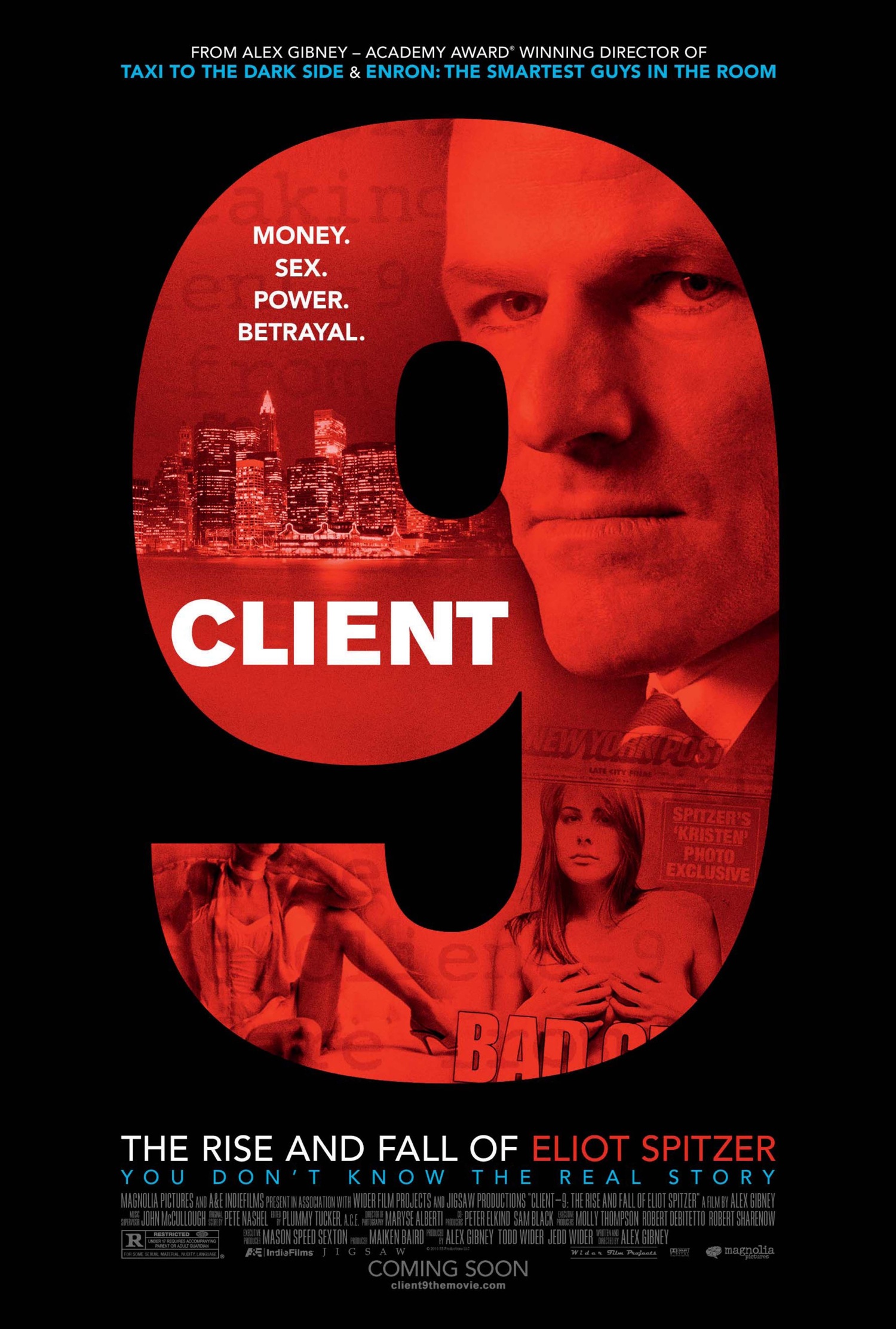
CLIENT 9: THE RISE AND FALL OF ELIOT SPITZER

Documentarian Alex Gibney (ENRON: THE SMARTEST GUYS IN THE ROOM, TAXI TO THE DARK SIDE) has a convincing but controversial thesis. That the enemies Eliot Spitzer made on Wall Street as New York Attorney-General, and in Albany as New York State Governor, combined to bring him down - exploiting his use of prostitutes with a FBI inquiry that was maliciously leaked to the press. Spitzer himself comes across as less melodramatic. He takes ownership of his mistakes, though unwilling to be drawn on the psychology behind them. He is also less than candid about how pugnacious he truly was as Attorney-General and State Governor. He comes across as an idealistic man who resorted to a thug-fight, and naively seems surprised that the people he bruised would resort to the same vicious tactics to exploit his mistakes. Spitzer is not a man one necessarily warms to, but was essentially right to throw a searchlight on Wall Street. And it says something that he was willing to give Alex Gibney an interview. 

The people who come off far worse than Spitzer are those Spitzer opposed - notably Frank Langone and Hank Greenberg - titans of Wall Street who resented Spitzer's legal cases against their fraudulent behaviour - fraud that has since been exposed in the 2008 financial crash. They come across as venal, smug, and crowing over his defeat. By comparison, Spitzer's political opponent, New York Senator Joe Bruno, since convicted of fraud, comes across as a mere second-tier fraudster. The prostitute, "Kristen" or Ashley Dupree, also comes off as a slick media-manipulator, eager to cash in on her new-found fame, enabled by the right wing media who love nothing more than to keep her in the public profile and thus keep Spitzer's name tarnished. 

The biggest surprise of the documentary was the prostitute that Spitzer sought out most frequently and who appears in the doc played by an actress to protect her identity. She comes across as smart, empowered, with enough integrity to spurn the media and just get on with her life. I guess it says something about the modern-day corruption of the politico-economic establishment when a whore is the most sane, selfless and intelligent voice in the room. 

The resulting documentary is an even-handed tale of hubris and nemesis. Spitzer made his own mistakes, but the people he pissed off took full advantage. Does it need to be two hours long? It certainly lost pace in the second hour. Does it need to be seen on the big screen? No. Gibney produces very high quality work, but this could easily be seen on the small screen. But for all that, this is a film that tells its story meticulously, has the air of truth about it, and educated me about the intricacies of Spitzer's downfall. Although I had followed his case closely at the time, it was fascinating to see a well researched documentary take us through the planted media stories and behind the scenes. 

CLIENT 9: THE RISE AND FALL OF ELIOT SPITZER played Toronto 2010 and went on release in the US and Canada last November. It is currently on release in the UK and has been released on Region 1 DVD.

Senin, 21 Februari 2011

Random DVD Round-Up 3 - GOING THE DISTANCE

Documentarian Nanette Burstein (AMERICAN TEEN, THE KID STAYS IN THE PICTURE) makes her debut feature with the like-able and sometimes authentic romantic-comedy GOING THE DISTANCE. Drew Barrymore and Justin Long - perhaps two of the most charming light-comedy actors currently working - play a couple who meet and have a fun fling knowing she's about to relocate from New York to San Francisco. Trouble is, they really connect, and so attempt to do a long-distance relationship. I love the honesty of it. Lots of scenes will feel familiar to anyone who's tried this. The financial strain of buying plane tickets - the jealousy of "friends" who are closer by - the justification to friends of why it's worth it - the struggle to weigh up career-choices versus life-partners. And the great thing is that Geoff LaTulippe's script handles it all very lightly. I can't say much bad about the script. It's well acted, contains consistent laughs and I genuinely cared about what happened to the characters. There may be a few rom-com cliché moments (do we really need the crude, OTT tanning salon scene?), but so many as to detract from the overall vibe. Basically, it's all good!

GOING THE DISTANCE was released last autumn and is available to rent and own.

Selasa, 15 Februari 2011

NO STRINGS ATTACHED


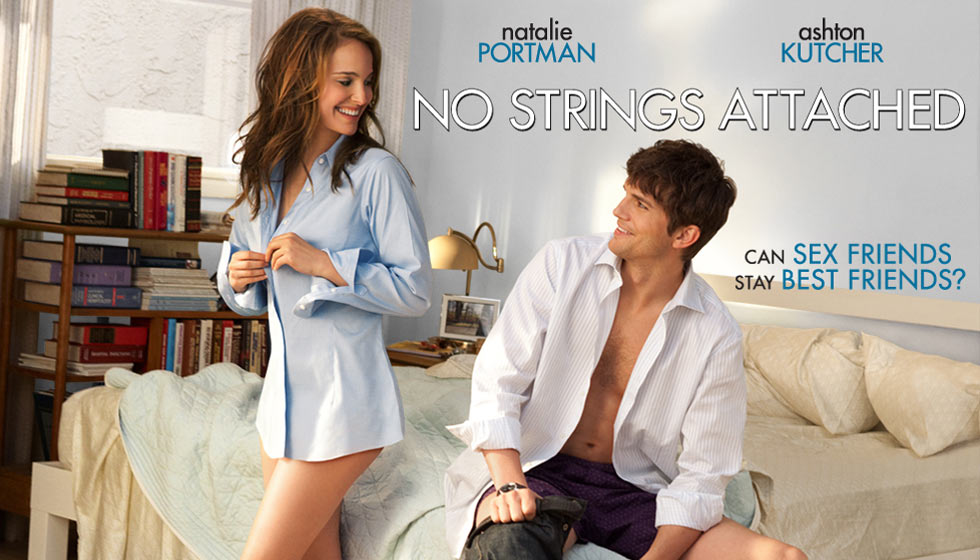
Ivan Reitman, of GHOSTBUSTERS, fame returns to our screens with the kind of contemporary social comedy more typically associated with his son Jason (THANK YOU FOR SMOKING, UP IN THE AIR). The result is a movie that wants us to think it's edgy and honest, but when you cut to the meat, it's still the same old rom-com happy-ending bullshit we've been subjected to for decades.

Natalie Portman and Ashton Kutcher play two emotionally bruised people who react to their wounds in diametrically opposite ways. The girl becomes emotionally repressed, running from anything that could turn sour and hurt her. By contrast, the boy becomes immensely open and vulnerable, rushing toward people who can't return his emotions. Not automatically the set-up for a rom-com, one might think. But hey-ho, this being Hollywood, the two star-crossed lovers meet cute and decide to have NSA sex. Inevitably, they fall in love. He pushes for a relationship and she runs. One suspects that if Jason Reitman had been directing the film that's where it would've ended. But no. Because, while this film tries to prove how modern and liberated it is with its explicit sexual references and a whole scene devoted to period cramps, essentially it is a conservative project. And this contradiction infects every scene. Thus, while there are some rather funny set-pieces, typically involving the superb supporting cast (Mindy Kalinga, Kevin Kline, Lake Bell, and a brilliantly ditzy Ophelia Lovibond), the movie as a whole just doesn't hang together.

Not only does the film not hang together, it also has the faint whiff of desperation about it. It's desperate for us to love it - for us to think it's cool. In fact, it's about as desperate as the scarily need mono-dimensionally good guy that Ashton Kutcher plays in this flick, not to mention last year's VALENTINE'S DAY. I am genuinely puzzled as to why Natalie Portman, darling of indie flicks since LEON, and soon to be Oscar winner for BLACK SWAN, decided to take a role in this film. And it's even more bizarre when you realise that she actually produced it. And perhaps most puzzling of all - what a bizarre and wasteful way to use Cary Elwes!


NO STRINGS ATTACHED was released in January in the USA and Canada. It is currently on release in Bulgaria, Belgium, Indonesia, Bosnia and Herzegovina, Hungary, Portugal, Finland, Norway, France, Germany, Hong Kong, Malaysia, the Netherlands and Singapore. It opens next week in Argentina, Greece, Brazil, Estonia and the UK. It opens on March 18th in Poland; on March 25th in Iceland and Spain; and on March 31st in Slovenia. It opens on April 1st in Sweden; on April 15th in Italy and on April 22nd in Japan.

Rabu, 19 Januari 2011

Random DVD Round-Up 2 - SEX AND THE CITY 2

I didn't hate SEX AND THE CITY 2 as much as I thought I would, but then again, my expectations were very low indeed. I'd never been a fan of the series. I didn't relate to a bunch of women defined by their conspicuous consumption of luxury goods or the apparent contradiction of wanting to be both sexually liberated AND pining for a rich husband. The show, and indeed the first movie, wanted to both have its cake and eat it, and was expressed with a vulgarity of tone, and shameless excess that seemed to undercut its wannabe-serious political agenda.

Fast forward to 2010 and the release of SEX AND THE CITY 2, and the franchise's crass vulgarity has been amped up even more than I thought possible, simply by transferring the four most egregiously consumerist girls in the US to the most egregiously consumerist nation on earth, the UAE. The resulting film feels like a 2 hour info-mercial advertising Abu Dhabi as a vacation resort just so long as you don't want kiss in public, and of course, conditional on you having $22,000 a night for a suite. The plot is the same-old bullshit we got on the TV show: privileged women whining about how tough life is. Miranda (Cynthia Nixon), the lawyer, is angry because her male boss dismisses her. Rather than deal with it maturely, she just quits. This is meant to be seen as a victory. Charlotte (Kristin Davis), having sweated spinal fluid to catch a rich husband and have two children, is tired and pissed off with being a mother, despite the fact that she has full-time help. Carrie (Sarah Jessica Parker) is angry her husband is, well, old, and wants to stay in, and when her book gets a bad review, kisses an ex- in a fit of pique. Her husband's reaction to this is just plain unbelievable. And finally, Kim Cattrall is eating hormones to stave off the menopause, and angry she can't fuck anyone she wants in public in a Muslim country.

Now, there are some moments when the movie feels vaguely interesting. I mean, it's nice to see women actually speaking openly about menopause and hot flashes. And yes, being a mother to small kids is hard. But the movie consistently fails to make itself relatable beyond this. There are few casual sentences referring to the awful economy, or congratulating mothers who survive without help, but when uttered by women in a $22,000 a night suite, it just feels condescending - as condescending as Carrie tipping her Indian butler so that he can fly home and visit his wife.

I guess it must sound like I'm criticising the movie less than criticising the lifestyle of the characters, but in a franchise that sells a lifestyle choice, I think that's fair game. But even if I bought into its lifestyle, would I like the movie? Nope. Because even on its own terms, it fails. The fashion is not fabulous but looks horrid. The women don't look wonderful in their middle age, but haggard and trying to hard. The shooting style is pedestrian and the direction workmanlike at best. And just what was that Liza Minelli song and dance number? Did they take her face and morph it onto a different body? It just looked plain weird.

SEX AND THE CITY 2 opened in summer 2010 and is now available to rent and buy.

Minggu, 16 Januari 2011

BLACK SWAN - glorious trash


Darren Aronofsky's much-praised new film, BLACK SWAN, is beautifully-produced trash, and I say that with all respect and admiration. It brings an auteur sensibility to material that is basically a camp psycho-sexual horror flick, in the style of Polanski's REPULSION or Dario Argento's SUSPIRIA. While the material may superficially resemble Powell and Pressburger's seminal ballet melodrama, THE RED SHOES, BLACK SWAN contains none of that film's elegant framing or love for high-art. Rather, BLACK SWAN is the ultimate B-movie - a genre movie that wears its balls-out craziness on its sleeve. The result is beautiful and exhilarating, but I can't say that it affected me as emotionally and as profoundly as Aronofsky's previous film, THE WRESTLER.

In fairness to Aronofsky, the B-movie craziness of BLACK SWAN can be traced back directly to its roots - the ballet Swan Lake - a Gothic melodrama containing elements of body-horror, psychotic doubling and ending in transformative suicide. If that isn't the stuff of a Polanski horror flick, I don't know what is. In the ballet, an evil wizard transforms the innocent princess Odile into a were-swan. The love of the handsome prince should set her free, but her evil doppelgaenger Odette seduces the prince, with results varying depending on which version of the ballet you watch. In the film, Natalie Portman's Nina Sayer has been infantilised by an over-bearing mother (Barbara Hershey). Under pressure to be the perfect "sweet girl" and ballerina, Nina self-harms, is bulimic, has a pathological desire to please, and a psychotic fear of imperfection. When given the role of the Swan Queen, Nina has to bring her innate sexuality, so suppressed by her mother, out into the open, to inform her dancing of the Black Swan. She simply cracks trying to reconcile her mother's expectations of pre-pubescent innocence and her ballet director's (Vincent Cassel) aggressive demands that she be as instinctively sexual as her understudy (Mila Kunis).

What follows is a movie that creates a sense of building tension through the use of claustrophobic interior shots; invasive close-ups; visual trickery with mirrors; and sound editing that suggests an inner self trying to break through. The movie is never pure horror despite plenty of shots involving nail-clipping and skin-scratching.  After all, we never really doubt whether what we are seeing is real or imagined. Nina is shown to be an unreliable witness too early in the movie for that. What we do have is a powerful display of hysteria - but heightened to the point where it is sometimes unintentionally funny (an early scene bedroom scene, for example) and moves so far beyond realism that one feels almost disengaged from it. Nina is less a person to sympathise with than a delicate compendium of every single neurosis that can arise from intensely un-boundaried parenting.

The thematic material in BLACK SWAN is very similar to THE WRESTLER. In both movies we have individuals who are so dedicated to and defined by their profession, that they ultimately sacrifice their physical and mental well-being to it. The Wrestler staples himself and batters himself to entertain, just as Nina breaks her toes and punishes her body. The Wrestler and Nina may be extreme examples of self-destruction, but they hint at the systematic physical abuse that their professions entail. That's why Aronofsky's shooting style is so perfect. By taking the cameras on-stage, by using tracking shots that immerse us in their worlds, Aronofsky is making us look behind the costumes to see the grueling physicality. He wants us to see the sweat, the muscles, the bleeding toes and the broken bones. 

In a sense, Aronofsky is making a bigger point about the demands the entertainment industries make of its professionals, begging the obvious question of how far this applies to his profession, with its pressure to maintain youthful good looks with botox, plastic surgery and aggressive dieting. To that end, one can only view the casting of Mickey Rourke in THE WRESTLER and Barbara Hershey in BLACK SWAN - both self-mutilated by plastic surgery and injury - as provocations. By casting these actors, Aronofsky is himself blurring the line between actor and character - just as Nina can't separate reality from fiction. Similarly, the use of Winona Ryder to play the prima ballerina Nina supplants is inspired. Ryder was a beautiful young actress whose early success morphed into career stagnation and personal humiliation.  Who else better signifies crushing rejection in reality and on screen?

Still, for all the similarity in material, and in the vérité shooting style used in the apartment scenes, to my mind BLACK SWAN is at once a greater and lesser film than THE WRESTLER. It is a greater film insofar as it shows Aronofsky and DP Matthew Libatique in perfect command of vérité shooting style but also able to inter-cut this with its exact opposite - a super-heightened gothic horror shotting style using chiaroscuro and close-ups. It also shows that Aronofsky can do genre cinema with the best of them. But BLACK SWAN is a lesser film insofar as that willingness to leap into melodramatic horror is ultimately a distancing device. Nina Sayers is such a compendium of crazy - under such extreme pressure - that she becomes a device rather than a person. Accordingly, as the film moves into its final act, it is beautiful but it isn't emotionally arresting. Nina's self-destructive tailspin is transfixing, wonderful, crazy and all-consuming - but it never made me feel the visceral hurt that The Wrestler did. That is BLACK SWAN's only flaw - but it is a serious one.

BLACK SWAN played Venice, Telluride, Toronto and London 2010. It opened last year in the US and Canada. It opens this Friday in the UK, Australia, Denmark, Germany, Ireland and Poland. It opens on the 27th in Chile, Greece, Slovenia and Lithuania, It opens on February 4th in the Netherlands, Portugal, Brazil, Iceland and Norway. It opens in France, Singapore and Mexico on February 10th. It opens on February 17th in Argentina, Hungary, Israel, Russia, Estonia and Spain. It opens on February 24th in Belgium, Hong Kong, Malaysia, Finland and Turkey. It opens in Sweden on March 4th, Italy on March 11th and the Czech Republic on April 7th.

Jumat, 14 Januari 2011

BLUE VALENTINE


BLUE VALENTINE is a justifiably praised indie drama about a young couple falling in and out of love. The stories of their meeting in the early twenties, and their disintegrating marriage six years later, and presented linearly, but inter-cut. Seeing the couple in their early heady romance juxtaposed so directly with their later frustrations brings an added pathos to what would have already been an incredibly affecting, brutally closely observed story.

Ryan Gosling (HALF NELSON) and Michelle Williams (WENDY AND LUCY) both give bravura performances as Dean and Cindy, perfectly rendering portraits of their characters at two stages of life. Gosling's Dean starts off as a charming, spontaneous, caring young man, stuck in a blue-collar job but apparently not asking anything more from life. No surprise then that Cindy - stuck in a loveless home - is drawn to his open-ness and warmth - so much so that when she falls pregnant she is willing to shelve her career ambitions to make a life with him. Six years later, and Cindy is tired and frustrated - a dutiful mother and working woman. Dean's spontaneity and charm now strike her as infantile, and though faithful to the idea of marriage, she has no desire for him. Meanwhile, Dean is seemingly so content with the idea of being a husband and father that he has no desire to push himself any further in life, or any real comprehension as to his wife's new-found coldness toward him. By marrying Cindy he has achieved more than he could have ever dreamed of - the pretty middle-class girl - and perhaps the greatest sadness of the film is that while Cindy can see more, has been raised to try for more, Dean has never been given that sense of possibility.

The bold performances are matched by documentary film-maker Derek Cianfrance's choices with the camera and editing. He shoots the couple in two very different styles in each period of their life - the courtship is in wide-angled Super 16 that always seems a little bright and grainy - like watching old cine-films of your childhood. It adds to the feeling that these are old memories. The present is shot with long lenses on DV, and it feels like the camera is always positioned to give us the feeling that the two characters are caught in a confined space, and yet never in the same focus when in the frame. It's as though the camera lens is literally entrapping them in a shared space but perpetual misunderstanding.

The overall effect is one of uncomfortable voyeurism. The movie is almost an endurance test. Because we are charmed by the couple's courtship - because they are both essentially good and charming and caring people - it becomes absolutely gruelling to watch them inflict hurt after hurt upon each other for no typically Hollywood-reason - no distinct cause - but just because they have grown up, or haven't in different ways.

BLUE VALENTINE played Sundance, Cannes, Telluride, Toronto and London 2010. It is currently on release in the US, Australia, Malaysia and Canada. It opens in the UK this Friday, in Portugal on February 3rd and in Sweden on April 1st. Both Ryan Gosling and Michelle Williams have been nominated for Golden Globes.
 

reiview movies and books Copyright © 2012 -- Powered by Blogger