Tampilkan postingan dengan label robert richardson. Tampilkan semua postingan

Jumat, 02 Desember 2011

HUGO

HUGO is a movie about the wonder and beauty of cinema - an elegy to the age of celluloid and hand-made special effects - a plea to preserve the fragile, crumbling history of this fantastic art form.  In this aim, HUGO is a wondrous, magical success.

But, far from being, conservative and nostalgic, legendary film-maker Martin Scorsese has shown us not just the past but the future of cinema.  The nostalgia is matched by an equal wonder at the new technology of 3D - not piss-poor retro-fitted 3D - but delicately aligned, beautifully designed 3D designed to give us that same immersive, spectacular thrill as when those first cinema-goers gasped at the Lumiere Brothers' train arriving at the station.  In this aim - in showing us both the past and future power of cinema, HUGO is a technical achievement that surpasses AVATAR and redefines what we thought was possible with 3D. HUGO is, if ever there was one, a movie that demands to be seen in 3D and on the biggest screen you can find.

HUGO is also meant to be a children's adventure - a physical comedy - a plea not to give up on love, or yourself. In that aim, HUGO is a tedious bore.  

So let's tackle these elements in reverse order. Hugo is the story about a young orphan boy (Asa Butterfield) who lives in a train station in a 1931 Paris heightened by fantasy and stunning production design.  Hugo is a tinkerer - he loves to fix things - in particular the beautiful automaton his father left him.  His love of mechanics lies in his loneliness and his need to find his own place in the world.  Together with a plucky little bookworm called Isabelle (Chloe Moretz), Hugo scampers through the station, stealing little mechanical parts to finish his work, and desperately trying to avoid the station inspector (Sacha Baron Cohen) and his hound-dog.  These chase scenes through the hidden passages and platforms of the station make up much of the tedious first hour of the film.  The dialogue is minimal, as are the genuine belly laughs. Poor Sacha Baron Cohen does his best, but I get the feeling that Martin Scorsese just cannot direct physical comedy.  Moreover, too many of his chase scenes through the train station are there to showcase the 3D and the spectacular production design but nothing else. They become repetitive.  They don't advance the plot.  The first hour of this two hour film could easily lose forty minutes. 

Then again, let's talk about that 3D and the production design.  Dante Ferretti (SHUTTER ISLAND, SWEENEY TODD) has created a beautifully detailed, rich set that evokes a kind of super-Paris - a Paris as we would all imagine it to be in our wildest romantic moments. Always snowing - couples dancing - accordion music - little plucky girls in berets - steaming croissants -  book shops that groan under the weight of beautifully engraved volumes - the Eiffel Tower always in the background.  All this forms the environment for a kind of 3D cinematography that combines achingly superb attention to detail with Scorsese's trademark breath-taking tracking shots.  The opening scene of this film, where we swoop through Paris, itself a giant automaton, then into the station, along the track, weaving through the crowd until we reach Hugo hiding behind the face of a clock - is a tour de force to match the Copacabana tracking shot in GOODFELLAS.  Martin Scorsese and longtime DP Robert Richardson - both new to 3D - deserve credit for such an achievement - not just in creating a particular look for their own film - but in echoing and recreating some of the seminal scenes of early cinema.

And so to the history of cinema. The second hour of the film, where the children are led through the history of cinema, first from Professor Rene Tabard (Michael Stuhlbarg) and then through Melies himself (Ben Kingsley) is just an absolute pure joy for any lover of the artform.  I already mentioned the recreation of the Lumiere Brothers' train scene, but the pivotal recreation is of Melies film, "A Trip To The Moon" - see the Youtube clip below. The movie shows us the joy and wit of those early special effects and spectaculars, and the final montage is a thing of awe and beauty. I defy any film-lover not to start crying at the skilful direction of a scene that is at once a culmination of the technical achievement of the film, and its emotional high-point.

The resulting movie is one that is, as I have said, not without its flaws. The first hour drags, and I do wonder whether children will engage with it.  But for cinema-lovers, the second hour is pure joy and an experience I would happily repeat at the cinema, because this is a movie that assures us that despite the fashion for watching movies on mobile devices - sometimes magic demands a communal experience and a big screen.


HUGO was released last weekend in the USA and Canada. It was released this weekend in the UK and Turkey. It opens on December 14th in France; on December 21st in Belgium; on December 23rd in India; on December 30th in Mexico; on January 5th in Russia; on January 12th in Australia and New Zealand; on January 26th in Israel and Spain; on February 3rd in the Czech Republic, Italy, and Poland; on February 9th in Germany, Hungary, the Netherlands and Portugal' on February 16th in Hong Kong and Brazil; on February 27th in Finland; on March 15th in Denmark, Singapore, Norway and Sweden; and on April 27th in Lithuania.

Rabu, 06 Oktober 2010

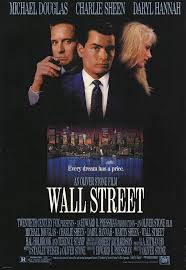
Some thoughts on WALL STREET (1987)


Oliver Stone is left of centre in his personal politics. How ironic, then, that his iconic 1980s morality tale, WALL STREET, single-handedly persuaded the teenagers of my generation that, rather than being teachers, doctors or engineers, what we really wanted to be when we grew up was Liquid. “Rich enough to have your own jet. Rich enough not to waste time. Fifty, a hundred million dollars, Buddy. A player. Or nothing.” Sure, the movie was an alleged morality tale and social critique. It took a naïve kid called Bud Foxx who traded insider information and his loyalty to his father’s little airline for a ticket to the big time. Naturally, he then got skull-fucked by his supposed mentor, Gordon Gekko. Foxx ended up in jail, and so did Gordon. But before we got to that point we saw a young kid living in a flash Manhattan apartment, date a hot blonde chick, eat at the best restaurants, and bask in the glory of the most charismatic man alive, Gordon Gekko. We wanted what Bud wanted, and so what if Gordon was a bit too sharp? – when he spoke about taking sleepy companies and making them profitable, it made sense! This man was dangerous PRECISELY because he was right. Greed was good. Greed was going to turn around over-unionised, over-bureaucratised corporations and increase profits. And don’t think Oliver Stone didn’t know what he was doing. As much as he gives Hugo Chavez a more than fair hearing in his latest documentary, half of what Stone’s doing isn’t applauding Chavez' Marxist policies but being dazzled by Chavez' power. WALL STREET is a film about power – and what makes it a great film – is that it shows how power is both repellant and fascinating. This is the ultimate human tragedy.

WALL STREET was both genius by design and favoured by good fortune. The good design lay in three things: a great script; great direction; and a great leading performance. To start with Stanley Weiser’s script, it’s about as near to perfect as you can get. You start with something rock-solid but not unusual: starry eyed boy tempted by fortune, sells his soul, loses everything, but finds himself. But then you add something truly original – you put that archetypal story in a world that few ordinary people have experienced – Wall Street – but which they were bound to be fascinated by, given its power and glitz. Finally, you express this story in a series of eminently quotable one-liners - “Lunch is for wimps” - “Money itself isn't lost or made, it's simply transferred from one perception to another” - “If you need a friend, get a dog.” 

And then you anchor the whole package in a speech so logical, so persuasive and so dangerous, that today most bankers of my generation can still quote it in full: 

“The richest one percent of this country owns half our country's wealth, five trillion dollars. One third of that comes from hard work, two thirds comes from inheritance, interest on interest accumulating to widows and idiot sons and what I do, stock and real estate speculation. It's bullshit. You got ninety percent of the American public out there with little or no net worth. I create nothing. I own. We make the rules, pal. The news, war, peace, famine, upheaval, the price per paper clip. We pick that rabbit out of the hat while everybody sits out there wondering how the hell we did it. Now you're not naive enough to think we're living in a democracy, are you buddy? It's the free market. And you're a part of it. You've got that killer instinct. Stick around pal, I've still got a lot to teach you.” 

If we look at the direction and the leading performance, that iconic speech is a great place to start. Michael Douglas, with his good looks, slicked back hair, designer suits, and charisma, was everything Gordon Gekko should be. He was the guy whose self-belief was so over-powering you wanted to be in his world.    And look at how Oliver Stone films that great speech. It’s basically a still camera, with no cut-aways. In other words, Stone has the good sense to let the man take centre frame and hold our attention with his words.

True success requires not just talent but luck, and Wall Street had the luck of being released at a time when a lot of people realized that something was afoot, but hadn’t yet seen it articulated. We knew that bankers were becoming more aggressive and that ordinary people were getting caught up in an equity boom – we knew that Reagan and Thatcher had somehow changed the rules of the game – that we could want to make money without being embarrassed about it – but no-one had come out and just plain said it. Gordon Gekko took what everyone was feeling, took it to its logical conclusion, and brought it out into the open. He scared us with his candour – but there was also a crucial recognition and identification. WALL STREET didn’t just echo the zeitgeist, it told us what it was and reinforced its importance. So much so, that when we look back at that era, it’s Gordon Gekko, with his DynaTac phone, who still best articulates the mood of the time.

WALL STREET was released in 1987. Michael Douglas won the Best Actor Oscar beating William Hurt for Broadcast News; Robin Williams for Good Morning, Vietnam; Jack Nicholson for Ironweed; and Marcello MAstroianni for Dark Eyes.
 

reiview movies and books Copyright © 2012 -- Powered by Blogger