Tampilkan postingan dengan label howard shore. Tampilkan semua postingan

Jumat, 02 Desember 2011

HUGO

HUGO is a movie about the wonder and beauty of cinema - an elegy to the age of celluloid and hand-made special effects - a plea to preserve the fragile, crumbling history of this fantastic art form.  In this aim, HUGO is a wondrous, magical success.

But, far from being, conservative and nostalgic, legendary film-maker Martin Scorsese has shown us not just the past but the future of cinema.  The nostalgia is matched by an equal wonder at the new technology of 3D - not piss-poor retro-fitted 3D - but delicately aligned, beautifully designed 3D designed to give us that same immersive, spectacular thrill as when those first cinema-goers gasped at the Lumiere Brothers' train arriving at the station.  In this aim - in showing us both the past and future power of cinema, HUGO is a technical achievement that surpasses AVATAR and redefines what we thought was possible with 3D. HUGO is, if ever there was one, a movie that demands to be seen in 3D and on the biggest screen you can find.

HUGO is also meant to be a children's adventure - a physical comedy - a plea not to give up on love, or yourself. In that aim, HUGO is a tedious bore.  

So let's tackle these elements in reverse order. Hugo is the story about a young orphan boy (Asa Butterfield) who lives in a train station in a 1931 Paris heightened by fantasy and stunning production design.  Hugo is a tinkerer - he loves to fix things - in particular the beautiful automaton his father left him.  His love of mechanics lies in his loneliness and his need to find his own place in the world.  Together with a plucky little bookworm called Isabelle (Chloe Moretz), Hugo scampers through the station, stealing little mechanical parts to finish his work, and desperately trying to avoid the station inspector (Sacha Baron Cohen) and his hound-dog.  These chase scenes through the hidden passages and platforms of the station make up much of the tedious first hour of the film.  The dialogue is minimal, as are the genuine belly laughs. Poor Sacha Baron Cohen does his best, but I get the feeling that Martin Scorsese just cannot direct physical comedy.  Moreover, too many of his chase scenes through the train station are there to showcase the 3D and the spectacular production design but nothing else. They become repetitive.  They don't advance the plot.  The first hour of this two hour film could easily lose forty minutes. 

Then again, let's talk about that 3D and the production design.  Dante Ferretti (SHUTTER ISLAND, SWEENEY TODD) has created a beautifully detailed, rich set that evokes a kind of super-Paris - a Paris as we would all imagine it to be in our wildest romantic moments. Always snowing - couples dancing - accordion music - little plucky girls in berets - steaming croissants -  book shops that groan under the weight of beautifully engraved volumes - the Eiffel Tower always in the background.  All this forms the environment for a kind of 3D cinematography that combines achingly superb attention to detail with Scorsese's trademark breath-taking tracking shots.  The opening scene of this film, where we swoop through Paris, itself a giant automaton, then into the station, along the track, weaving through the crowd until we reach Hugo hiding behind the face of a clock - is a tour de force to match the Copacabana tracking shot in GOODFELLAS.  Martin Scorsese and longtime DP Robert Richardson - both new to 3D - deserve credit for such an achievement - not just in creating a particular look for their own film - but in echoing and recreating some of the seminal scenes of early cinema.

And so to the history of cinema. The second hour of the film, where the children are led through the history of cinema, first from Professor Rene Tabard (Michael Stuhlbarg) and then through Melies himself (Ben Kingsley) is just an absolute pure joy for any lover of the artform.  I already mentioned the recreation of the Lumiere Brothers' train scene, but the pivotal recreation is of Melies film, "A Trip To The Moon" - see the Youtube clip below. The movie shows us the joy and wit of those early special effects and spectaculars, and the final montage is a thing of awe and beauty. I defy any film-lover not to start crying at the skilful direction of a scene that is at once a culmination of the technical achievement of the film, and its emotional high-point.

The resulting movie is one that is, as I have said, not without its flaws. The first hour drags, and I do wonder whether children will engage with it.  But for cinema-lovers, the second hour is pure joy and an experience I would happily repeat at the cinema, because this is a movie that assures us that despite the fashion for watching movies on mobile devices - sometimes magic demands a communal experience and a big screen.


HUGO was released last weekend in the USA and Canada. It was released this weekend in the UK and Turkey. It opens on December 14th in France; on December 21st in Belgium; on December 23rd in India; on December 30th in Mexico; on January 5th in Russia; on January 12th in Australia and New Zealand; on January 26th in Israel and Spain; on February 3rd in the Czech Republic, Italy, and Poland; on February 9th in Germany, Hungary, the Netherlands and Portugal' on February 16th in Hong Kong and Brazil; on February 27th in Finland; on March 15th in Denmark, Singapore, Norway and Sweden; and on April 27th in Lithuania.

Senin, 24 Oktober 2011

London Film Fest 2011 Day 13 - A DANGEROUS METHOD


A DANGEROUS METHOD is a deeply disappointing movie - dull, vacuous, with a desperately poor central performance by Keira Knightley - little sexual or emotional tension - it rolls through its scenes until it comes to a sudden halt. Frankly, the most exciting that happened during the Gala screening at the BFI London Film Festival was some poor sod having a seizure. Fans of Cronenberg's dark, dangerous films will be underwhelmed, I suspect, and those of us looking for Christopher Hampton's trademark elegant screen-writing will feel let down.  And if you want to see Michael Fassbender in psychologically challenging material, look no further than SHAME.

The central conflicts of the movie are almost bourgeois in their banality.  The first conflict is between Dr Carl Jung (Fassbender) and his one-time mentor Dr Freud (Viggo Mortensen).  Jung thinks not all neuroses have sexual origins, and that psychiatry should also embrace spiritualism.  Freud thinks Jung is discrediting an already embattled new field of research with his mystic nonsense.  Moreover, the poor Viennese academic resents Jung's rich wife.  The second conflict is between Jung and Sabine Spielrein (Knightley), Jung's patient, lover and finally his academic peer. Initially traumatised by her father, whose spankings excited her, Sabine progresses to become a psychiatrist of greater skill than Jung. Moreover, in the Freud-Jung conflict, she sides with Freud. She also escapes their love affair a stronger woman, whereas we are asked to believe that engaging in sado-masochistic sexual practices precipitated Jung's nervous breakdown.  

All this should have made for an intellectually challenging, daring, complex film.  But it does not.  The almost sterile production design; stilted camera-work; and almost coy treatment of the sexual material make for what can only be described as a kind of TV afternoon movie biopic.  I am hard-pressed to think of less erotically charged sex scenes, and a movie about overcoming sexual repression where the actors faces seem so wooden.  Worst of all, in the early scenes of most acute neuroses, Keira Knightley acts "at" being mad, rather than portraying the emotional truth of the scenes. Her physical contortions are mannered rather than real - the part was simply too challenging for her.  Still, the movie could've survived this had the script been more profound, the conflicts mined more fully, and the camera-work more innovative.  I wanted to see more of the anti-semitism and mistrust of psychiatry in Vienna. I wanted to see more of the reaction to Otto Gross' (Vincent Cassel) breakdown.  This film desperately needed widening out. 

A DANGEROUS METHOD played Toronto and Venice 2011. It opened earlier this year in Italy. It opens in Germany on November 10th, in the Netherlands on November 17th, in the USA on November 23rd, in Spain on November 25th, in France on November 30th, in Denmark on January 12th 2012, in Sweden and the UK on February 10th and in Hungary on March 8th.

Sabtu, 17 Juli 2010

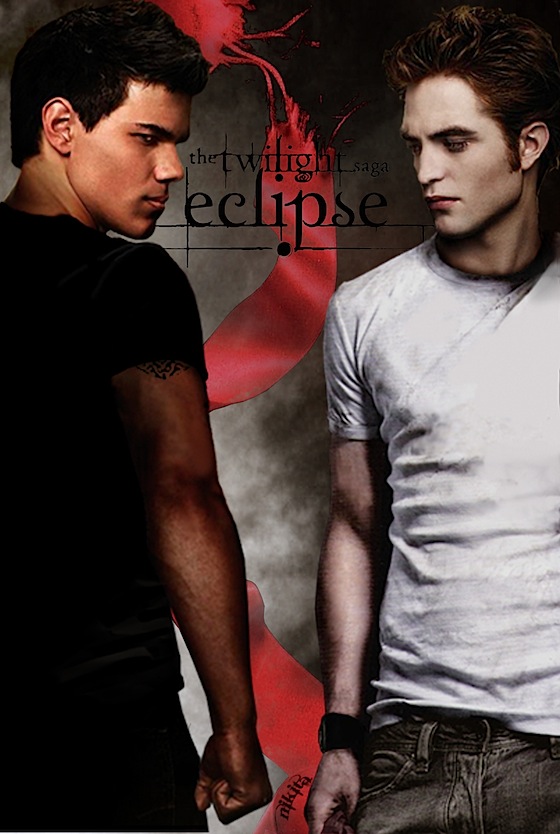
TWILIGHT: ECLIPSE - a world of bad hair colour and worse CGI

So, in an evening of girlie bonding my early twenties cousin and I went to see the third installment of the immensely popular Twilight series, ECLIPSE. Not that either of us could be called fan-girls. I’ve read the first book and seen the first two films: my cousin had only seen the first film. We proclaim no membership of either Team Jacob or Team Edward. But, along we went, open-minded, and if nothing else, happy to be in the lovely big Extreme screens in the Vue Westfield. Two hours later we emerged from a world of bad hair-dye, bad CGI effects and hammy dialogue. For this, my friends, is not a movie of high quality trying to appeal to the neutral movie-goer. Rather, ECLIPSE takes its audience’s buy-in for granted and delivers a workman-like condensed version of the novel, with the cheapest visual effects and wigs it can find. Seriously – the wolves bounce through the forests with little heft, much like Ang Lee’s HULK – and the crimes against hair colour perpetrated by Emmett Cullen and Rosalie Hale disgrace a big-budget film.

As the movie opens, we see our heroine Bella Swan torn between the two boys who love. The first is Edward Cullen – ancient vampire in the body of teen heart-throb – who won’t deflower her until they’re married, and for whom she would have to become a vampire. The second candidate is Jacob Black – ridiculously buff teen werewolf – who is happy to keep Bella warm (sadly, this saga being ludicrously chaste, we can read no double-entendre here) and offer her a romantic life that doesn’t involve dying. So follow two hours of hackneyed dialogue as each boy declares his love for Bella, and Bella looks sulky in response. At the end of which, she declares that the decision was never really about who she loved more but about who she wanted to be. This struck me as a rather unconvincing last minute attempt to give movie that is basically about a chick being dependent on two guys for her physical safety (evil mean red-headed vampire wants to kill her with her “new-born” vampire army) some kind of feminist cred. It would’ve bought into it more if during the course of the film, Bella had talked about this journey to self-realisation with her dad or her friends, or the two boys in her life. Overall then, I remain unconvinced by the whole Twilight phenomenon. The heroine is sulky: the vampires are unsexy: the werewolves on steroids: the CGI sucks: and basically very very little happens indeed. For the life of me I can’t figure out why David Slade, director of edgy indie hit HARD CANDY, would want to helm such a mainstream, banal movie, other than, of course, for the paycheque.

Additional tags: Taylor Lautner, Anna Kendrick, Ashley Greene, Elizabeth Reaser

TWILIGHT: ECLIPSE is on global release.

Sabtu, 30 Januari 2010

EDGE OF DARKNESS - Curiously flat

EDGE OF DARKNESS is a curiously anemic political thriller starring Mel Gibson as a straightlaced cop whose daughter is assassinated by her employer - a shadowy military defense contractor. While the police are distracted with the idea that the killer was really after the cop, the father begins his own investigation that takes him into the upper reaches of government and business. The marketing campaign for this film led me to believe that the film would be akin to the recent Liam Neeson vehicle TAKEN - in which a vengeful father murdered and tortured his way through Paris. But I was pleasantly surprised to find that EDGE OF DARKNESS is a far quieter, more talkative film. Indeed, barring one or two scenes, it is hardly an action movie at all. Rather, the movie takes the form of a series of conversations. Mel Gibson is actually rather sympathetic and credible as the grieving father and his scenes opposite Ray Winstone, who plays a government fixer, are marvelous to watch. Winstone is more modulated than is typical, and keeps us guessing as to his true motives. But I was rather disappointed to see Danny Huston roll out the same oleaginous sinister performance as the corporate boss. I was also disappointed by the technical quality of the film, despite being shot by the team behind CASINO ROYALE, and by the complete lack of tension. Indeed, the film was so baggy that after an hour I was tempted to leave. The mechanics of the plot - the secret everyone is trying to hide - is very mono-dimensional and obvious. There is no real attempt to work out the ramifications of the secret either politically or in the media. Indeed, despite a rather impressive corporate HQ, the movie has a rather parochial air (all the more because only Gibson attempts a Boston accent.) This extends to one of the most flat and brushed aside endings to a thriller I've seen in a while. So, all in all, despite a rather sympathetic performance from Gibson, this is ultimately a rather frustrating film.

EDGE OF DARKNESS is on release in the UK, the US, Hong Kong, the Netherlands, Singapore, Brazil and Canada. It opens next weekend in Australia, Denmark, New Zealand, Finland and Sweden. It opens later in February in Belgium, Slovenia, France, the Czech Republic, Greece, Norway, Romania and South Korea. It opens on March 4th in Argentina and Germany; on March 12th in Taiwan and on April 2nd in Estonia.
 

reiview movies and books Copyright © 2012 -- Powered by Blogger