Tampilkan postingan dengan label war. Tampilkan semua postingan

Sabtu, 23 Oktober 2010

London Film Fest 2010 Day 11 - ROUTE IRISH


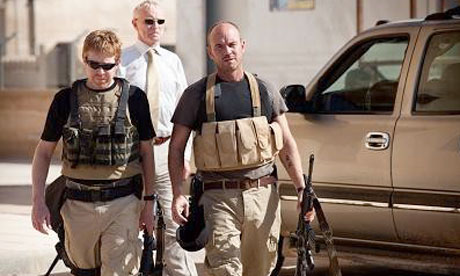
Ken Loach is one of Britain's most uncompromising directors. His films are political, unblinking, and have a relentless focus on the reality of working class life. Even his most recent film, a comic fantasy called LOOKING FOR ERIC, was firmly rooted in the everyday petty humiliations and victories of life as a postman in a Northern town. It was, then, only a matter of time before Ken Loach gave us his take on the war in Iraq. And with his typical perception for what is at the core of an issue, he goes straight for the one truly unique facet of this war - the widespread use of mercenaries. This outsourcing of state-power - this compromise of the idea that in liberal democracies the elected government is the only legitimate source of violence - because it is only the government that can be held to account for its abuse - is absolutely key to understanding Iraq. It is the abuse of this power, widely reported in the more thoughtful media, that serves as a kind of short-hand for all the abuses of power that have come to characterise the war in Iraq. Power abused, violence unchecked, and all for no end other than the perpetuation of power and the amassing of wealth.

Unfortunately, the insights that Loach and his regular screen-writing partner, Paul Laverty, bring to the Iraqi war have not resulted in a compelling film. In fact, I found ROUTE IRISH to be near unwatch-able - it fails as a thriller; it contains a truly risible love story; and suffers woefully from the heavy-hand of didactism.

The story begins with the death of a mercenary called Frankie on Route Irish - the road from Baghdad airport to the Green Zone. His best friend Fergus, also a squaddie turned gun for hire, decides to investigate the death, convinced that the company they worked for is covering up foul-play. Fergus investigates with the help of Frankie's widow, Rachel, and the translating skills of a local Iraqi refugee. Sure enough, the video on the phone is compromising.

Let's break down why the film fails. First, it fails as a thriller. We all know the mercenaries will have committed some heinous crime against innocent Iraqi civilians and Frankie too - after all, we've all seen wikileaks and it's not like Ken Loach is going to side with the neo-cons, is it? Second, it fails the test of simple logic. Once Fergus finds the damning video, why doesn't he put it on the web? This is what his Iraqi helper tells him to do. It's what Rachel tells him to do. Fergus refuses. He says he wants to get more, better evidence. But we know what's really going on. Loach and Laverty want to extend the film - draw out the narrative - so that they can show Fergus' moral disintegration - show him resorting to torturing a witness. Or whatever. Simply put: in the age of Wikileaks, I can't take any movie seriously that doesn't just dump the evidence on the web as soon as possible.

This brings us to the central failing of this film: the lack of emotional grip at its heart. After all, in a world of wikileaks - years after Brian de Palma's REDACTED - what can a movie like this really teach us? Nothing about the facts. Anyone who wants to know can find out. So the reason to watch a movie like this can only be because empathy with well-written characters can teach us something about ourselves and give us an emotional insight that mere documentary evidence cannot give. But ROUTE IRISH fails on that score too. It's characters are too crudely, thinly drawn to be of interest. I didn't buy into Fergus. I didn't buy into his slow decline into torture. And I certainly didn't buy into his clichéd relationship with Rachel. Mark Womack (Fergus) portrays anger, frustration and guilt by shouting loudly. Andrea Lowe is wooden and two-dimensional as Rachel. The casting of British stand-up comedian John Bishop as Frankie is a distraction.  Too little space is given to the Iraqi refugees. Most damning, one of those characters actually asks Fergus why he is obsessed with the death of one Brit when so many Iraqis are dying. Isn't it just another act of chauvinism to have another film from a Western point of view? Loach never answers this point.

ROUTE IRISH is, then, a complete failure. A failure in execution at every level. I was sadly disappointed.

ROUTE IRISH played Cannes 2010 and was released in Norway in September. It will be released in France on March 16th 2011.

Senin, 22 Maret 2010

GREEN ZONE - too simplistic, too late

GREEN ZONE is Matt Damon and Peter Greengrass' risible attempt to sucker the fanbase of the BOURNE films into watching a movie with a more avowedly political subject matter. Which just goes to show that the mainstream audience isn't that dumb. Just because it's got shaky handheld camera work and Matt Damon running around looking earnest and puzzled, doesn't mean that a movie is suspenseful or fundamentally politically interesting. I think the basic problem with GREEN ZONE, other than that it's not BOURNE 4, is that it's trying to make something we now taken as read look interesting. Yes, yes, it's a crying shame that we were taken into war in Iraq on the false premise that the Iraqis had weapons of mass destruction. But, seven years later, I think the public is too jaded to really care. We were lied to - we're in a mess - now what? Kathryn Bigelow broke through the apathy with her micro-psycho take on the archetypal figure in a street-fighting war - the bomb disposal expert. Her film, THE HURT LOCKER, was tense, but also took us into a side of the war that we genuinely might not have know about before. But GREEN ZONE, for all its earnest good intentions, tells us nothing new, and shows us nothing new. Roger Ebert says that GREEN ZONE looks at war in a way no other war film has, insofar as the US is the dupe not the hero. I beg to differ. Hollywood has been making great films about the vicious lie at the heart of most wars for decades, not least about Vietnam and more recently with THREE KINGS. Ebert also damns with praise here: "By limiting the characters and using typecasting, he [Brian Helgeland] makes the deceit easy to understand". Respect to Ebert, but no. If you have to debase yourself with typecasting, then you're just not up to the job. And at any rate, this film really just isn't that complicated. The trick missed is to show the personal human price paid. As THE HURT LOCKER took inside the insane world of the lead character, we should've seen more about how a stand-up guy like Damon's CWO Roy Miller would've reacted psychologically to realising that he'd been duped. What happens when the naive man grows up? That to me is more interesting than how fast and where he runs around.

GREEN ZONE is on release in Australia, Kazakhstan, Russia, Singapore, Canada, Finland, Indonesia, Norway, the Philippines, Spain, Sweden, the UK, the USA, Egypt, Germany, Kuwait, Switzerland, and Austria. It opens this weekend in Denmark, South Korea and Estonia. It opens on April 14th in Belgium, France, Argentina, the Netherlands and Brazil. It opens in Italy on April 23rd, in Turkey on April 30th, in Japan on May 14th, in Hungary on June 3rd and in Poland on June 4th.

Senin, 14 Desember 2009

AVATAR - you can have too much of a good thing

AVATAR is the much hyped new film from writer-director and special effects obsessive James Cameron - the man who brought us TITANIC, ALIENS and TERMINATOR. Let us say that James Cameron has consistently pushed forward the technology of film, and has produced consistently thoughtful sci-flicks. Indeed, I would argue that he deserves more kudos than Spielberg - creating fewer but more consistently entertaining and polished blockbusters. But let us also admit that Cameron is the master of hyping himself, and has saddled us both with Celine Dion and with a 130 minute movie of arse-numbing proportions.


First, the praise. AVATAR is a technical marvel. Not because it does anything new - rather, it pulls together all of the advances of the last five years and pushes them further and does them better than anyone else. The 3-D is immersive rather than trying to shock us. The CGI is photo realistic. The characters and animals have weight and heft. The natural science detailing on the plants and animals is breathtaking. Fantastic creatures seem real. It is easy to mock a director who goes to the lengths of actually inventing a new language for his fictional race, the Na'vi. But it works. Much like LORD OF THE RINGS, AVATAR works because it makes us believe in an alternate world, and through believing, we care about its future.

AVATAR is also tightly structured and directed so well that it maintains momentum throughout its runtime (which is not to say it couldn't have done with being a good forty minutes shorter). Cameron may be a master of CGI but he never forgets that story comes before technical wizardry. The movie plays a three-act drama. We are in a dystopian future where humans live on a dieing world, and have colonised a planet called Pandora, in order to mine a precious metal, whose main deposits lie underneath the "hometree" of the indigenous Na'vi people. In Act One, the audience invests its sympathy with the hero and heroine. A disabled jarhead pilots an avatar Na'vi body in order to infiltrate the tribe and negotiate a relocation by any means necessary. Problem is, he becomes fascinated by their respect for nature and falls for a Na'vi chick. In Act Two, the stakes are established. The army, impatient for profits, decimates the hometree, scattering the Na'vi people, and destroying their trust in the Jarhead. The science team establish that the whole ecosystem of the planet is connected and a powerful source of energy. In Act Three, we have the dramatic climax and resolution. The Na'vi regroup and with their human allies take on the colonials.

The strength of the AVATAR story is that James Cameron knows who to weave successful aspects of genre fiction into his more modern allegory of environmental degradation and ruthless military exploitation. We have a good old-fashioned romance between the jarhead and the Na'vi chick. We have a coming of age story, as the jarhead learns the rules of the new world. We have a buddy movie as the jarhead bonds with the science officer. And finally, we have a spiritual story of redemption. I love the fact that Cameron is willing to tackle both issues of science, politics and religion in the same film - to that end, it reminded me a lot of the better aspects of Ronald D Moore's BATTLESTAR GALACTICA.

Given all these positives, it isn't a surprise that I had a good time watching this flick, even though it did seem just too long to spend in a cinema for what should just be a bit of entertainment, albeit intelligent entertainment.

But there are negatives. AVATAR features some of the most hokey dialogue and two-dimensional characterisation seen on film since STAR WARS. And maybe that's no coincidence. Maybe when a writer-director is having to balance different genres, a large cast, action, technology and romance, it's just too much to ask to have good dialogue and nuanced characterisation too? But then again, BATTLESTAR GALACTICA did, by and large, pull that off. One of the strengths of that series was its ability to present conflicted characters who changed, evolved, and felt three-dimensional. By contrast, in AVATAR, you're either a righteous hippie earth-child or a cigar-chomping, profiteering rat-bastard. And characters say the stupidest things. Towit, jarhead to Na'vi chick: "why didn't you kill me?" Na'vi chick to jarhead: "Because you have a big heart." I mean, no-one, not enough imaginary aliens, speaks like this! There's also something slightly hypocritical in a movie that thinks nasty evil people who blow shit up are bad, but nevertheless wants us to be excited by a final act which is basically about people blowing shit up in more and more noisy ways.

Ultimately, AVATAR is such a feat of imagination that, like STAR WARS IV: A NEW HOPE, it survives the hammy dialogue and weak characterisation. It's nice to spend time in this world. It would've been even nicer to have been all done in two hours.

AVATAR is on global release.


Rabu, 25 November 2009

Preston Sturges Retrospective 6 - HAIL THE CONQUERING HERO

HAIL THE CONQUERING HERO! is a movie that prefigures films like THE FLAGS OF OUR FATHERS but is all the more impressive because it was made while World War Two was still raging and because, in contrast to Clint Eastwood's earnest dirge, it dares to treat its subject comedically. Preston Sturges is arguably at his most political in the tale of a young soldier called Truesmith (Eddie Bracken) who is demobilised on a humbug and confused for a war hero. Pretty soon, egged on by "Sarge" Heffelfinger (Sturges regular William Demarest), Truesmith is the town hero. His mother's mortgage has been paid, and he's being offered the mayorship.

Despite its superficially syrupy concerns - the love story with the hometown sweet-heart - the humility of the naive protagonist - HAIL THE CONQUERING HERO is one of the most subversive movies ever made, especially when you consider the timing of the release. Preston Sturges satirises everything that makes up the iconic American ideal - smalltown values, sentimental treatment of the family home, hero-worship, and the ease with which the democratic political process can be corrupted. The dialogue is razor-sharp witty but also dangerous! A perfect combination.


HAIL THE CONQUERING HERO was released in 1944 and was nominated for a Best Screenplay Oscar in 1945 but lost to biopic WILSON.

Rabu, 14 Oktober 2009

London Film Fest Day 2 - THE MEN WHO STARE AT GOATS - A Funny Idea In Search Of A Plot

From the producer of GOOD NIGHT, GOOD LUCK and the writer of SIXTY SIX, comes a directorial debut that is uneven, misguided and ultimately unengaging, despite occasionally very funny scenes indeed.

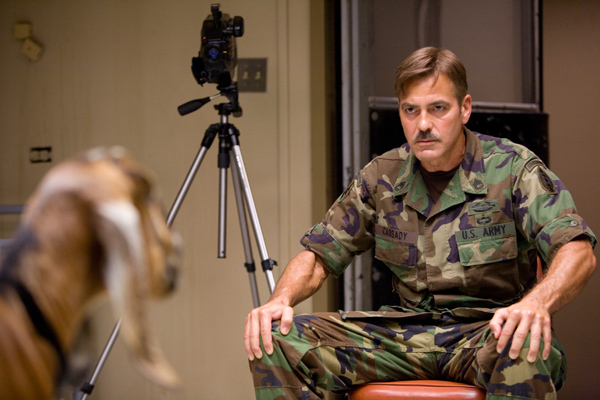
The film is about as convincing as Ewan MacGregor's dodgy American accent. He stars as a naive young journalist who goes to Iraq when his wife dumps him. He takes up with a strange man called Lyn (George Clooney in a "trying-to-be-goofy" moustache). Lyn used to be part of a secret US military programme that was training soldiers to use paranormal powers (mind-bending) and so become "Jedi". The title of the film comes from an experiment whereby the Jedi soldiers would try to kill a goat by staring at it. As the Jedi and his acolyte cross Iraq looking for the US Army psych-op/PR-op base, the movie periodically flashes back to the story of how this bunch of kooks got government funding and were ultimately taken down by a cynical soldier jealous of Lyn's power (Kevin Spacey.)

Now, given the sheer ridiculousness of the premise, we could have had a seriously wacky, funny movie. People might reference the Coen Brothers because of Clooney, but I could imagine Guy Ritchie in the old LOCK-STOCK days handling the voice-over and the freeze frames brilliantly. Sadly, director Grant Heslov has neither the flair nor the confidence to pull off the kind of bravado-film making needed to sell such a ludicrous (even if true) concept.

As for the modern day footage in Iraq, as I said before, Ewan MacGregor is mis-cast, while Kevin Spacey and Jeff Bridges are type-cast as the Antagonist and The Dude respectively. The plot seems to meander aimlessly, just like their journey in the desert. Worse still, when Heslov does try to show something serious - something that's meant to shock - like an IED explosion or incarcerated, tortured Iraqis - the scene is trivialised by the surrounding ludicrous material.

The upshot is that this is a movie that works neither as a comedy nor as a provocation about the war in Iraq.

THE MEN WHO STARE AT GOATS played Venice and Toronto 2009. It will be released on November 6th in the USA: November 19th in the Netherlands; December 4th in the UK; December 24th in Slovenia; January 2010 in Italy, Sweden, Switzerland and Norway; February 2010 in Turkey; and in March 2010 in Germany.
 

reiview movies and books Copyright © 2012 -- Powered by Blogger