Tampilkan postingan dengan label black and white. Tampilkan semua postingan

Selasa, 18 Oktober 2011

London Film Fest 2011 Day 7 - THE ARTIST

Jean Dujardin and Berenice Bejo, the stars of
THE ARTIST, at the UK premiere at the
BFI London Film Festival 2011.


Michael Hazanavicius’ charming silent movie about the end of silent movie-making stars Bérénice Bejo and Jean Dujardin (of the recent secret-agent spoofs OSS 117) as actors Peppy Miller and George Valentin, who fall in love against the dreamy backdrop of an early golden-age Hollywood. When the talkies take off, George, the go-to man of the silent picture, finds himself outcast by a determined and winning Peppy, a role in which Bejo dazzles, and where THE ARTIST might have kept up with her singular energy it slows to the nostalgic time spent by George in relative poverty and obscurity. Nonetheless, Dujardin's performance remains a broad and irresistible focus, and there may be no modern leading man better suited to the demands of the silent movie genre. Rare in any case does it seem to enjoy watching actors watching themselves on screen.

THE ARTIST played Cannes, where Jean Dujardin won Best Actor; Toronto and London 2011. It is on release in France. It opens in the US on November 23rd; in Italy on December 9th; in Spain on December 16th; in Greece on December 22nd; in Germany on January 26th and in Hong Kong on February 9th.


Jumat, 14 Oktober 2011

London Film Fest 2011 Day 3 - THE DAY HE ARRIVES


THE DAY HE ARRIVES is an intriguing, slippery, funny little South Korean art-house flick, directed by Hong Sang Soo as a kind of vintage Woody-Allen-esque take on thirty-somethings drinking, flirting and ruminating on life, relationships and co-incidence. The trigger of the film is a semi-famous movie director called Yoo Seongjun visiting friends in Seoul from a self-imposed exile in a provincial university. He seems diffident, annoyed at fawning film-students and embarrassed by former colleagues. He's sentimental about an old love affair and yet throws himself at a pretty young girl in a bar. He seems compelled to relive the day he arrives over and over, each time events take a slightly different turn and shed light on characters and relationships. And the whole thing revolves around drinking and eating and drinking some more! The movie is hard to characterise. It's very funny, contains some on-point relationship insights - and yet feels somehow insubstantial - an exercise in writing around a funny central "Groundhog Day" concept. And yet I do find myself thinking about it - it has left its mark - and of all the films I have seen to date, it strikes me as the most original, and the one I'd love to see again. Definitely worth seeking out, and thanks to Filmland Empire for the tip-off. 


THE DAY HE ARRIVES / BOOK CHON BAN HYANG played Cannes 211. It doesn't have a commercial release date yet.

Rabu, 24 November 2010

Greta Garbo retrospective - CAMILLE (1936)

CAMILLE is one of the many adaptations of Dumas Fils La Dame Aux Cameilias - the story that became La Boheme, Rent and Moulin Rouge. This version is directed by legendary Hollywood director George Cukor (THE PHILADELPHIA STORY, MY FAIR LADY) and stars Greta Garbo as the beautiful prostitute, Margeurite aka Camille. She is kept by a wealthy baron, but because of a mix-up, turns her attention to the dashing Armand Duval (Robert Taylor - QUO VADIS) and falls in love with him. She gives up her luxurious life to be with him, but after a harsh pragmatic conversation with Armand's father, (Lionel Barrymore - IT'S A WONDERFUL LIFE), decides to abandon Armand. She knows he might follow her, but decides to sacrifice their love to save him from a life with a courtesan, and one dying of tuberculosis no less. Initially angry and disaffected, eventually Armand pursues her and comes to realise her self-sacrifice. Finally, she dies of tuberculosis in his arms, after one of the most affecting and legendary scenes of romantic declaration in the history of cinema.

The movie feels lush and romantic at every level - it's every inch an Irving G Thalberg production from the glory days of MGM. The interiors are rich and detailed, the countryside setting beautiful, and Greta Garbo's sumptuous gowns by Adrian (THE PHILADELPHIA STORY) make Garbo look even more stunningly beautiful than usual. Her hard beauty is perfectly suited to playing the woman in love whom life has taught to be practical nonetheless. When she finally melts, it's all the more moving for knowing the real risks she faces in compromising her profession. Has there ever been an actress who could portray such nuanced and conflicting emotion, barely uttering a word? And when she speaks, the dialogue might seem soupy on the page, but my goodness, it gets a little dusty in the theatre in those final scenes.

CAMILLE is one of those rare things - a romantic tragedy that never feels manipulative or melodramatic - that has the sheen of a melodrama but communicates a genuine chemistry between the leads and makes us believe in their love. It is for that reason that this seventy year old film of an eighteenth century love story still feels fresh and still moves us.

CAMILLE was released in 1937. Garbo was nominated for the Best Actress Oscar but lost to Luise Rainer in THE GOOD EARTH.

Selasa, 23 November 2010

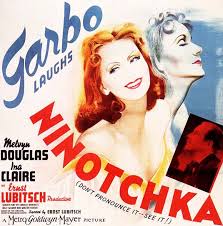
Greta Garbo retrospective and Pantheon movie of the month - NINOTCHKA (1939) - Garbo laughs!


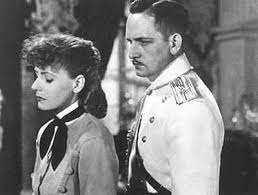
NINOTCHKA is a marvellously spiky satirical romance that manages to mock capitalist decadence and communist dogma in equal measure, as well as giving us Greta Garbo's most versatile performance. She stars as a dour Soviet agent sent to Paris to castigate her three comrades who have so completely failed in their mission of selling confiscated jewellery to raise hard currency for the state. The irony is that the harder than hard Ninotchka is seduced, just as her comrades have been seduced, by fine wines, beautiful clothes, and yes, laughter and love. The seduction comes in the form of Count Leon (Melvyn Douglas), a Parisian rogue, who discovers something finer in himself when he meets Ninotchka and is even willing to go to Russia to get her back. Ninotchka discovers love through laughter rather than melodrama, just as we see the absurdity of dogma through satire. It's a wonderful mix and absolutely pitch perfect, from Billy Wilder's scabrous script through to Garbo's silly hat and the fascinating cameo by Bela Lugosi as the Commissar. But, ultimately, as much as the dialogue shines, it's Garbo's deadpan delivery that kills us - her willingness to send up her cold, unapproachable beauty and to deaden her endlessly expressive face in the early scenes only to truly laugh at herself and her love of champagne as the movie builds.

Ninotchka: We don't have men like you in my country.
Leon: Thank you.
Ninotchka: That is why I believe in the future of my country.

Ernst Lubitsch (TO BE OR NOT TO BE, THE SHOP AROUND THE CORNER) was famous for directing sophisticated comedies for Warner Brothers, and brought his famous "Lubitsch touch" to MGM in the 1930s, typically directing comedy musicals. Given his facility with comedy, he might've seemed a perfect fit for Billy Wilder's scabrous, satirical script, and for the movie marketed as "Garbo laughs!", but he was actually drafted in as a replacement for George Cukor, who had gone off to direct GONE WITH THE WIND. At any rate, no matter how he came to the project, he certainly gave it that wonderful mix or wry humour and genuine warmth. NINOTCHKA feels like it lives in a strange half-world - not quite real but not completely absurd either. It feels like emotions and politics are heightened - lifted above the floor by an inch or two, thanks to the sheer charisma of the cast and genius of the script. The real-unreality reminds me of one of my favourite plays, Peter Ustinov's satirical comedy Romanoff and Juliet. The play is set in a surreal fairy-tale land somewhere between the Cold War and reality and is told with a wry detachment but subtle understanding that, I feel, only comes from the cultural cosmopolitan. Maybe it's pushing it a little too far, but I can't help but wonder whether there's something in both Ustinov and Lubitsch being Russian émigrés, with that outsider's ability to look coolly at the folly of different political regimes.

That cool urbanity runs through every scene of the film and is part of its central concept. NINOTCHKA feels modern - post-modern even. It takes one of the most beautiful romantic leading ladies in Hollywood - a woman famous for the deathbed romance of CAMILLE - and made her play against herself. Without make-up, suppressing her innate charisma, refusing to be romanced, Garbo subverts her natural place in the Hollywood movie. That subversion - that brilliant daring - is what keeps NINOTCHKA fresh and captivating today.

NINOTCHKA was released in 1939 and was nominated for Oscars for Best Picture, Best Actress, Best Original Screenplay and Best Original Story. It lost to Gone With The Wind in the first three categories, and to Mr Smith Goes To Washington in the last.

Senin, 22 November 2010

Greta Garbo retrospective - ANNA CHRISTIE (1930) - Garbo speaks!


"If anyone wants to get drunk, if that's the only way they can be happy, and feel at peace with themselves ... they have my full and entire sympathy. I know all about that game from soup to nuts. I'm the guy that wrote the book." Hickey, in The Iceman Cometh.

ANNA CHRISTIE is a powerful and moving film about living with two emotionally destructive forces: illusions and alcoholism. It was based on a play by Eugene O'Neill, a writer who was himself an alcoholic, and who writes with an acute perception and empathy that seems utterly modern and shocking in a major MGM movie, until you realise that Anna Christie was released pre-Code. How brave, though, for silent movie star Greta Garbo to pick ANNA CHRISTIE for her first "talkie". To shatter the illusion that her fans had of her as a brittle beauty, with a movie about a woman who is herself perceived to be virginal and pure. The reality is that rather than having milk ordered for her by her father and lover, she'd rather wash away her memories of an abusive childhood and her years as a prostitute with whiskey.

The movie is a ninety minute exercise in disciplined story-telling, and the taut structure combined with director Clarence Brown's largely static camera gives the film a stagey feeling. No matter. A modern director might have tried to open the play out for the film, but with Brown - Garbo's favourite director - he was too busy opening out the emotions to care.

The first fifteen minutes sees Chris Christoffersen (George F Marion), a humble sailor, brimming with joy that his daughter, an au pair, is returning home. Marthy Owens (Marie Dressler), a bar-room drunk, and Chris' friend resents his lionising of his daughter, and is only too happy when, in the second fifteen-minute segment, Anna walks into her bar and orders, iconically, "A visky, ginger ale on the side, and don' be stingy, baby." The film comes alive as these two women edge into a friendship over a shared need to drink. Anna hints that her life has been hard and that she resents that her father abandoned her to their distant family. Marie Dressler and Garbo spark off of each other, and it's a joy to watch. In the third fifteen-minute segment, we see Anna and her father on their boat. Her father is reluctant for her to take to the sea, fearing it's no place for any proper person, but Anna, melancholy, comes to love it. And so, we sail into the second half of the movie. A storm strikes, and a fellow sailor appeals for help. So, Anna meets Matt Burke (Charles Bickford). Initially, she resists his advances, and we sense that she hates men just as her father hates the sea. But slowly they settle into a kind of domesticity on the boat and fall in love with each other. This prompts a proposal, and the final twenty minutes of the film gives us the full dramatic results of that. Anna feels she can't accept until her father and lover know the full truth about her.

This is Garbo at her best - strong, honest, upright, and yet vulnerable, damaged, self-sacrificing. Ultimately, through revealing the truth, she becomes the stronger person, leaving the men around her with their shattered illusions - literally throwing them off of her as each one grabs one of her arms as though she is a rag doll to be fought over. The irony is that she becomes strong by revealing her vulnerability - the truth about how damaged she is.

ANNA CHRISTIE is a wonderful film - raw, honest, perceptive, powerful. Garbo gives an amazing performance and dominates the screen, and Marie Dressler is fine in support. But ultimately it's O'Neill's play that is the strength of the film, with its empathy for the damaged alcoholic and its need to confess all.

ANNA CHRISTIE was released in 1930. Garbo, Clarence Brown and William H Daniels were nominated for Oscars but Norma Shearer for THE DIVORCEE, Lewis Milestone for ALL QUIET ON THE WESTERN FRONT and Joseph T Rucker and WIllard Van der Veer for WITH BYRD AT THE SOUTH POLE respectively.

Minggu, 21 November 2010

Greta Garbo retrospective - ANNA KARENINA (1935)

Anna Karenina is my favourite novel. There are novels that I think are better written, though not many, and those that I admire more. But Anna Karenina has my heart, and I read it typically twice a year. When you love a book so passionately - when you have visualised every scene and every character - it becomes incredibly hard to give another person's vision a fair viewing. And so, in general, I have avoided watching the many film and TV adaptations of the novel*. However, I have recently been rewatching a lot of Greta Garbo's films on my many train journeys to Paris, including her 1935 ANNA KARENINA directed by Clarence Brown.


Anna Karenina is a beautiful society woman who's love for her son compensates for her marriage to a staid and self-satisfied man.  She is pursued by the dashing Count Vronsky, and knowing what is at stake, refuses his advances at first. When she gives in she sacrifices her place in society and access to her son.  Worst of all, cut off from the air of society, Vronsky becomes clasustrophobic and Anna becomes insecure and paranoid with tragic consequences. This story is set against that of Anna's sister-in-law Kitty, who's heart is broken when Vronsky leaves her, but is courted by the fascinatingly ill-at-ease, philosophically mired aristocrat Levin.

This movie adaptation is just 95 minutes long and much is sacrificed to get the movie down. The story of Kitty and Levin is given very short shrift, as well as anything more dark and searching in Levin's philosophical quest. This is of particular pain to those who, like me, think that Levin is the true hero of the tale. When it comes to the story of Anna and Vronsky, Garbo is of course, perfectly cast. Her magisterial beauty makes Vronsky's reckless behaviour unsurprising, and her ability to play against that, and show deep vulnerability and doubt, is deeply affecting. It might be a cliché, but in the final scenes, when we see Anna in the extremity of suffering, one can't help thinking that only a silent movie heroine would know how to convey such complexity and depth of emotion as Garbo does.

I also rather like the direction. Brown was apparently Garbo's favourite director and he took her from silent films such as FLESH AND THE DEVIL into her first talking feature, ANNA CHRISTIE and beyond. Of what I'd seen of his earlier films, Brown was not a director with visual flair - rather leaving his camera static to observe a beautifully framed tableaux the better to fix our attention on Greta Garbo's face. But ANNA KARENINA starts with a tour-de-force scene in which he shows Count Vronsky in his element - at a lavish officer's dinner. It isn't a scene that exists in the novel, but perfectly captures the decadence of that era and the capacity for self-indulgence that Vronsky will display. It also foreshadows the tragedy that will occur when Vronsky is cut off from the oxygen of these society events. The officers are tucking in to luscious food, almost like unruly schoolchildren, and then, we realise, this has only been a starter! As they are called to dinner, the officers start singing and line up at a long banqueting table, richly laden with yet more luscious food. The camera tracks back slowly down the length of table, at food rather than officer height, and the effect is powerful and overwhelming. Truly brilliant film-making. This understanding of the fact that much of Russian high society at that time was about creating spectacle carries through into the first ball-room scene, in which a mazurka is staged. William Daniels photography is once again superb, and as we see high society indulging in emotional games in their lavish frocks, there is no mistaking that this is a David O Selznick film with all the MGM glitz and glamour that that entails.

So, there is much to like in ANNA KARENINA - Brown's visuals and Garbo's performance. But for me this can never quite be a great film because of the liberty taken with the text by screen writers Clemnece Dane and Salka Viertel (QUEEN CHRISTINA) and in particular the downplaying of Levin-Kitty as a counter-point to Anna-Vronsky. Doctor007 thinks I am being unfair on this point - and that the movie stands up perfectly well on its own terms. Maybe he is right, but I am far too enmeshed in the novel to be able to make that separation.

*Anglo-Saxon versions began with J Gordon Edwards' 1915 Anna starring Betty Nansen, Edward Jose and Richard Thornton; and Julien Duvivier's 1948 film, produced by Alexander Korda and starring Vivien Leigh as Anna, Ralph Richardson as Karenin, Kieron Moore as Vronsky with a score by Constant Lambert and a score by Cecil Beaton. More recently, Bernard Rose's 1997 Anna starring Sophie Marceau, Sean Bean, Alfred Molina, James Fox and Danny Huston.

Russian Anna's include Tatyana Lukashevich's 1953 version starring Anna Tarsova; Aleksandr Zarkhi's 1967 movie starring Tatyana Samoljlova as Anna; and Margarita Pilikhina's 1974 film, with Maya Plisetskaya as Anna and Alexander Godunov (Karl in DIE HARD) as Vronsky. German Anna's include Friedrich Zelnik's 1919 Anna starring Lya Mara and there are versions from France, Italy and Hungary from the silent era.

ANNA KARENINA played Venice 1935 where it won the Mussolini Cup for Best Foreign Film (shudder) and was released in 1935 and 1936.

Selasa, 06 Juli 2010

TETRO - They fuck you up, your mum and dad - Part Four

TETRO is a beautiful, fantastical, shamelessly self-indulgent movie about family dysfunction and the impossibility of living with a self-proclaimed genius. It is worth watching for the cinematography and Vincent Gallo's lead performance alone - but there are many other joys to be had - not least a blistering cameo from Klaus Maria Brandauer; a cheeky little Dolce Vita moment featuring Carmen Maura; and a wonderful little Red Shoes homage.

The most surprising thing about TETRO is that is was written and directed by Francis Ford Coppola - indeed, it is his first writer-director credit since THE CONVERSATION. The result is a movie that feels nothing like Coppola's mafia epics - despite some similarity in the emotional material. TETRO also feels nothing like Coppola's last movie - another self-financed (and unjustifiably maligned) art-house flick - YOUTH WITHOUT YOUTH. That movie was beautifully shot, but serious, mournful, byzantine in its structure and conceit. By contrast, while TETRO may deal with the most violent of emotions, but it always has a playful, self-mocking edge. At times, it almost feels like the lighter parts of Almodovar. Every character is sometimes aware that they are striking a pose - that is, except Miranda (Maribel Verdu - Y TU MAMA TAMBIEN) who is the emotional heart of the film.

Tetro is the pen-name of playwright Angelo Tetracini (Vincent Gallo). He cut loose from his domineering, Mephisto-like conductor father (Klaus Maria Brandauer) and ran off to Buenos Aires. This movie opens as his little brother Bennie (Alden Ehrenreich - a dead-ringer for the young Leo diCaprio) shows up on his doorstep - still hero-worshipping his elder brother but also angry that Tetro left him behind with the monster-father. Tetro's girlfriend Miranda adores having Bennie around, but for Tetro to come to terms with a relationship with Bennie, he will have to confront many family ghosts. That - and a performance at a arts festival in Patagonia - provide the narrative and emotional drive of the movie.

Gallo perfectly embodies the hard-faced charisma of Tetro. Ehrenreich has just the right mix of vulnerability and chutzpah to be able to pull off the central con of Bennie finishing Tetro's long abandoned play. Verdu's Miranda is charming and credible - anchoring a movie featuring all sorts of crazy characters. I particularly loved Carmen Maura as "Alone" - the theatre critic that allows Coppola to spoof the art-house world he is at once seeking to re-engage with. But the real masterstroke is casting Klaus Maria Brandauer (MEPHISTO) as Papa Tetracini - world-famous composer, charmer and shit. The genius is that even an old and flabby Brandauer can be charming enough to convince as the seducer of his young son's girlfriend - or as the firebrand Furtwaenglerian composer. He commands attention in every scene he's in and we can well understand why his sons struggle to escape from his physical and emotional presence.

I loved TETRO - moreso on the second viewing. And I am thrilled that Coppola is moving back to these self-financed, self-penned utterly artistically liberated movies.

Additional tags: alden ehrenreich, maribel verdu, rodrigo de la serna, klaus maria brandauer, osvaldo golijov, mihai malaimare jr

TETRO played Cannes and Toronto 2009 and was released in Spain, Greece, Portugal, Italy and France last year. It was released in Hungary and Brazil earlier this year and is currently on release in the UK.

Selasa, 09 Februari 2010

Werner Herzog Retrospective 2 - EVEN DWARFS STARTED SMALL (1970)

Next on the smorgasbord of crazy in the Herzog back catalogue is his film EVEN DWARFS STARTED SMALL. Filmed in black and white, on location in Lanzarote, this movie presents a world of midgets in which the inmates take over the asylum and the pristine wards descend into barbaric violence. Thematically, the film reminded me a bit of IF... - another film that scratched the surface of an institution (in that case, the British public school) to reveal the savagery beneath.

Just like FATA MORGANA, Herzog is trying to create an environment that looks alien to our eyes but that contains the savagery of human nature. In FATA MORGANA, he used Africa and in this movie he uses midgets to create that distancing effect. If he weren't such an iconoclastic liberal, and if he weren't known for being so playful, you'd have to take issue with this. I guess his excuse would be that he's only using midgets as a shorthand for weirdness because that's what works for his bigoted audiences, rather than because he personally agrees with such a presumption.

Anyways, back to the film itself. I thought it was a lot easier to watch than FATA MORGANA, partly because there are actual characters with actual dialogue, and partly because it's just a lot more fun to watch a bunch of people go crazy (some of whom are wearing those Fata Morgana goggles), as opposed to some random people wandering in front of a moving camera. It's not so much "fun" as just bizarre and compelling. It's like watching a sort of demented nightmare unwind. Admittedly, it's a nightmare in which a monkey gets crucified. Now, the DVD I watched didn't have a director's commentary on it, which is a shame. But I gather from reading about the film, that "demented nightmare" is the look he was going for. The movie has a bizarre power that commands your attention from start to end. Well worth a look.

Additional tags: Klaus Kinski, Thomas Mauch, Beate Mainka-Jellinghaus, Helmut Doering, Paul Glauer, Gisela Hertwig,

EVEN DWARFS STARTED SMALL played Cannes 1970 and is available on DVD.

Senin, 11 Januari 2010

Douglas Sirk Retrospective 2 - ALL I DESIRE

We're a big disappointment to each other, aren't we? You've got a mother with no principles; I've got a daughter with no guts.


Continuing with the Douglas Sirk retrospective, we have his 1953 melodrama, ALL I DESIRE. In a theme that Sirk would explore most famously in IMITATION OF LIFE, Sirk shows the price paid by a woman who sacrifices her family to her career, and who later is positioned as a rival to her daughter. Barbara Stanwyck stars as the classic Sirkian heroine, a woman who has made a break for freedom and personal happiness, by leaving her decent but dull schoolteacher husband, her three children and her possessive lover, to pursue a career on the stage. A decade later she returns, to find her grown daughter about to graduate, and her family convinced she has made it as a big star. As with all Sirkian heroines, she is forced to sacrifice and subsume her passions in order to make her judgemental family happy. This is the genius of Sirk - on the face of it, ALL I DESIRE is a deeply conservative morality tale in which a malcontent runs from her responsibilities, returns home with her tail between her legs, realises that she really wants her dull husband and settles down to her dull life. But in reality, it is a film about the invisible constraints of suburbia - the malicious force of small-town gossip - and settling for less than you wanted through exhaustion and desperation. The resolution is less a happy ending than a resigned return to repression. It is a tremendous film - and all the more astounding because it is examining the dilemma of MAD MEN's Betty Draper on screen at the time at which it was *actually* happening, right in front of an audience who think they're in for some populist sentimental nonsense.

ALL I DESIRE was released in 1953.

Rabu, 25 November 2009

Preston Sturges Retrospective 6 - HAIL THE CONQUERING HERO

HAIL THE CONQUERING HERO! is a movie that prefigures films like THE FLAGS OF OUR FATHERS but is all the more impressive because it was made while World War Two was still raging and because, in contrast to Clint Eastwood's earnest dirge, it dares to treat its subject comedically. Preston Sturges is arguably at his most political in the tale of a young soldier called Truesmith (Eddie Bracken) who is demobilised on a humbug and confused for a war hero. Pretty soon, egged on by "Sarge" Heffelfinger (Sturges regular William Demarest), Truesmith is the town hero. His mother's mortgage has been paid, and he's being offered the mayorship.

Despite its superficially syrupy concerns - the love story with the hometown sweet-heart - the humility of the naive protagonist - HAIL THE CONQUERING HERO is one of the most subversive movies ever made, especially when you consider the timing of the release. Preston Sturges satirises everything that makes up the iconic American ideal - smalltown values, sentimental treatment of the family home, hero-worship, and the ease with which the democratic political process can be corrupted. The dialogue is razor-sharp witty but also dangerous! A perfect combination.


HAIL THE CONQUERING HERO was released in 1944 and was nominated for a Best Screenplay Oscar in 1945 but lost to biopic WILSON.

Selasa, 24 November 2009

Preston Sturges Retrospective 5 - THE GREAT MOMENT

After the success of THE LADY EVE, SULLIVAN'S TRAVELS and THE PALM BEACH STORY, Preston Sturges took a break from self-penned screwball comedies to direct a historic biopic about a Boston dentist called William Morton who discovered the use of ether as an anaesthetic. Apparently these sorts of medical biopics were rather popular at the time, and one can only assume that Sturges was personally interested in the subject matter. After all, he was already so much better paid than any of his contemporaries, this can't have been a shameless cash-in, can it? The movie opens strongly with a segment that excoriates political process and venality as much as anything in THE GREAT McGINTY: our hero is manipulated into filing a lawsuit to protect his patent that makes him seem like a profiteer and disenfranchises him. The rest of the movie, told in flashback, is only sporadically interesting. Joel McCrea does his best to pull of the drama, but for the first time, Sturges can't quite balance the emotional content with the broad comedy. Admittedly, the main fault for the film's failure is studio meddling to create a contrived happy ending. But one can't help but feel that Sturges either misjudged the material.

THE GREAT MOMENT was released in 1944.

Senin, 23 November 2009

Preston Sturges Retrospective 4 - THE PALM BEACH STORY

THE PALM BEACH STORY is perhaps my favourite Preston Sturges film, beating THE LADY EVE, and just like THE LADY EVE, it's a wonderfully quick-witted, sophisticated comedy featuring a strong, charismatic female character dabbling with the emotions of men who can barely keep up. Claudette Colbert excels as the beautiful Gerry Jeffers, who manages to be world-wise without appearing cynical. Frustrated by her loser-husband Tom (Sturges' regular Joel McCrea) she decides to take off to Palm Beach for a divorce, while simultaneously squirrelling a fortune out of a millionaire to give her ex a start in business. As she so wryly tells him, "You have no idea what a long-legged woman can do without doing anything." Having charmed her way into a free train ticket, Gerry manages to get "picked up" by J. D. Hackensacker III, a chivalrous millionaire who falls for the straight-talking beauty. Conveniently, his much-married sister falls for Tom, who has, by now, made it to Palm Beach too and, as this is a screwball comedy, is introduced as Gerry's brother. Whip-smart dialogue and shenanigans ensue, and they all live happily ever after, or, famously "do they?!"


What I love about this film is how much more modern, frank and wise it seems compared to contemporary romatic-comedies. Most of us would view the 1940s as a far more sexually repressed and simpler world, but here we have the battle of the sexes fought with far more elegance and savoir-faire than you see in the average chick flick. There's something wonderfully grown-up about THE PALM BEACH STORY despite the zany plotting. And most wonderfully, it still seems fresh and full of verve today.

If I prefer THE PALM BEACH STORY to THE LADY EVE it's simply because Tom and Gerry's foil is so much more charismatic and surprising than Henry Fonda's Charlie Pike. Indeed, John D Hackensacker III is one of the all-time great comic creations. Consider lines like "Chivalry is not only dead, it's decomposed," or "That's one of the tragedies of this life - that the men who are most in need of a beating up are always enormous." Or his catch-phrase - that state-rooms and tipping are "un-American". It's shocking to discover that Rudy Vallee didn't merit an Oscar nom for his performance. Then again, is there anything more heart-breaking than watching Tom and Gerry fall in love again while JDH sings "Goodnight Sweetheart"? Only Sturges can pull off that wonderful combination of clever and genuinely heartfelt.

THE PALM BEACH STORY was released in 1942.

Senin, 02 November 2009

Pantheon movie of the month - DOUBLE INDEMNITY

Phyllis: I'm a native Californian. Born right here in Los Angeles.

Walter Neff: They say all native Californians come from Iowa.


DOUBLE INDEMNITY is a brutal, enigmatic film noir - one of legendary director Billy Wilder's best films (a bold claim seeing as he helmed SUNSET BOULEVARD, THE SEVEN YEAR ITCH and SOME LIKE IT HOT) - a slippery masterpiece, like all of Raymond Chandler's slippery thrillers - and creepily shot by John Seitz, DP on SULLIVAN'S TRAVELS. Watching the film today is to find a film that still feels modern, perhaps because of its cynical approach to relationships, and puzzling, because of the conundrum at its centre.

The film takes the form of a crime thriller. Beautiful Barbara Stanwyck is a ruthless woman who uses her sexuality to manipulate men for money. She does a quick number on an insurance salesman called Neff (Fred McMurray), convincing him to murder her husband but to make it look like an accident so that they can both collect on his life insurance. Under the double indemnity clause, an accidental death pays out double. What's completely bizarre is that there is no heat in the relationship between Phyllis and Neff, and it's not clear why he'd switch from being a successful businessman to a murderer. There is something willfully, arbitrarily self-destructive which is utterly sinister and incredibly compelling to watch. The relationship that's arguably even more compelling is that between Neff and Keyes - the boss sent to investigate the "accident", prove it was suicide or murder and deny the claim. Keyes (Edward G Robinson) is the hero of the piece, if you can have a hero in a noir. He forms a genuinely empathetic relationship with Neff and the real suspense of the film comes not from whether Keyes will track Neff down, but why Neff feels compelled to collude in that process.

DOUBLE INDEMNITY was released in 1944 and is available on DVD. It was nominated for seven Oscars. Barbara Stanwyck lost out to Ingrid Bergman for GASLIGHT; John Seitz lost to Joseph LaShelle for LAURA; Billy Wilder lost to Leo McCarey for GOING MY WAY; Miklos Rozsa lost to Max Steiner for SINCE YOU WENT AWAY; it lost Best Picture and Best Screenplay to the Bing Crosby comedy GOING MY WAY; it lost Best Sound to WILSON.

Eventual tags: barbara stanwyck, billy wilder, black and white, edward g robinson, fred macmurray, james m cain, jean heather, john seitz, miklos rozsa, noir, pantheon, porter hall, raymond chandler, thriller

Sabtu, 31 Oktober 2009

Preston Sturges Retrospective 3 - THE GREAT McGINTY (1940)

If it wasn't for graft, you'd get a very low type of people in politics, men without ambition, jellyfish!


THE GREAT McGINTY was the movie that made Preston Sturges an auteur: it's the movie in which he moves from being a screen-writer to a writer-producer-director. Already we can see some of the thematic concerns that will colour his great films: unlikely romances; social and political injustice; all pinned on a narrative arc that strains credibility. The fact that Sturges chose to hang his narrative on a character that would typically be a Hollywood villain still seems daring. After all, the McGinty of the title is a muscle-bound homeless bum with little elegance and less charm. He's plucked from the soup-line by a mobster looking for someone to vote illegally and rises through the ranks to become a stooge gubernatorial candidate. Sturges' depiction of the machinations of politics is cynical, astute and stands sharply in contrast to the sugar-gum optimism of MR SMITH GOES TO WASHINGTON. In Sturges film, we know up front that when McGinty does finally try to do the right thing, inspired by his wife-of-convenience turned actual lover, he's going to end up on the run. I love the fact that Sturges skilfully manages to combine rather dark material with genuine light-hearted comedy: a truly amazing balancing act. But there's no denying that this film does not reach the same high standards of witty one-liners, nor physical comedy, as SULLIVAN'S TRAVELS or THE LADY EVE. The movie is a daring and assured debut with one or two dialogue scenes that are superb - but it remains a promise of greatness to come rather than the finished product.


THE GREAT McGINTY was released in 1940. It won the Best Writing, Original Screenplay Oscar, beating Charlie Chaplin's superb THE GREAT DICTATOR.

Jumat, 30 Oktober 2009

Pantheon movie of the month and Preston Sturges Retrospective 2 - THE LADY EVE (1941)

There are two stars in THE LADY EVE: Preston Sturges' witty script, and Barbara Stanwyck as the beautiful adventuress with a vulnerable heart, Jean Harrington. The joy of the film is watching these two stars toy with the other characters in the film, and with us! Stanwyck - in sharp contrast to the impenetrable shark in DOUBLE INDEMNITY - plays a witty, wise businessman who happens to be a woman, and like any woman, is capable of being piqued, and once piqued, of exacting revenge! In a bravura opening scene she sits in a cruise-ship dining room surveying her rivals - a variety of sophisticated women trying to attract the attention of limpid, naive, rich Charlie Pike (Henry Fonda). Subtly spying on their pathetic attempts on her compact, she gives a razor-sharp, incredibly funny commentary on woman trying to catch a man. And really, as she says later in the film, is there anything so wrong in being a blatant adventuress? Isn't every woman an adventuress at heart?!


"Holy smoke, the dropped kerchief! That hasn't been used since Lily Langtry. You'll have to pick it up yourself, madam. It's a shame, but he doesn't care for the flesh. He'll never see it. Look at that girl over to his left. Look over to your left, bookworm. There's a girl pining for ya. A little further. Just a little further... There! Wasn't that worth looking for? See those nice store teeth all beaming at you. Oh, she recognizes you! She's up, she's down, she can't make up her mind. She's up again. She recognizes you! She's coming over to speak to you. The suspense is killing me. "Why, for heaven's sake, aren't you Fuzzy Oathammer I went to manual training school with in Louisville? Oh you're not? Well, you certainly look exactly like him, it's certainly a remarkable resemblance... But if you're not going to ask me to sit down, I suppose you're not going to ask me to sit down... I'm very sorry, I certainly hope I haven't caused you any embarrassment, you so and so.""

Of course, Jean Harrington, as a professional, has a better plan and catches her man rather elegantly, culminating in a seduction sequence where she makes playing with his hair the most sexy thing you've seen on screen for a long time. Only problem is, poor Charlie Pike discovers her game and casts her off at the end of the first half of the movie. Does Jean sulk? Does she feel bad? Not at all! This wonderfully active, ballsy heroine takes her destiny into her own hands again, and infiltrates Charlie's circle as an English aristo, the Lady Eve! Of course he recognises her, and perhaps subconsciously wants to fall in love with her again. His loyal valet may keep protesting it's the same chick, Charlie is in denial all the way to the altar, when Jean skewers his ego with tales of past loves. The second truly bravura dialogue scene is on the honeymoon night. Just watch how Jean elegantly lets slip about a certain Angus and then unravels a sorry tale of her mis-spent youth. And look how Charlie goes from moon-calf love to pompous forgiveness to absolute disgust!

Even after seventy years, the dialogue in THE LADY EVE still fizzes off the screen - the pratfalls are still brilliantly funny if, admittedly, childishly over-used. Just stop and think awhile how clever it is that Sturges can pull off both styles of comedy in the same film. Even more amazing, think how clever it is that Sturges can create as finely balanced character as Jean/Eve - she's a powerful modern woman but also, a sucker for love! She is urbane and sophisticated, and yet you do believe that she would fall in love with the innocent Charlie, just as you believe that Charlie is bewitched and amazed by Jean. We talk a lot about "odd couples" in comedy, but this is one of the best. THE LADY EVE is, simply put, a great film!


THE LADY EVE was released in 1941. It was nominated for the Best Screenplay Oscar but in a year when even CITIZEN KANE was overlooked in most categories in favour of HOW GREEN WAS MY VALLEY, lost out to a forgotten pic by Harry Segall.

Minggu, 25 Oktober 2009

London FIlm Fest Day 12 - POLYTECHNIQUE

POLYTECHNIQUE is Canadian film director, Denis Villieneuve’s, fictional retelling of the Montreal Polytechnicque masssacre in the late 1980s. A disaffected student, angry at feminists studying mechanical engineering who apparently wanted the best of both words, entered a classroom, split the girls from the boys and shot the girls, before walking through the rest of the university, shooting at random, before committing suicide. In dealing with this material, Villeneuve chooses to take a formal approach, establishing the motives of the killer and its impact on the students by recreating the events of that day rather than in essaying the journey to that place. Villeneuve takes accounts of the massacre and creates a killer and a composite male and female student. The male is shown being ushered out of the room before the girls, his friends are massacred, and then takes us with him for the rest of the day. The movie then cuts back to the classroom and shows us the shooting from the perspective of the female character and shows us the impact on her life.


The film is well-made and has moments of real impact, but I have a few problems with it. First, I think that Villeneuve makes a wrong choice in taking the killer at his word at being angered by feminists and following up this theme in the struggle of the female character to be taken seriously in the male-dominated world of mechanical engineering. This is, I think, pandering to the killer’s twisted view of the world. And after all, aren’t all these psychopaths just using whatever particular beef they have as a justification for a more basic need to cause hurt and gain attention? The other reason I think Villeneuve makes a mistake in focusing on the feminism theme is that it leads him into mawkish territory - particularly in the final, cliché ridden monologue of the female character.


POLYTECHNIQUE played Cannes 2009 and London 2009 and opened in Canada in February.

Rabu, 21 Oktober 2009

London Film Fest Day 8 - THE WHITE RIBBON - DAS WEISSE BAND


Michael Haneke makes films that toy with the audience - whether with malicious black humour in FUNNY GAMES or with subversive, slippery political provocation in CACHE/HIDDEN. He hates clear-cut answers and stories that claim that life is more simplistic than it really is. He is concerned with human nature and the cruel violent and sexual impulses that lie behind the facade of bourgeois life. All these preoccupations are visible in his beautiful, disturbing, Palme d'Or winning new film DAS WEISSE BAND - A GERMAN CHILDREN'S STORY.

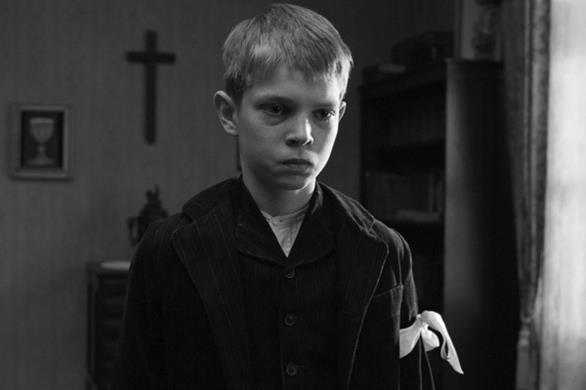
In terms of toying with the audience, this starts with the very title of the film. DAS WEISSE BAND or THE WHITE RIBBON is translated for non-German audiences, but the beautifully written sub-title isn't. Haneke claims that this is because the story should resonate for people whichever country they are from, rather than being read as a particularly German fable, but then why have the sub-title there at all, untranslated and provocative. The games continue with the first image of the film, shot in pristine black-and-white. This serves as a distancing device that panders to our images of the early twentieth century, in black and white photos. The distancing also comes through the employment of a voice-over from one of the characters in the film, who admits in the first line of the film that he can't be sure that he's remembering events correctly after all this time. In other words, nothing we are to see can be taken at face value.

The tale that unravels is certainly concerned with sexual violence and cruelty. It is set in a North German town in the year before World War One, but could easily be depicting a world from centuries before. The town is oppressed financially, under the feudal system under the Baron, and by the fierce religious morality enforced by the town priest. A young boy is forced to wear a white ribbon to remind him of the purity to which he should aspire. But more violently, each night his hands are tied to the side of the bed by his pastor-father to stop him from masturbating. Naturally, this being Haneke, superficial rigid morality disguises physical and moral corruption - incest, murder, arson, theft, adultery. Adults brainwash children, but act like wilfully, as children. Children are either presented as cherubic paragons of virtue or as sinister and in mobs. For every scene that is heartbreakingly beautiful there is a scene that is perverse and frightening.

There is no doubt that DAS WEISSE BAND is a great, beautiful, challenging, multi-faceted film. You can watch it for the sheer joy of the composition of the photography, or for the tense portrayal of an oppressed society. No doubt some will watch it, reductively, as a story of how the generation who became Nazis was formed. But this movie is much richer, and more applicable, than that.

THE WHITE RIBBON played Cannes, where it won the FIPRESCI prize and the Palme d'Or, and Toronto 2009. It was released in September in Germany and Austria. It is currently on release in Belgium and France and opens next week in Greece and Italy. It opens in the UK on November 13th, in the Netherlands on November 19th, in Sweden on December 11th, in Norway on December 26th, in the USA on December 30th and in Russia on January 12th.

Kamis, 03 September 2009

Pantheon movie of the month - ERASERHEAD

David Lynch - master of surreal suburban horror. Things that seemed egregious and silly to reviewers of his first feature back in 1977 (check out the dismissive, excoriating review in VARIETY) now seem like early examples of style and themes that have been consistently mined over his career. To my shame, I hadn't seen ERASERHEAD until yesterday despite being a hard-core Lynch fan. (Two weeks ago, some friends and I did a Twin Peaks Series 1 marathon - Series 2 is next weekend).

What shocked me was how much now-classic Lynchian tropes were present in ERASERHEAD and how, even in his first film, he managed to find a perfect balance between beauty and horror. Take the haunting song sung by the deformed Lady in the Radiator. It's as beautiful as the song Donna and Maddie sing with James in Twin Peaks but far more unsettling. Even the design is similar to later works - little things like the pattern on the floor, or the style of dress.

The plot sees a repressed man with iconically frizzy hair father a deformed child, perhaps the result of the machinations of the Man in the Planet. The mother leaves him, unable to cope with the child's mournful crying. The father is plagued with nightmares in which his severed head is sold to a pencil company to be used as erasers. He has an affair with the Beautiful Girl Across the Hall, who then cuckolds him. In a fit of pique, the father unwraps the swaddling bandages of his baby, only to find that they are part of the baby's flesh. In an electrical storm, he is transported to another place with the Lady in the Radiator.

It's pointless to try and lay down what all this means. Far better to linger on the nightmarish, Freudian images of a father threatened by his own offspring - visions of impotence - the dread of suburban family existence - the possibility of spiritual salvation.

This movie is source-gold for Lynchians, and I suspect, more annoying to non-Lynchians, than anything else in his oeuvre. It's obscure, but in a manner that provokes emotional, visceral responses, as opposed to the more opaque, and frustrating INLAND EMPIRE. It has been referenced by tens of films, its music has been covered by many a band, and it was reputedly one of Kubrick's favourite films. It prompted the offer to direct ELEPHANT MAN and also, rather bizarrely RETURN OF THE JEDI. You can see a lot in ERASERHEAD, but I'm not sure whether you can see anything to make you think of cute cuddly Ewoks.

ERASERHEAD was released in 1977, after a five-year, cash-constrained shoot.

Kamis, 23 Juli 2009

SHINE A LIGHT - I just don't get it

Bad joke - what do The Rolling Stones and Martin Scorsese have in common? They both did all their best work before I was born. And, let me be clear, I'm not that young. As if in testament to the sheer ludicrousness of the Rolling Stones' continuing concert career, Scorsese inter-cuts this vanity project/concert movie with vintage TV interviews with the younger Stones, musing on how long their careers with last. And in an effort to make their music seem relevant to the Kidz we also have Christina Aguilera and Jack White guesting on a couple of songs. The resulting film is presumably a must-see for Stones fans but left me cold. It's just a tragic continuation of the failed 1960s radical project. Here we have counter-culture icons, continuing to milk that iconography for their audience - who have themselves grown-up and sold out. The Rolling Stones wait around to shake the hand of Bill Clinton's mother-in-law. Give me a break. Martin Scorsese parodies himself with an unnecessary closing tracking shot. The whole thing reeks of crass commercialisation.

SHINE A LIGHT opened Berlin 2008 and was released in Spring 2008.
 

reiview movies and books Copyright © 2012 -- Powered by Blogger