"We are all one trade from humility." Marv, WALL STREET.
WALL STREET (1987) - a movie that vocalised the mood of the time; gave birth to the world's greatest greedy capitalist bastard; and sent a population cohort into investment banking - that same cohort that by and large caused the global financial cluster-fuck whose ill effects we are still grappling with. A movie with a simple narrative; strong characters; and an innocence, almost, in retrospect, about what it was doing. Because make no mistake, WALL STREET, exposed something nasty and cut-throat, but oh so tempting, that was taking over corporate America.
Jump forward twenty years, and the world is a very, very different place. No disrespect to my mother, but even she can tell you why the credit crunch happened and has an opinion on the government sponsored bank bail-outs. Economic commentators from Nouriel Roubini to Gillian Tett have made reputations and fortunes explaining this crisis to the Ordinaries who are going to have to pay for it, maybe for the rest of their tax-paying lives. Bankers - their lifestyles, their economic power, their slippery ability to get a bail-out AND a bonus, still, still! - are out in the open. Even hedge fund managers have been exposed. And righteous anger runs forth.
Pity then, poor Oliver Stone, trying to bring a script to screen in a period when reality was over-taking even the most scandalous fictional depiction of high finance. A period, moreover, where every new book release - every new Rolling Stone magazine article - was beating him to the punch in exposing the corruption, greed and excess that led us to this Fall. By the time we got to Cannes 2010, what else was left to say? Was there, in short, an appetite, to see and be dazzled by the titans of finance when we were left in negative equity if we were lucky, and unemployed if we weren't? WALL STREET could surprise us, and tell us something we didn't know. WALL STREET 2 feels like a re-hash.
In short, WALL STREET: MONEY NEVER SLEEPS feels like a movie over-taken by events - a movie without a concrete idea of itself - without a clear idea of what it wants to say and what it wants to be.
But before we get to why it's such a mess - let's lay out its basic structure, post Cannes-2010-edits. (Spoilers follow.)
The movie plays in four acts. The first act sees a crypto-Lehman collapse, when the New York Fed, advised by the heads of her competitor banks, refuse to bail her out. As a consequence, the head of crypto-Lehmans (Frank Langella) tops himself, much to the horror of his mentee, a young energy prop trader called Jake Moore (Shia LaBeouf). Jake is prompted to propose to his girlfriend Winnie Gekko (Carey Mulligan), estranged daughter of Gordon Gekko (Michael Douglas), and in doing so, starts meeting Gordon on the sly.
In Act Two, there is little evidence YET of the fallout from the Lehman collapse - the jewellery still glitters as the money is still there. Jake is corrupted both by Gordon Gekko and his business enemy Bretton James (Josh Brolin), CEO of a crypto-Goldman Sachs. Jake brokers a reunion with Winnie in exchange for Gordon dishing the dirt on who let crypto-Lehmans fail - and uses that info. to screw over Bretton James on a trade. Such is the fucked up value system of Wall Street that James reacts by offering Jake a job.
In Act Three, the corruption goes further. The systemic financial collapse is in full effect. Crypto-GS is suffering, as is Jake's mother - a nurse turned realtor. Jake's corruption continues - he connives with Gordon to free up Winnie's $100m trust fund, thinking he'll invest it in clean-tech. Gordon, being Gordon, takes the money to London, opens a hedge fund, and makes a cool billion. Winnie, pissed off with Jake for being suckered by her dad, dumps him.
In Act Four, Jake, not learning, again tries to trade with Gekko - access to his grandson against giving the money back. Gekko being Gekko says no. And then, in what one can only assume to be a tacked on post-Cannes 2010 ending, Gekko has a last minute change of heart, gives back the money, and plays happy family with his kid and grandkid. Meanwhile, Bretton James has been exposed as trading on his own account against the bets of his clients, getting him sacked from crypto-GS and indicted by the SEC.
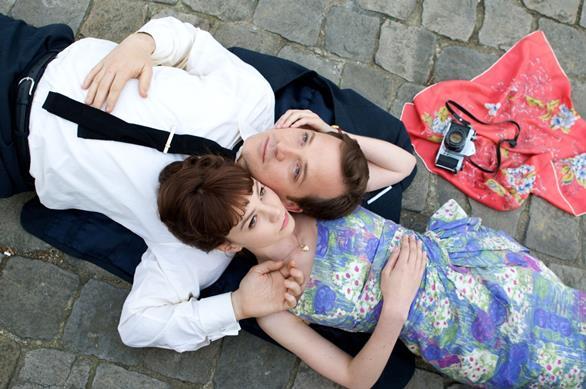
So what's really going on here? There are four strands to the story. Strand number one is a romance. A guy, with partially good intentions, lies to his girlfriend, is found out, loses her, but is forgiven. This strand really doesn't work. Shia LaBeouf doesn't have the emotional range, and poor Carey Mulligan is given nothing to do by the script other than look tearful. We're meant to think Jake is basically a good kid, but what kind of arsehole tries to trade money for pictures of his unborn child's ultrasound. Horribly misjudged. Utterly unconvincing.
The second strand of the story is a revenge thriller. This could've been great but is crowded out by all the other crap in the film. Revenge part one sees a young trader punk a slippery CEO. This really works, is thrilling and well explained. Revenge part two sees Gekko use Jake to expose Bretton James. This could've worked - it could've been the dramatic heart of the film - but it isn't given a chance. Truly, Josh Brolin's Bretton James - deeply good-looking and even more attractive when dripping with power - is as charismatic as Gekko ever was. But they have no real screen-time together. What we really needed was a show-down scene, but the skinny idiot Jake is always used as the go-between, undermining the power of the whole thing.
The third strand of the story is a coming-of-age drama. This should've been Jake Moore's story. He should've gone through shit and come out of it with self-knowledge - just like Bud Foxx in the original movie. But of course he doesn't, because there are no consequences to what he does. He screws up time and again, but is forgiven. He doesn't even serve time for the original market manipulation in Revenge Part One. Where is the scene with Jake Moore crying in the rain in Central Park? It gets worse. Not only does WALL STREET 2 refuse to let Jake Moore learn from his mistakes, but it even retro-fits Bud Foxx's narrative arc. Rather than serve time, come out and do something useful with his life, we see him in a cameo in the sequel, a self-made billionaire, dripping with hot chicks and as morally vacuous as ever. But it gets even worse than this. Jake Moore and Bud Foxx should've been changed by their experiences in the film, but Gordon Gekko shouldn't have been. Gekko does what he does because he can do no other - that is his tragedy. By tacking on a last minute emotional U-turn, the movie betrays Gekko and assumes the audience are a bunch of idiots who are going to buy it.
The fourth strand of the movie is a fictional recreation of real events. This is where the movie both succeeds and fails most. To its credit, WALL STREET 2 creates some amazing set pieces surrounding the collapse of Lehman Brothers and the creation of the TARP bail-outs. Set in the New York Fed, with a room full of bank CEOs and a crypto-Paulson and Geithner, we get a real sense of the panic and time-pressure involved in taking these momentous decisions typically over the course of a weekend to pre-empt the markets. The slippery reasoning, the desperation, the brutality of the survival instinct - it's all there. Frankly, I would've paid good money just to see Oliver Stone take us through a fictional recreation of these real events, without all the romantic, personal crap in this film. In particular, you have to love Eli Wallach as a crypto-GS founder, with his ruthless survival instinct and enigmatic whistle.
But it's also in its attempt to chronicle a period that WALL STREET 2 fails. And this is perhaps nobody's fault - insofar as the screenwriters were trying to hit a moving target. Still, all that aside, I can't help but think that the screenwriters made a fundamental mistake in trying to anchor their story in a long-term vendetta between Bretton James and Gordon Gekko that's basically about exposing insider trading. The whole point of the current crisis is that it wasn't by and large about illegal trades. Kerviel, Madoff etc are not actually the point. The real point is that these bankers weren't actually doing anything wrong, legally speaking. They were acting in a loosely regulated system, with perverse incentives, enabled by cheap central bank credit, and they ran riot. If this story were about a single rogue trader we simply wouldn't be in the global meltdown we're in. So to try to pin it on something personal, something basically quite petty, like trading on one's own account, is to basically miss the point.
Just as the genius of WALL STREET is best seen in the seminal keynote speech by Gordon Gekko, the failures of WALL STREET: MONEY NEVER SLEEPS are best expressed in the new keynote speech by Gordon Gekko. The big speech - far from being prescient and persuasive as in the first film - sounds old-hat and banal in the second. There are no witty one-liners - no startling sucker-punches. I can't remember a single line that stood out. In fact, the best one-liner that sums up the current situation comes from the FIRST movie, and is quoted at the head of this review. There is no feeling that we are seeing fundamental truths exposed and taboos broken. Worst of all, as if in embarrassment at the poverty of the content, Stone directs the scene like a kid with ADD. It's all jump cuts and shifting camera angles - hardly a sentence is completed. Poor, poor, poor.
In fact, Stone's direction in general is pretty poor. There are too many editing visual tricks - especially in the many mobile phone conversations - and cheap effects. Take for example a scene in which the camera rapidly moves down the length of a sky scraper as we here the sound effect of a ball in a roulette wheel - supposedly to symbolise the market crash. Crude. And perhaps most unforgivable is that Stone breaks the fourth wall. By that, I don't mean that he has the characters speaking to the audience face-on. But he does something stylistically as jarring. He acknowledges, within the world of the film, just how iconic the original movie has become. In other words, he induldges in cameos that serve no purpose other than to show how desperate celebrities are to be associated with the world of WALL STREET. So we get Warren Buffett, Graydon Carter, Jim Cramer, Nouriel Roubini, and a host of CNBC anchors playing along, winking at the audience, and worst of all, that Bud Foxx redux. This all smacks of not taking the project, and the audience, seriously.
WALL STREET: MONEY NEVER SLEEPS is on global release.
 0
komentar
0
komentar

 It should be clear by now that I am full of admiration for this bold, brave, painful movie. Fassbender once again displays his complete courage and Steve McQueen his ability to use visuals and silence to create scenes of quiet power. But perhaps the biggest revelation was Carey Mulligan, who takes on an extremely challenging role - exposing herself physically and emotionally - and is utterly convincing. Admittedly, SHAME is in some respects less pure than HUNGER, given that it plays with a wider cast of characters and a less austere colour palette. But what it looses in purity and visceral power it makes up in its deep humanity.