Tampilkan postingan dengan label France. Tampilkan semua postingan

Sabtu, 22 Oktober 2011

London Film Fest 2011 Day 10 - GUILTY - Guest review by George Ghon

Philippe Torreton stars in Vincent Garenq's docudrama, GUILTY.


This review has been provided by George Ghon, stylist, writer, editor and friend of the blog. 

Early one morning in 2001, when it was still dark, the police came knocking on the door of Alain Marécaux, a successful bailiff. Without much explanation they searched the house, separated him from his wife and three children and put him in custody. What followed was a biased police interrogation; information embargo; and no contact with the world outside the prison walls - a nightmare trip for Mr Marécaux, who was accused of child molestation, a crime he always strictly denied committing. Asserting his innocence, and the conspicuous lack of hard evidence supporting the arrest, did not stop the legal machine from rolling in the wrong direction, in turn causing one of the biggest judicial errors in French history. 

Director Vincent Garenq turned the true story, based on Alain Marécaux’ memoirs, into a docu-drama that stays close to the facts, but provides a subjective angle on the case, following the lead actor (Philippe Torreton) from start to end. Information is dispensed only scarcely, making the claustrophobic lack of it a viewing experience, too. Garenq puts us through the same process of indignation that Marécaux must have gone through at the time of his arrest. ‘I wanted to keep the anger that I felt when I read the book’ the director said during a Q&A session. He didn’t make an objective study of the Outreau affair that Marécaux was part of, but zoomed in on his take of it, and shows the disastrous implications that the judicial system can have on the citizen’s life when it steers off its correct path. 

After going through several suicide attempts, a body wrecking hunger strike, and desperately appealing to the justice minister himself, Marécaux was eventually acquitted in 2004, but the case left a stain on a nation that prouds itself being built on the republican values liberté, égalité & fraternité. In 2006, a special parliamentary enquiry looked into the case, after president Jacques Chirac called the affair a ‘judicial disaster’, but the commission hardly acknowledged any erroneous behaviour within the judiciary corps. In 2009, finally, the Conseil Supérieur de la Magistrature issued a reprimand for the judge Burgaud, a minor penalty, which he, in turn, appealed. The case reveals how stubbornly one-directional the bureaucracy apparatus can work in so called advanced western democracies. Not one of all the magistrates involved in the case dared to reassess the initial judgement lacking any solid evidence in a fleeting spell of individual brain activity. Besides, it wasn’t only laziness or intellectual inertia that caused the magistrates to lose their objective eye. 

Europe was shocked by the Dutroux case in Belgium, where girls got abducted, sexually abused in a dungeon, later drugged and eventually killed. The general policy, quite understandably, was to go hard on child molesters. Police officers, magistrates, psychologists, prosecutors and judges became biased, so much so that they evidently lost their sense of good judgement. All this shows the Janus-faced correlation between a moral codex, of what we deem to be right or wrong, and the judiciary system in a civil state, which is based on equal rights. The former is necessarily subjective and demands an individual assessment of the situation according to the values of the society we live in. The latter, however, needs to be unambiguously bound to the law. In other words, it requires the inhuman objectivity of a system that does not deem an individual guilty before proof of his wrongdoing has been found in order to safeguard the pole of humanity where the European flag is hoisted. 

Garenq’s GUILTY is an eye opener for Europeans who tend to proud themselves for their moral superiority. It also staggeringly unveils how an all too human emotion that abhors child molestation can bias a supposedly fair legal framework and torques the objectivity of the law. 

GUILTY opened in France in September and played Toronto and London. It was released earlier this year in France.

Kamis, 20 Oktober 2011

London Film Fest Day 2011 Day 8 - REBELLION

French writer-actor-director Matthieu Kassovitz (LA HAINE) returns to his French art-house roots with an uncompromising political docu-drama based on the Ouvea hostage crisis of 1988. The action takes place in the French overseas territory, New Caledonia, where a group of amateur freedom-fighters had taken a bunch of French policeman hostage, hoping to win independence for the Kanaks. The resolution should've been straightforward - send in the police force's GIGN negotiators and get the hostages out. But the situation was complicated by the fact that the crisis took place in the middle of the French Presidential election - a fight between the incumbent President Mitterand, a a left-wing advocate for negotiation and compromise - and the incumbent Prime Minister Chirac, a right-wing advocate of armed intervention and restoring "l'ordre et la morale" - the Order and Morality of the movie's French title. Thus the central conflict is established. The police are put under the authority of the army - the stakes escalate - a massive attack is launched - and many hostage takers executed and their leader left for dead. (No spoilers here, for even if you hadn't been aware of the events, as I hadn't been, the final tragedy is established in the opening shots.)


Kassovitz chooses to tell the tale in a straightforward manner, moving through the events with a strict timeline, chronologically, moving between the hostages in Polynesia and the politicians in Paris. He also takes a single and definite position on events, both playing and sympathising with Capitaine Philippe Legorjus, the GIGN negotiator hamstrung by politics and gung-ho army officers. Kassovitz is firmly on the side of the liberals, seeing the attack on the hostage takers as clumsy, the violence unjustified, and the results as a scandal. Stylistically, the movie is similarly straightforward - the only innovation a very elegant and subtle flashback scene where a hostage explains to Philippe how the initial kidnapping took place. 

All that seeming straightforwardness should not detract from the genuine power of the film. It was utterly compelling - had me on the edge of my seat - even though I had been forewarned of the conclusion. Even when it turns into a military thriller in the final segment, the movie never looses its profound concern with the politics of imperialism and the expediency forced by the electoral cycle. 

REBELLION played Toronto and London 2011 and opens in France on November 16th.

Selasa, 18 Oktober 2011

London Film Fest 2011 Day 7 - THE ARTIST

Jean Dujardin and Berenice Bejo, the stars of
THE ARTIST, at the UK premiere at the
BFI London Film Festival 2011.


Michael Hazanavicius’ charming silent movie about the end of silent movie-making stars Bérénice Bejo and Jean Dujardin (of the recent secret-agent spoofs OSS 117) as actors Peppy Miller and George Valentin, who fall in love against the dreamy backdrop of an early golden-age Hollywood. When the talkies take off, George, the go-to man of the silent picture, finds himself outcast by a determined and winning Peppy, a role in which Bejo dazzles, and where THE ARTIST might have kept up with her singular energy it slows to the nostalgic time spent by George in relative poverty and obscurity. Nonetheless, Dujardin's performance remains a broad and irresistible focus, and there may be no modern leading man better suited to the demands of the silent movie genre. Rare in any case does it seem to enjoy watching actors watching themselves on screen.

THE ARTIST played Cannes, where Jean Dujardin won Best Actor; Toronto and London 2011. It is on release in France. It opens in the US on November 23rd; in Italy on December 9th; in Spain on December 16th; in Greece on December 22nd; in Germany on January 26th and in Hong Kong on February 9th.


Minggu, 16 Oktober 2011

London Film Fest 2011 Day 5 - TALES OF THE NIGHT / LES CONTES DE LA NUIT


In the cynical world of commercial cinema, there is something heartening and wonderful about the French animator Michel Ocelot.  He creates films of such vivid colour, beautiful design, and delicate style that you can't help but admire them.  And even better, he sees himself as an entertainer in the most old-fashioned sense. He simply wants to give us, the audience, pleasure, and can see no better way than by using the ancient fairy-tales from around the world that have held us captivated for centuries.  Ocelot's latest film is not a single-story feature, in the manner of KIRIKOU AND THE SORCERER or AZUR ET ASMAR, but a compendium of six short stories, each set in a different mythical land - from Africa, to Aztec temples, to the Himalayas, to the medieval Europe of the Brothers Grimm. His tales are filled with princes and princesses, young lovers who conquer evil, magic necklaces and tom-toms, werewolves and evil dragons.  The style is like something out of a magic lantern show projected onto colourful, richly textured tapestries - a style that feels perfectly suited to the 3D in which the film is presented. I found the movie to be an absolute delight.  Never simple-minded, but containing an economy of design and a simplicity, maybe purity, of purpose that was refreshing and delightful.  And judging by the young audience, many too young to read the subtitles and certainly too young to understand the French, once again Ocelot has created a film in which the images are so powerful and delightful that they can communicate clearly and entertain regardless.

TALES OF THE NIGHT / LES CONTES DE LA NUIT played Berlin, Sitges and London 2011. It was released in France in July 2011.

Rabu, 15 Desember 2010

Random DVD Round-Up 2 - HEARTBREAKER


French TV director Pascal Chaumeil makes his big-screen debut with the commercial hit, HEARTBREAKER. It's a whimsical romantic-comedy starring Romain Duris (THE BEAT MY HEART SKIPPED) and Vanessa Paradis (er...Chanel ads?). Penned by Laurent Zeitoun, Jeremy Doner and Yohan Gromb, the plot is driven by a conceit that is so palpably stupid that the film never really recovers from it. Duris plays Alex - a man who is hired by the friends and family of women who are stuck in awful relationships but can't see it. He comes along, charms them, and they, realising how crummy their current boyfriends are, dump them. Problem is that in this particular set-up, Vanessa Paradis' Juliette boyfriend Jonathan (Andrew Lincoln) isn't actually crummy. In fact, he seems to be genuinely in love with Juliette and vice versa. So, if Alex hadn't come along with his Patrick Swayze dance moves, all would've been well. This is a major problem for a romantic-comedy where we're meant to be rooting for a couple to get together.

The humour is sporadic, sometimes plain weird and lazy. The caper aspects - how the heartbreaker team set up the meet-cutes - are just silly. And call me pragmatic, but I was wondering why, if you had such good IT and general spy skills, you wouldn't be using them for something more lucrative and impactful. There's some attempted humour at the expense of Juliette's nympho best friend, but that seems discordant when the tone the director is trying to go for with the main plot is one of whimsical romance. And then, of course, there's the idea that Alex and Juliette fall in love over a shared passion for the film DIRTY DANCING. This could've been tremendous, but I found the pivotal dance scene somehow lacking in spark and fun. Romain Duris seemed to be putting his all into the role, but Paradis seemed rather cold and disengaged. That is, to be sure, part of her character, especially in the early scenes, but we should've seen more of a progression.

Overall, the film struck me a laughably silly but never so silly as to make me laugh. It looks like a hundred minute commercial for Monaco and has very little merit other than that. God help us for the remake. I predict some piss-poor Gerard Butler-Katherine Heigl set-up.

HEARTBREAKER opened in summer 2010 and is available on DVD and on iTunes.

Random DVD round-up 1 - LEAVING

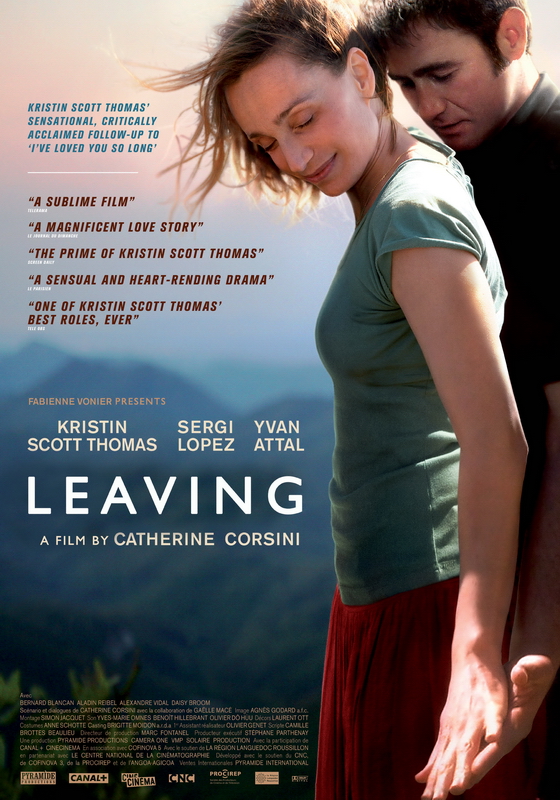
Kristin Scott Thomas has a cool hard beauty that has seen her cast in many a film as, well, a cool hard beauty - emotionally repressed and stolidly dutiful. How wonderful then to see her madly, wide-smilingly in love - almost fey.

In Catherine Corsini's LEAVING, Scott Thomas plays Suzanne, a middle-aged middle-class woman married to a financially successful medic and living in a beautiful house. She is rather taken for granted by her husband (Yvan Attal) and kids, and is trying to reclaim her career as a physiotherapist. She is, in many ways, wandering through life on auto-pilot with occasional outbursts where the rage erupts - as in the powerful opening scene. Suzanne's life changes when she meets and pursues a Spanish builder called Ivan (Sergi López). Their attraction is physical - for sure - but not as singularly as her husband tries to portray it. She isn't just a middle-aged woman who has discovered sex but rather, as in Lady Chatterly's Lover - a kind of freedom and self-knowledge. The second half of the film sees the erotic character study move into a sort of procedural thriller as the two lovers are forced to live cut off from the husband's money and Suzanne's children. The surprise is that it isn't Ivan who drives the narrative - neither as seducer nor as breadwinner. Pretty soon Suzanne's girlie happiness turns into a more brutal, steely survival instinct.

By putting Suzanne firmly at the centre of the film, writers Catherine Corsini and Gaëlle Macé have given Kristin Scott Thomnas a role of the kind that is rarely seen in cinema. A middle-aged woman is allowed to be multi-faceted and the driving force of the action and emotional content of the film. Scott Thomas is completely up to the task and this is further evidence of an actress at the top of her game. I also appreciate that Corsini doesn't feel the need to spin this movie out beyond a 80 minute run-time. Too many films nowadays are unnecessarily baggy. But, there is a big problem with this film - and that's the final act. The closing action is too predictable, too crude relative to what has come before, and the final scenes over the end credits, while presumably trying to be ambiguous seem rather off-tone.

LEAVING played London and Toronto 2009 and was released last year in Belgium, France, the Netherlands, Spain and Brazil. It was released earlier this year in Germany, Italy, Portugal, the UK, Argentina, Denmark, Sweden and the US.

Minggu, 05 Desember 2010

Late review - London Film Fest 2010 - HORS LA LOI / OUTSIDE THE LAW


This review is brought to you by guest reviewer, Alex:

Director Rachid Bouchareb’s story of a family of Algerian immigrants to France and their lives from 1945 to 1962 has been likened to “The Godfather” or “Once Upon A Time in America”. Like the excellent “La Haine” which touched on the same themes, the movie provoked protests and high security when it played the Cannes film festival and right-wing French politicians labelled it historically revisionist and "anti-French".

Bouchareb’s previous Oscar-nominated 2006 movie “Days of Glory” shamed the French government into supporting Algerian veterans who fought for the French state against the Nazis in World War Two. “Outside The Law” reunites many of the previous film’s cast. Brutal, real and enjoyable, “Days of Glory” had me slavering at the chops for more. After all, a well-made action movie with a social message is the best of both worlds – the equivalent of Saturday night in the pub and early Sunday morning mass rolled into one. Sadly, I was disappointed.

“Outside The Law” limps prosaically through over two hours chronicling the brothers varied involvements in the cause of the arm of the FLN, a terrorist group whose premise was to campaign for Algerian independence, from within French borders. One leads it, asserting control first over the organisation’s French chapter and then over rival groups, the other, a veteran of the doomed Indochinese war, is the violent facilitator of the FLNs’ ends, and the last distances himself from the group until forced to participate.

The irony of this premise is little explored, except in the film’s intellectual denouement when arch-nemesis police inspector Colonel Faivre (Bernard Blancan) is forced under duress to meet with our boys in a posh Parisian in private club. Abdelkader’s comparison, and the ironic synchronicity, of his own political and armed struggle for Algerian freedom with the Colonel’s previous decoration for his role in the French Resistance to Vichy regime is well-made.

Bouchareb has used the family tale as metaphor for French immigrant experience; represented by brothers Abdelkader (Sami Bouajila), educated and politicised; Roschdy Zem as Messaoud, the brutal bag-man and assassin, and Jamel Debbouze (of “Amelie”) as Saïd who is amoral, entrepreneurial and secular. Stoic and grim, the boys’ mother (Chafia Boudraa) is the patriotic conscience and maintains the family’s religious and traditional practices; she is also the most vibrant of the female cast members, although that’s not saying much. Messaoud’s wife is dutiful and introverted and Sabrina Seyvecou as Hélène, a white French sympathiser and financier to the FLN cause is anaemic and obsessed with unfulfilled desire for Abdelkader. His rejection of her advances in favour of total devotion to the cause is clumsily portrayed and represents a token attempt at character development.

Better handled is the conflict played out between the brothers. Saïd’s dream of creating the first French boxing champ of Algerian origin, representing ideas of assimilation, is opposed by the very real threats he faces from his ideologically torn brothers who see his fighter as a courtesan of the despised French state. Given that we already know how violent the group’s measures can be, how far will they go to stop the fight, we wonder?

Action scenes such as the opening recreation of the infamous Sétif massacre in 1945 were well made (Bouchareb admits he was trying to create "a sort of western") but the plot develops falteringly and there’s a sense that in trying to popularise the movie beyond its natural audience, an action scene has been added every so often to cattle prod us awake again between the characters’ soap opera-like vacillations.

Telling the story of a 20th century conflict from the underdog (and ultimately winning) perspective is undoubtedly a rich, unmined cinematic vein; Vietnamese Bảo Ninh’s novel “The Sorrow of War” would be an interesting antidote to the abundance of Hollywood movies on the same topic. Arguably “Outside The Law” is another take, from a different angle, on the much better “Battle of Algiers”.

If Bouchareb wished to again provoke social change and political action he has succeeded. There is even some similarity in his film in this respect to Visconti’s “Rocco and his brothers”. If he wished to entertain, he has fallen short of the mark, but not failed entirely. Add to your Lovefilm rental queue but don’t pay good money to watch at the cinema.

HORS LA LOI / OUTSIDE THE LAW played Cannes, Toronto and London 2010 and opened in France, Switzerland and Belgium in September. It opened in the US in November.

Minggu, 28 November 2010

Late and incomplete review - London Film Fest 2010 Day 10 - FILM SOCIALISME


We are on a cruise ship. We are in contemporary Europe. We are at the End of Days. We are in Palestine. We are in politics. We are listening to Alain Badiou. We are listening to Patti Smith.  We are in hi-def DV. We are in lo-def pixelated DV. We are in hi-camp Hollywood. We are in present-day desolation. We are mashing up images from everything and everywhere.

So what is the point? That we live in a post-political society? That we decadent capitalist Europeans care nothing for the class-struggle? That we are beyond political redemption? That we are living in a culture mediated by iconic media images, unable to disentangle reality from fiction? That we are merely repeating /parroting media image rather than critically engaging with life? Does there have to be a point? Is the point that there is no point?

FILM SOCIALISME is the worst kind of pretentious, patronising, pseudo-intellectual bilge that claims to have something profound to say about politics and the nature of cinema, but in fact is nothing more than self-indulgent, adolescent nonsense. The fact that it was produced by Jean-Luc Godard, French auteur, means that reviewers have been generous, ascribing to it meaning and coherence and earnest intentions that it simply does not possess. His film is insulting to us as viewers - it holds us in contempt. It tells us that we are not worth narrative structure or coherent exposition because we are party to the contemporary culture it is condemning. At least, that is the most generous explanation I can give for a film that plays like a collage, a scrapbook, where Godard has pasted in scenes from past films, news-reels and other sources into a layered, incoherent mess. Godard basically holds up two fingers to his audience in the film. Indeed, it is perhaps one of the most hateful film I have seen in recent years. The correct response is to walk out. And that is exactly what I did.

Now, a lot of the film's fans are going to say that basically I am just admitting my own ignorance. That I'm not well versed enough in Godard's back catalogue, that I don't speak French, that I don't understand the philosophical and political movements he is engaging with. That, basically, I am a poor creature who can only feel safe in the warm embrace of mindless Hollywood genre-cinema. To them, I say, in the words Godard might've have used as a title to this film, baise-toi! I speak French, I've watched his films, I read philosophy at university, and I like tough cinema. But this film is a case of the Emperor's New Clothes. It reflects back the pretentions of the viewers and cinema-goers who love cinema, LOVE cinema, should fight back.

FILM SOCIALISME played Cannes, London and Toronto 2010. It was released in France in May 2010 and was released on DVD last month.

Minggu, 07 November 2010

Late review - THE ILLUSIONIST / L'ILLUSIONISTE - Will you still love a man out of time?


Sylvain Chomet is a wonderfully old-fashioned animator. He still draws his characters by hand, rather than using CGI. And he uses very little dialogue, relying instead on subtle suggestion and sight-gags. The result, in BELLEVILLE RENDEZ-VOUS, was a film full of whimsy, charm and real heart. Viewers looking for that same odd-ball humour in THE ILLUSIONIST will be wrong-footed, as I was. For THE ILLUSIONIST, while similar in technical style to BELLEVILLE, is quite different in tone. Whimsy and charm are replaced by a rather unrelentingly bleak and depressing feel, and while THE ILLUSIONIST is just 80 minutes long, it felt far longer because the material was tough and problematic.

The movie is based on a script written by the legendary French vaudevillian and film-star, Jacques Tati. Written in the late 50s, it is the script of a man painfully aware that modern culture - the creaton of the "teenager", pop idols and film-stars - was rendering Vaudeville a dying art. As M. Hulot, his supremely popular film alter-ego, Tati had shown an anachronistic man struggling to deal with modernity in a comic light. But in his script for THE ILLUSIONIST, he confronted the true tragedy of the Man Out Of Time. It is no surprise to me that Tati never filmed THE ILLUSIONIST. It is a film so full of bleak reality - so self-negating - that it feels more like a shadowy form of therapy than a realistic project. And so it fell to Sylvain Chomet to finally bring the film to screen.

THE ILLUSIONIST sees a M.Hulot magician called Tatischeff - Tati's real name - performing to small indifferent crowds in music halls now filled with teenagers screaming for pop music. He leaves Paris, and then London, in search of work, and finds himself in Mull and Iona. There, the locals are still enamoured of his tricks, although it's only a matter of time before he's obsolete there too: they applaud him, but the jukebox is being installed. So ends the pre-amble. The story really takes off when a teenage girl called Alice believes Tatischeff really is a magician, and follows him to Edinburgh. They take up together - he is perhaps trying to recreate a father-daughter relationship - and he desperately tries to maintain the illusion that he really is a magician. Tragically, the production of coins from behind her ear, or pretty dresses and shoes, requires real, degrading work that he hides from her. It is exhausting, ultimately unsatisfying, and cannot be sustained.

The film - in particular its ending - makes a number of key statements - all of which are bleak. First, vaudeville is dead:  the crowds that once laughed have discarded it and its artists most cruelly, with desperately tragic consequences. Second, vaudevillians gave happiness to others at a great price - the travelling deprived them of real personal relationships, and left them economically at the mercy of rapacious agents and fickle audiences. Third, that the illusions that once gave happiness can become a source of dangerous delusion, enabling a deeply damaging relationship. By the end of the film Tatischeff has realised this - all of this. Little Alice will have to struggle with these lessons after the film ends.

Maybe if I'd been better primed I would have liked THE ILLUSIONIST more. I love the idea of exploring tragedy through animation. But even if I had been warned, and as much I appreciate the intention of the film, I still found it deeply problematic. The relationship between Tatischeff and Alice seemed to me sinister. It wasn't clear to me that she really thought the money appeared my magic. Rather, that she was simply playing him for money. Was she really so self-involved that she couldn't see what it was costing him? And if he could really magic money for clothes and shoes why wouldn't he magic money for rent in a better lodgings? Alice is either stupid or conniving - either way - a gaping hole where empathy should be at the heart of the film. Or maybe that was intentional? Maybe Tati wanted to show that Alice was just another example of fickle youth screaming for pop? Hard to square this with Chomet's contention that Alice is a stand-in for Tati's real-life daughter Sophie. Stylistically, I also thought there were some mis-steps. I loved the attention to detail in recreating 1960s Edinburgh, but why break the beautifully hand-drawn world? There is a scene where Tatischeff releases his white rabbit into the wild and the camera lifts up and gives us a whirling panoramic aerial view of Edinburgh. It's stunning, but it feels very CGI and quite out of keeping with the rest of the film.

Overall, then, I found THE ILLUSIONIST to be a bleak, often dull, and problematic in terms of the central relationship, and occasionally the technique. A great disappointment, and greater still because the central ideas are so powerful.

THE ILLUSIONIST played Berlin, Telluride and Toronto 2010 and was released earlier this year in France, the Netherlands and the UK. It opens in Turkey on October 29th; in Italy on December 3rd; and in the USA on Christmas Day.

Sabtu, 30 Oktober 2010

Late review - London Film Fest 2010 Day 4 - CARLOS


CARLOS is a sprawling, intense five hour cine-spectacular biography of the cack-handed, vainglorious terrorist Ilich Ramirez Sanchez aka Carlos aka Carlos The Jackal. Written and directed by Olivier Assayas and originally broadcast as a three part mini-series on French TV, the film was shown in its original length, back to back at this year's London film fest.It is also being released in some countries as a three hour edited down movie. It features a charismatic central performance from Edgar Ramirez who, as Carlos, isn't just IN every frame, but dominates the film.

As the opens we see Carlos as a good-looking, womanising, politically motivated young man living in Paris, hiding weapons in the bedrooms of compliant girls. He moves into the big leagues when he persuades a Lebanese terrorist organisation (the PFLP) to bypass his immediate superior and make him their point-man. Flush with pride and power, he organises a raid on OPEC headquarters in Vienna. The first part of the film ends with the terrorists and their hostages on a plane desperately trying to find an Arab country that will give them permission to land. Carlos thought they would be feted as heroes, but turns out no-one wants to alienate the international community. He is embarrassed and angry, but shows his true colours - when the ultimate sacrifice is called for - he wants life, fame, girls, money - rather than a martyr's death. And so the pattern is set. He isn't a revolutionary. He's a bank robber - self-interested, petty, vain, eager for cash and respect. He hides out in Hungary, festering, brooding, drinking, fucking. He hides out in Sudan. He causes a few more ructions but never really pulls anything off. Basically, he's just a massive pain in the ass. And then, when the Berlin Wall came down, he was a flabby irrelevance, of interest only to Interpol and the vengeful French prison system.

The ironic truth of Carlos' life is established: as a terrorist he's both a failure and a success. In pure terms, he causes little damage - his missions are failures. But in terms of causing terror with his notoriety - he is a roaring success. And this is irony is perfectly portrayed by Edgar Ramirez - in one of the stand out performances of the year - he is everything Carlos is - charismatic, pitiable - good-looking, a physical mess - radical, bourgeois. It's a multi-faceted performance, enabled by the long run-time of the movie - a long run-time, by the way, that simply skips by. The movie is also beautifully directed by Assayas, and while it was financed by TV it really does look tremendous on the big screen. One can only assume that cinematographer Denis Lenoir (PARIS JE T'AIME, RIGHTEOUS KILL) shot the action sequences and that Yorick le Sau shot (I AM LOVE, JULIA) the beautiful vistas of Lebanon. At any rate, however, they sliced up the credits, the film looks beautiful.

There is a rule that states that if a movie is shown on TV anywhere before it's released at the cinema, it can't be eligible for the Oscars. This is a desperate shame because CARLOS would certainly be in the mix for Best Director and Best Actor. It's definitely worth checking out, and ideally in the long form.

CARLOS was shown on French TV in May 2010 and played Vancouver, Cannes and London 2010. It will be released in the UK as two feature films. It is also airing on the Sundance channel as a 3 part mini-series.

Senin, 25 Oktober 2010

London Film Fest 2010 Day 13 - THE SLEEPING BEAUTY


Following her previous film, BLUEBEARD, Catherine Breillat revisits the fairy-tale world with her latest film, THE SLEEPING BEAUTY. She twists strands of various fairy-tales into a whimsical, go-where-it-may story of a little girl fearlessly discovering love, becoming a teenager, and exploring her sexuality.

We start in an eighteenth century middle-European castle, with Princess Anastasia cursed in the cradle by a cackling witch to prick her finger and die. So far, so conventional. But the three good witches give her a new escape from her fate - Anastasia will fall asleep for a hundred years but she will do so at age 6 and awaken at 16, and while asleep she will dream marvellous adventures, because "nothing happens when you're a child". The movie thus sets up childhood as a period of latency and boredom until puberty awakens us to our sexuality. The first act of the film introduces us to Anastasia as six-year old fearsome child, who dreams of being a knight, hates frou-frou ballerina dresses, and brooks no opposition. Carla Besainou is absolutely charming in this role. As Anastasia falls asleep we move into Act Two. She journeys through a peasant world that takes on aspects of the story of the Ice Queen and of Alice in Wonderland and falls in love with a little boy called Peter. Once again, it is Carla Besainou's personality that captivates. In Act Three, Anastasia wakes up as a sixteen-year old girl, wearing a Victorian frock, but in present day France. She is courted by a teenage boy and emerges as a liberated young French girl with short hair and a short dress.

THE SLEEPING BEAUTY isn't as good as it should be. Sure, Catherine Breillat has imagination, and a willingness to put female emotion at the centre of the film, but where's the visual wonder of PAN'S LABRYNTH or the fluidity and surreality of Sally Potter's ORLANDO? And, most of all, where is the willingness to truly explore the danger and subversion at the heart of all fairy tales that we find in Neil Jordan's THE COMPANY OF WOLVES. Catherine Breillat's film simply isn't up to their high level in terms of the intellectual content or the visual style. It's fun as far as it goes, but essentially just a bit of low-budget whimsical fluff. There is, after all, a fine line between go-where-you-will whimsy and plain lack of discipline.

THE SLEEPING BEAUTY played Venice and Toronto 2010. It has no commercial release date.

Rabu, 20 Oktober 2010

London Film Fest 2010 Day 8 - MAMMUTH - Castigat Ridendo Mores


Typically you go to the London Film Fest and when you sit down to a French flick you get existential angst. But this year, with LITTLE WHITE LIES and MAMMUTH, I've had a wonderful, joyful time! After the hard-core psycho-drama of WOMB it was marvellous to watch MAMMUTH - with its warm colours, gonzo style DV photography, hilarious physical comedy, and ultimately uplifting sentiment. Gerard Depardieu plays a complete fuckwit called Serge Pilardosse - he's physically clumsy; sports a mullet that Mickey Rourke in THE WRESTLER would be proud of; basically, he's a walking disaster zone. Dumped into retirement, he realises that, like many working class people, he doesn't have enough money for retirement. So starts a sort of motorcycle road trip in which he tries to gather up the necessary paperwork from his seven previous casual jobs in order to qualify for a state pension. The road trip allows writer-directors Benoît Delépine and Gustave de Kervem to examine the basic injustice of an economic system in which you can work hard your whole life in blue collar jobs but still basically have nothing to show for it. But this social critique is explored with the lightest of touches and with so much good humour! Any film that can show a scene of mutual masturbation that seems utterly cute and sweet (not to mention recalling NOVOCENTO) deserves credit. And any movie that can use the device of a crash-victim (Isabelle Adjani) haunting the driver and not seem hammy also deserves credit. Depardieu excels at this kind of physical humour - and his final scenes are truly inspirational. But it's Yolande Moreau, as his long-suffering wife, who truly steals the picture with her hilarious turn dealing with automated call centres, and vengeful attitude toward the woman who stole her phone. In addition, we get a great little cameo from the evidently mental Miss Ming. What else can I say? This is a movie with a lot of heart, a good message, some first-class swearing, physical comedy and a joyous ending. Parfait!

MAMMUTH played Berlin 2010 and was released earlier this year in France, Belgium, Germany and Austria.

Senin, 18 Oktober 2010

London Film Fest 2010 Day 6 - THE PRINCESS OF MONTPENSIER


Lifeless French costume drama set at the same time as LA REINE MARGOT and suffering by comparison with that passionate, violent film. Melanie Thierry is decorous but banal as the Princess, married off to her dull cousin Montpensier, rather than the man she loves, wily, manipulative Henri de Guise. Left alone in a rustic castle she inspires the love of wise, gentle Huguenot, the Comte de Chabannes, but it's hard to see why. And then when the Duc d'Anjou, heir to the French throne pops by, he also falls for her. Sent to Court, we then get the Princess attracting the admiration and jealousy of her husband, Chabonnes, Anjou and Guise - at the same time. I kid you not, but there are messages given to the wrong man behind the mask, and a lot of hiding on staircases for a man who never comes. People get pissed off, lovers recoil, and it all runs out of steam long before it ends. This film lacks any passion, spark of sense of stakes. Which is amazing when you consider that we have Catherine de Medicis as a character and the St Bartholomew's Day massacre as an event. Altogether, this movie feels less like a costume drama/romance and more like a lo-fi soap opera. Dull, dull, dull.

Additional tags: Bruno de Keyzer, Melanie Thierry, Raphaël Personnaz, Bertrand Tavernier, Francois-Olivier Rousseau, Jean Cosmos.

THE PRINCESS OF MONTPENSIER played Cannes 2010 and was released earlier this year in Greece. It will be released in France on November 3rd.

Sabtu, 16 Oktober 2010

London Film Fest 2010 Day 4 - LITTLE WHITE LIES / LES PETITS MOUCHOIRS


LITTLE WHITE LIES is a superb film from French writer/actor/director Guillaume Canet (TELL NO ONE.) It is laugh-out-loud funny; wryly observed and reduced me to tears. What more could one want?

In a bravura opening sequence, Ludo (the beautiful, hilarious Jean DuJardin) is horrifically injured in a motorcycle crash. We watch his close friends gather at the hospital, distraught, but convincing themselves that they should still take their summer holiday in Bordeaux. After all, Ludo is in intensive care, and they can do nothing for him. It's a marvelous scene and reminded me of Austen's opening in Sense and Sensibility where Mr and Mrs Dashwood reason their relatives out of a bequest, all the time reassuring themselves that they are doing what duty requires of them. The friends then proceed to Max and Veronique beautiful summer home, where their neuroses, romantic entanglements and narcissism will be exposed. Francois Cluzet is absolutely superb playing the stressed-out, up-tight successful businessmen, ruining his and everyone else’s holiday with his strict schedules and castigation of his staff. But Max has another reason to be stressed out – his long-time, very married, friend Vincent (Benoît Magimel) has told him he’s in love with him! Poor Vincent’s wife, Isavelle (Pascale Arbillot) has no idea, other than that her husband would rather binge on chocolate than sleep with her. And then there’s Marie (Marion Cotillard), a beautiful woman who may or may not be in love with the injured Ludo, but is also being stalked by a soft-hearted musician, who turns up unexpectedly at the house with a guitar and an atmosphere of awkwardness. And finally we have two single men - Éric (Gilles Lellouche) and Antoine (Laurent Lafitte) – the former denying he is in love, the latter desperately, delusionally, boringly so. All of this emotional indulgence is played out in sharp contrast to Jean-Louis (Joël Dupuch) – the proprietor of a local beach-side restaurant who has to listen to all these characters whining, all the time fulfilling their expectation of him to play the role of jovial provincial host.

LITTLE WHITE LIES is a long film that doesn’t feel long, because we’re immersed into the emotional lives of a large cast of characters, all of whom are slightly eccentric and yet very much rooted in real life. Maybe it’s the kind of people I hang out with, or the fact that I’m much the same age as many of these characters, but it felt as if Guillaume Canet had perfectly captured the way in which an old bunch of friends interact. I found myself laughing with them, rather than at them, willing them to succeed in their romantic games, and moved to tears by their tragedies. I left the cinema feeling like I’d had an emotional work-out but also sad to be leaving their company. And that, I think, is pretty much the best praise one can give a film – when it immerses you in a world that feels authentic and makes you glad to spend time there.

LITTLE WHITE LIES played Toronto 2010 and goes on release in France and Belgium on October 20th.

Senin, 06 September 2010

CERTIFIED COPY - A noble failure


Reknowned Iranian auteur, Abbas Kiarostami, has made his first non-Farsi feature, CERTIFIED COPY. The movie plays as a two-hander between Juliette Binoche, who won an award at Cannes for her performance in the film, and opera-singer William Shimmel, who makes his feature debut. He plays an English author called James Miller, in Italy to promote his book. Its central idea is that copies are as valuable as originals - and indeed, that all originals, in art, are essentially copies of the real-life model anyway. Pulled away from his lecture, Binoche's character leaves a note inviting him to meet the next day. She is a fan - he has to sign many copies of his book for her - but then again, she doesn't seem to agree with his central thesis. The opening half hour sees them argue of the nature of worth and beauty. She is fan - nervous, following his direction - and he seems irritated, spending time with her merely to pass time. The movie is hard to engage with - the conversation is too dry, too stilted - maybe a fault of the translation? The only thing that held my attention was the recognition of familiar Kiarostami tropes - conversations in cars, mobile phones interrupting conversations, the inability to communicate. The movie seems strange, disconcerting, and rather boring - but was this deliberate - the calm before the storm?

Something changes in the movie when the protagonists drive to a Tuscan hill-town and take a coffee. James describes the inspiration for the book - having observed a scene with a mother and son in Florence. He does not finish describing it, but it has a deep emotional impact on Binoche's character. Was she the mother? Why is she crying? Why does he callously get up to take a call regardless of her distress? We will never know - this just isn't that kind of film. The second occurrence in the cafe that shifts the gears of the film is that the proprietress mistakes them to be a married couple. Binoche's character falls in with the mistake, and soon James does too. The tension increases - the disquiet increases. By playing husband and wife without ever discussing why or whether too, they don't just flirt, or have moments of tenderness, but bicker and disagree. Binoche's character resents her husbands long absences and neglect of their teenage son. Using the man in front of her as a proxy - a copy - she vents her frustration and he responds in kind. The intensity of the exchange makes us wonder if they are really acting or if they were acting in the first part of the film - are they really husband and wife?

The film is hard to read - or rather there are many ways in which to read it. But what troubles me is that I can't read its success because even the performances are hard to pin down. Is William Shimmel a wooden actor - outclassed by Binoche? Or is he playing a character that's meant to be wooden, callous, emotionally avoidant? Is Binoche's performance bad because it occasionally veers into hamminess? Or is she playing a woman who is melodramatic, emotionally unstable, needy?

Overall, I found CERTIFIED COPY intellectually interesting but ultimately unsatisfying. I admired it more than enjoying it. It raised interesting questions about proxies and originals, and the difficulty of communication. But it also raised too many questions about the essential quality of the performances - and I suspect the answers would not be forgiving to either actor. So, overall, a noble failure, but far better to fail at something provocative and slipper than mundane.


CERTIFIED COPY played Cannes 2010 and was released in France, Italy and the Netherlands earlier this year. It is currently on release in the UK.

Sabtu, 14 Agustus 2010

RAPT - This is not my beautiful house

Stanislas Graff is the President of a French industrial conglomerate. He has a beautiful wife, a beautiful house and a beautiful car. He hunts with the cream of French society and is invited on trade missions with the President of the Republic. And then, one day, Stanislas Graff is kidnapped, and the facade cracks when his family tries to raise the €50m ransom. They discover the apartment he has kept for fifteen years, the string of affairs, and - most damning - the heavy gambling debts. The company, once keen to stake their man, now backs away. In the midst of a global recession, where the unions chafe at the bosses' bonuses, they cannot be seen to bail out at playboy President whose gambling debts have presumably resulted in the kidnapping.

Now, you can see what's wrong with RAPT. It's a thriller, and yet in describing the main outline of the plot I haven't given away anything that the movie itself doesn't give away inside the first fifteen minutes of its two hour run-time. There is, simply put, no dramatic tension in the movie. Even a scene in which Stanislas has his finger cut off isn't as gruesome or shocking as it should be. I found my attention wandering. Admiring Mrs Graff's elegant clothes, and the beautiful lampshades in the apartment, and the modernist kettle in the mistress' apartment. That can't be good - can it? I mean, not when our protagonist is being kept, blind-folded and manacled in a grotto, with his finger cut off. On two occasions, I thought I could scent a plot twist - or at least a change of direction into something that could've been more interesting. Maybe the protagonist had been stitched up? Maybe dark forces were painting him to be a playboy gambler in order to seal his fate? Or maybe he was paying off the kidnappers himself to pay off the gambling debts?

Maybe not.

I'm not sure why this film has garnered so much critical acclaim. To be sure, it is beautifully produced and photographed. I certainly fell in love with the apartment. And the acting is, given the constraints of the script, very good. Yvan Attal (THE SNAKE, LEAVING) plays Stanislas Graff with a cold intensity; Anne Consigny (THE DIVING BELL AND THE BUTTERFLY) is noble and fragile as his wife; and Andre Marcon (THE FATHER OF MY CHILDREN) is particularly authentic as the ruthlessly efficient COO.

But, ultimately, one has to ask, what is this film for? Does it work as a thriller? No. But, I am told, it's not a thriller. It's merely using the structure of a thriller to explore the power structures in French society and to show psychologically what happens to a man in this situation. But if that's the case why don't they spend more time exploring the relationship between Stanislas and his Board? And why don't we get more of Stanislas' reactions through the kidnapping? Most puzzling of all, and here I will try to be oblique, is the final scene. The scene isn't actually puzzling. In fact, I'd seen it coming since it was obviously set up half an hour before hand. And I was pissed off it was left to the end when the script couldn't deal with it. But you have a film reviewer I really respect - Peter Bradshaw in The Guardian - calling it a master-stroke. Strange.

RAPT was released in France and Belgium last winter and is currently on release in the UK. It was nominated for four Cesar Awards (the French Oscars) but was beaten by UN PROPHET in each category.

Additional tags: Lucas Belvaux, Andre Marcon, Francoise Fabian, Alex Descas, Maxime Lefrancois, Pierre Millon, Danielle Anezin, Frederique Belvaux

Kamis, 12 Agustus 2010

Random DVD Round-Up 1 - FROM PARIS WITH LOVE

To my mind, the greatest tragedy of the Bush presidency was that the image America projected of itself was a crude caricature of all that was great in the idea of America. A country founded on lofty principles had descended into populist, xenophobic, knee-jerk foreign policy, and with figures like Sarah Palin and media outlets such as Fox News, was portraying itself as a country that gloried in its own ignorance - where a stubborn refusal to see the complexity of an issue was lauded as homespun wisdom.

The problem with playing with such caricatures (as I am sure many of the more savvy in Washington were consciously doing) is that others may take you at face value. And for every American who thinks of the French as cheese-eating surrender monkeys, and the average Pakistani as a terrorist-harbouring rag-head, there's a Frenchman and a Pakistani who believes that Americans are basically coming straight out of TEAM AMERICA: WORLD POLICE with a cultural chauvinism and gun-totin' agenda that is as abhorrent as it is (I hope) mistaken.

If cinema reflects the times in which we live, FROM PARIS WITH LOVE is, then, a fascinating cultural artefact. A movie financed by a US studio, starring a major US movie star, in which a US secret agent comes to Paris to chase down a Pakistani terrorist cell that is pushing coke to launder money. (Presumably they have never heard of Liechtenstein). The French are impotent, bereaucratic fools; the Chinese are drug-dealers; the Pakistanis are terrorists; and the brave heroic Yanks are there to save the day, with their Jack-Bauer-inspired brand of summary justice. In a scene that could come from a Glenn Beck wet-dream, at the end of the film, the Ivy-League-educated protagonist, James Reece, overcomes his squeamishness about killing people to join up with his buddy Charlie Wax in a campaign of killing "bad guys".

And so, ladies and gentlemen, we have stepped through the looking glass. A Frenchman, Luc Besson, is peddling back to American mainstream cinema a vision of American chauvinism. I can't decide whether this is particularly insidious or just brilliant business.

The basic mechanics of the movie are the same as in most other Luc Besson-penned movies. As in TAKEN, a hard-ass American (John Travolta) comes to Paris to kick some Muslim terrorist ass. As in the TRANSPORTER movies, there will be a lot of driving really really fast through busy streets and some loud explosions. There will also be a lot of swearing and the occasional line that's trying to be as iconic as Arnie in TERMINATOR. (Is there any reason for John Travolta's character to be called Charlie Wax except to allow a lame KARATE KID joke? And for that matter, did they only cast John Travolta so that they could reference a Royale with Cheese?)

Still, for all that, I can't deny that FROM PARIS WITH LOVE zipped along at a pace, and wasn't as painfully shit as Besson's ANGEL-A. The stunts are fine; the car chases through the streets of Paris exhilarating; and John Travolta chews up the scenery. I even liked Jonathan Rhys Meyers as his square side-kick, Reece. In the one scene where Meyers gets to act - when he sees himself in a mirror covered in blood and his to react to his new life - he actually looks pretty convincing. The key point is that this movie is firmly in the B-grade of action flicks. It's treading well-worn ground and dripping in faintly offensive cliché. That they're being peddled by a Frenchman is about the most interesting thing about the whole enterprise.

FROM PARIS WITH LOVE was released in Spring 2010 and is available on DVD and on iTunes.

Additional tags: Frederic Thoraval, David Buckley, Richard Durden, Kasia Smutniak

Senin, 01 Maret 2010

MESRINE: PART 2 - PUBLIC ENEMY #1

In MESRINE PART 2: PUBLIC ENEMY NUMBER 1 we see Mesrine in frumpy middle-age, already notorious as a bank robber and serial prison escapee, but now trying to fuel his reputation with an ill-judged foray into political terrorism. The second part of this all-star cast biopic of the real French thug is thus a tale of hubris and decline, neatly cancelling the glamour, raciness and sheer absurdity of his daring exploits in the first film. Vincent Cassel puts on weight and a series of fruity wigs to play the older Mesrine and he is convincing as a man out of time. The bank robberies of the 1960s look rather quaint in the 1970s - a world where crime is a political act and the players are the PLO and the Baader-Meinhof gang.

Dramatically, Mesrine is contrasted with his co-conspirator Francois Besse (Mathieu Amalric). Besse just wants to keep his head down and out of prison. He doesn't understand Mesrine's need to fan his notoriety and to make ill-judged political forays. He doesn't understand Mesrine's need to taunt his victims - sitting in front of them in disguise and asking if they have had any trouble with a notorious bank robber. Despite the flashes of dark humour in such exchanges, the overall tone of this second film is one of tragedy. Mesrine is a debased and delusional man, kidding himself that his crimes, and his anger at the French state, has some deeper meaning. Even his relationships are debased. Rather than the more genuine love of the mother of his children, he now ends up with Sylvia (Ludivine Sagnier) - a woman who is attracted to Mesrine the myth rather than Mesrine the man.

As in the first film, the quality of the production in Part Two is top notch. From the costumes, to the architecture of the escape scenes to the acting - everything is impressive. I was particularly impressed that despite an opening shot that shows how Mesrine will be brought down, the film-makers still manage to sustain tension throughout, especially in the final sequences leading up to that event.

MESRINE: PUBLIC ENEMY NO 1 played Tokyo 2008 and was released in Belgium, France and Russia in November 2008. It opened in 2009 in the Czech Republic, Hungary, the Netherlands, Croatia, Israel, Slovakia, Italy, Turkey, Greece, Norway, Germany, Denmark, the UK and Japan. It is available on DVD.

Additional tags: jean-francois richet, abdel raouf dafri, gerard lanvin, olivier gourmet

Selasa, 26 Januari 2010

A PROPHET/UN PROPHET - Powerful, tense, exhilarating.

French writer-director Jacques Audiard's new film, UN PROPHET, is a devastatingly good film - even more searing than the already impressive 2005 flick THE BEAT THAT MY HEART SKIPPED. It's the kind of film that has you on the edge of your seat, wincing with unease throughout, and yet leaves you exhilarated and re-energised in your belief of what cinema, at its best, can be capable of.

The movie opens with a teenage kid being admitted to prison. Malik El Djebena is a zero. He has no politics, no religion, no friends, no ambition and no clue. Within ten minutes of the two and a half hour run-time his fate is sealed. The Corsican chief Cesar has demanded that Malik kill the Arab chief Ryad, or be killed himself. The means by which the murder has to be committed, and Malik's practising it, is one of the most insanely horrific scenes in recent cinema history. Half an hour into the run-time and Malik has established his modus vivendi, protected by the Corsicans, educating himself, working up his own network. He's still an outsider: too Corsican for the Arabs and too Arab for the Corsicans, but he is on the ascendancy. Once again, while he shows some initiative, this is basically success by default. When Sarkozy's new policy sends Cesar's goons back home, Cesar has no choice but to depend on Malik, and to exploit his day-release passes. During this middle-section, the movie seems to drift a little. There are excursions and petty deal-making - it all seems rather banal. But this is, in fact, the genius of the film's structure. Because it comes almost as a surprise that, inch by inch, Malik is now the man in control - and Cesar just a pathetic, lonely old man.

I shan't say more because I feel that UN PROPHET is a movie that works best when you know as little about it as possible. Suffice to say that I think this is a movie that is a worthy contender for Haneke's DAS WEISSE BAND as the foreign-language film of the year. Moreover, Tahar Rahim and Niels Arestup, as Malik and Cesar respectively, deliver powerful and nuanced performances worthy of praise in their own right.

Not to be missed.

UN PROPHET played Cannes, Telluride and London 2009 and Sundance 2010. It opened last year in Belgium, France, Russia, Hungary, Kazakhstan, Greece and Portugal. It is currently on release in the UK. It opens in February in the Netherlands, the USA, Argenina and Spain. It opens in March in Germany, Israel, Taiwan, and Finland. It won the Grand Jury Prize at Cannes.

Jumat, 15 Januari 2010

OSS-117: LOST IN RIO - sporadically funny French spy spoof

The OSS-117 movies are French parodies of the early Bond movies, where Bond was a slick-haired, cock-sure spy in a flash car and a shiny suit, bedding women to cheesy 1960s background music. The latest release, RIO NE REPOND PLUS or LOST IN RIO, sees the hapless French spy Hubert Bonisseur de la Bath dispatched to Rio to purchase a microfilm containing the names of French collaborators from a Nazi colonel. On the way he teams up with a beautiful Mossad agent called Dolores, the Nazi’s hippie son Heinrich, and a CIA agent called Trumendous. As with the previous OSS-117 flick, when the movie works, it works because of star Jean Dujardin’s tremendously funny facial expressions coupled with the fact that he really does have the cheesy grin and good looks of Sean Connery. There’s also a lot of verbal humour around Hubert’s verbal clumsiness in dealing with women, Mossad and Germans. The resulting film contains more than its fair share of laugh-out loud moments, even if the source of the humour is sub-Austin Powers. The problem is that this film is too long and contains too many scenes that just don’t work, especially early on in the film. For instance, the character of CIA agent Trumendous, who seems to just laugh and swear for no reason, simply doesn’t work as a spoof of Felix Leiter. I would’ve preferred a shorter, more tightly written movie, with a runtime of maybe 80 minutes rather than 100 minutes. This would’ve put the sequel up there with the first movie, CAIRO, NEST OF SPIES, which felt like it had a lot more energy and more consistent laughs. So, maybe one for DVD.

OSS 117 - LOST IN RIO / RIO NE REPOND PLUS was released in Belgium, France, Latvia, Greece, Russia and Kazakhstan in 2009. It is currently on limited release in the UK.
 

reiview movies and books Copyright © 2012 -- Powered by Blogger