Tampilkan postingan dengan label religion. Tampilkan semua postingan

Minggu, 24 Juli 2011

A SEPARATION

Leila Hatami, joint winner of the Berlin Silver Bear

This is the first of what should hopefully be a series of reviews from our new contributor, "A.H"':

After being denied permission by the law courts to a divorce in order to raise her daughter away from Iran, Simin (Leila Hatami), in an early scene of A SEPARATION, moves out of the apartment she shares with her husband, daughter and father-in-law, to live with her mother. The demanding familial situation she leaves behind becomes the work of Razieh (Sareh Bayat), whom Simin’s husband hires as a housekeeper and carer to his elderly, invalid father. In taking on these significant responsibilities, Razieh encounters difficulties almost immediately: she must travel a tiring distance to work each morning; with her own young daughter to mind in tow; and she finds herself unsure of what her religion will allow her to do in the nursing of a lost old man who is unable to clean or speak for himself. However, the larger problem that becomes clear by pieces as this unstylised, unhappy film unfolds is that Razieh herself, in accepting this unsuitable role and the money it will bring, is attempting to deal with the failings and inconstancies that have taken place in her own family. Her fraught situation further complicates the newly altered life of Simin’s family, and the elusive, final separation that Simin desires at the outset of the film.

The meeting of these stories is the intricate art of this drama, and the ensuing tangled involvement of these two families, from notably different classes, is worsened by a few heated, tragic events that move this private confluence from Simin’s family apartment and its environs into the Tehranian law courts. There the tragic events and the lonely histories behind them are variously debated and confessed, and their judgements are harsh and quick and always inadequate in comparison to the length and complexity of what has been previously witnessed and sadly understood – most of all by Simin’s daughter, Termeh (Sarina Farhadi). Indeed, at the end of the film, when a final trip to the courts is made, a resolution to the contest of family, and moreover, to the contest of loyalty, becomes the most impossible and dreadful of tasks. That heart-wrenching scene is a testament to the subtly cumulative method and ultimately powerful work of this compelling film.

A SEPARATION played Berlin 2011, where it was the first movie in history to win 3 Bears: the Golden Bear for director Asghar Farhadi; and two Silver Bear for Best Actor and Actress given to the entire ensemble. It also played Sydney 2011 where it won the award for Best Film. It was released earlier this year in Iran, Belgium, France and Thailand. It is currently on release in the UK, Turkey and Germany. It opens in August in the Netherlands, Hungary and Spain. It opens in Sweden on September 16th; in Poland and Denmark in October; in Italy and Norway on December 25th; and in Brazil on January 6th 2012. 

Senin, 11 Juli 2011

THE TREE OF LIFE


This review contains spoilers.

THE TREE OF LIFE opens with a mother in an idealised 1950s American Suburbia reacting to a telegram telling her that her that her son has died. This is inter-cut with a middle-aged man in a contemporary American city - a prisoner of the sterile modern architecture that he has helped create.  We intuit that this man is her son, the elder brother of the child who died. And he too is trying to make sense of his grief - to unravel the meaning of his life and his brother's death - and to understand - on the most profound existential level - "how did I get here?"  

This opening prologue sets up both the style and themes of the movie that is to follow.  Stunning photography of the natural world set against the world that ambitious men have created. Whispered voice-overs questioning the meaning of existence - the choice between Grace and Ambition.  The audience left to intuit what is really happening - and to glory in the sensory experience.  I suspect that most viewers will know at this point whether they are going to find the film a pretentious, wilfully obscure film over-loaded with hokey spiritual themes, or a cinematic masterpiece that pushes the boundaries of narrative cinema and has an earnest engagement with spiritual matters that leaves most contemporary cinema looking superficial and banal.  I fell into the latter camp. 

And so, after its opening prologue, the film moves into its first act - the most challenging in the film and presumably the point at which many audience members walk out. Because the questioning brother, now grown-up, tries to answer his questions by taking us right back to the beginning. Not to the beginning of his brother's life, but to the beginning of life itself.  We are immersed into a twenty minute display of creation - Kubrickian visuals that are quite simply wonderful in the literal sense of that world. Writer-director Terrence Malick wants us to wonder at the glory of nature - the power and beauty of it - but also to see that the tendency toward brutality was always there - even from the time of the pre-history.  My reaction to a scene where a dinosaur holds down the head of another injured dinosaur, and then tentatively lifts up his foot, was to see this is the same questioning of grace versus brutality.  I wouldn't blame others if they thought, WTF?  

In the second act we return to 1950s suburbia, and see the birth of three sons of the family.  Brad Pitt plays the father, truly loving but also a strict disciplinarian. It is a nuanced performance and arguably the best of his career. He has a harsh self-improvement philosophy, and is feared rather than loved by his children. The mother, played by Jessica Chastain, is cast as a kind of Virgin Mary figure - loving, forgiving, gentle, a source of succour.  She looks on mournfully as she sees the father castigate the children.  And so we have embodied the battle between the Ambition and Grace. It is a battle that the father ultimately loses - his musical career and his patents come to nothing  - and they have to leave their family home in a scene that ends the second act. He admits in a voice-over that his striving has brought him nothing but estrangement from his family and disappointment. He demands kisses from his children, he knows that they hate him.  The one son he is truly proud of - who he accompanies on the piano in a marvellous scene - is killed. And the elder son, who watches this scene of intimacy from outside the window, is left resentful.  

That isn't to say that this section of the movie is depressing - there are scenes of children goofing around that made me utterly nostalgic for my own childhood - and all portrayed with an intimacy that is captivating.  The camera is typically placed at the height of a child, looking around table-legs or looking up at adults. And the mother is portrayed in one particular scene as floating in the air - just as a little kid might ideate his mother as a kind of angelic figure. It is truly beautiful. 

In the final act of the film, we move into a kind of dream world, where the questioning middle-aged son is reunited with his family from the 1950s - including his kid brother. The mother and father are overjoyed to see the little boy, it feels to anyone familiar with the Bible like a reunion in paradise. And then we have, after two hours of questioning, a scene that I found utterly cathartic - a scene in which the mother seems to accept that God has taken her son, "I give him back to you", surrounded by the supporting embrace of the people on the beach.  A lot of reviewers have criticised this scene in particular as being an unnecessary epilogue - detracting from the scenes in suburbia. But to me, this is the most crucial part of the film. Without it, we have no resolution, no closure, and the film really has been for nothing.

I am fully aware at how earnest and pretentious this review might seem. What can I say? Malick approaches his material with such a sense of wonder and goodness and earnest questioning - his films are quite without cynicism and it seems mean-spirited to approach them with anything but that same degree of earnestness.  I suspect that this unabashed, heart on your sleeve approach - this wide-eyed wonder at the beauty of nature and the goodness in the world - is what irks so many modern viewers, so used to post-modern irony and nihilism.  This is a film that comes from a time before ironic detachment. In fact, it wants us to jump into our sensory experiences, without barriers, and to really feel everything.  It is, in that sense, a truly radical, truly stunning, beautiful, graceful film. It is, to my mind, Malick's best work since Badlands, a worthy winner of the Palme D'Or, and a true pantheon film.

THE TREE OF LIFE played Cannes 2011 where it won the Palme D'Or. It was released earlier this year in France, Belgium, Italy, Switzerland, Denmark, Greece, Israel, Portugal, Sweden, the Netherlands, Bulgaria, Georgia, Russia, Ukraine, Canada, Poland, Germany, Austria, Taiwan, the Philippines and Australia. It was released this weekend in Hong Kong, Thailand, Ireland, the UK and the USA. It opens on August 12th in Japan; on August 25th in New Zealand and Finland; on September 2nd in Norway; on September 16th in Spain; on December 9th in Estonia and on December 15th in Argentina.

Jumat, 01 Juli 2011

iPad Round-Up 4 - SEASON OF THE WITCH


Evidently, the Nic Cage crusader-slash-religious-hysteria flick SEASON OF THE WITCH is a bunch of ridonkulous hokum. The key question is whether, like SOLOMON KANE, it manages to embrace its pulpy traits to become a truly entertaining piece of work. The sad answer is, "a thousand times No". SEASON OF THE WITCH is a confused, sub-par piece of hammy genre entertainment, in which Nic Cage is disappointingly not as crazy as he was in BAD LIEUTENANT. 

The plot is pretty simple.  Nic Cage and Ron Perlman are 14th century Crusader knights who, despite battling for their Christian Kings, end up falsely accused and on trial for their lives. Thus newly sensitised to the cruelty of arbitrary justice, they journey home through a plague-infested land.  A monk charges them to deliver a Witch to an exorcism designed to rid the country of the plague, but of course Nic Cage's Knight wants her to have a fair trial. And, after all, we sort of think that the plague might be caused by a travelling salesman with infected reliquaries rather than an innocent girl attracting unwanted attentions. That said, as Roger Ebert points out in his review, the film's post-modern cultural sensitivity is somewhat undermined by the fact that the poor girl doesn't even get a name!  

The look of the film is sort of lo-rent Conan slash Coppola's highly colour-coded Dracula with battle scenes from the Ridley Scott school of loud noises and incomprehensible editing. Lots of over-wrought CGI backdrops, mud and sweat, but not much actual inspiration or imagination. DP Amir Mokri (TRANSFORMERS 3, FAST & FURIOUS) obviously long since sold his soul to Michael Bay and is probably a better candidate for  salvation-by-exorcism than the poor girl. And as for Director Dominic Sena, where's the visual wit and verbal cheekiness that enlivened SWORDFISH? 

SEASON OF THE WITCH went on global release in January through March. It is currently on release in Italy and opens in Japan on July 30th. It is also available to rent and own.

Kamis, 30 Juni 2011

iPad Round-Up 3 - PAUL


What is it about British comedians that they go to America, garner a little success, and then get the urge to mock the key difference between America and Britain - Christian fundamentalism. Don't get me wrong - people who believe in Intelligent Design give me the heebie-jeebies - but there does seem something rather odd, and pathological even - in these movies that delight in undermining religious belief. I speak here of Ricky Gervais' THE INVENTION OF LYING and, now, Nick Frost and Simon Pegg's new film, PAUL.

The plot is simple.  Frost and Pegg play two best friends and sci-fi geeks who attend a convention in the US. They pick up an alien who needs to get home, voiced by Seth Rogen, and so set up a comedy road-movie that could've been a clever satire on genre films, just in the same way that SHAUN OF THE DEAD brilliantly spiked zombie movies, or HOT FUZZ spiked cop films.  But  no, Frost and Pegg add a fourth character to their movie - a religious fundamentalist (Kristen Wiig) whose entire world-view is over-turned by her realisation that there is life on other planets.  

Of course this could've been as funny as anything in HOT FUZZ or SHAUN, but somehow - maybe the sensitivity of this material in the US, or maybe the real Hollywood money behind the picture - dulled their wit. (Or maybe it's that Frost and Pegg are without their usual collaborator - Edgar Wright?)  There are still flashes of the kind of ribald, laugh-out-loud comedy that we got in the earlier films, but overall this seems like a much tamer, and less memorable affair.  That unmistakeable damp squib sensation that settles in at about the hour mark isn't helped by a rather flat cameo by Jason Bateman as the spooky Fed, and can't be saved by a cameo from Sigourney Weaver. I also feel that Seth Rogen is straying into the territory occupied by Jack Black - that of always playing himself - even when voicing a CGI alien. 

PAUL was released earlier this year in the UK, Ireland, Belgium, France, Canada, the US, Belarus, Kazakhstan, Russia, the Ukraine, Australia, Croatia, Germany, the Netherlands, Estonia, Hungary, Malaysia, Singapore, Iceland, Italy, the Philippines, Denmark, Finland, Norway and Lithuania. It is currently on release in Sweden, Thailand and Turkey. It opens in Spain on July 22nd.

Selasa, 07 Juni 2011

Overlooked DVD of the month - THE SUNSET LIMITED - Fides et Ratio

THE SUNSET LIMITED is a philosophical drama based upon the stage-play by Cormac McCarthy (THE ROAD, NO COUNTRY FOR OLD MEN). As both stage-play and film, it is rather an odd fish - dispensing with the conventional requirements of plot and character development for a straightforward dialogue between two characters, "Black" and "White". Tommy Lee Jones (who also directs) plays "White", a dessicated college professor and atheist who wants desperately to commit suicide. Samuel L Jackson plays "Black", an intelligent but poorly educated former convict and Christian convert, who stopped "White" killing himself before the movie begins. The movie is, then, simply a debate between these two men, the atheist and the believer. Both are articulate, passionate and sympathetic and the stakes are the very highest. Thankfully, we are spared any pat answers. 

Why is the film worth watching? Why wouldn't you just read the stage-play? Given the suitably restrained direction, photography and score, the real answer is for the brilliant central performances by Tommy Lee Jones and Samuel L. Jackson. Jones has, I think, the easier task, as the clever man, convinced he is right, and essentially unchanged by his experience. Jackson, on the other hand, has to portray a man whose faith is challenged by a brilliant defence of nihilism - by a superficial failure - and yet emerge triumphant. 

THE SUNSET LIMITED was released in the US in February 2011 and in Spain in April. It is available to rent and own.

Sabtu, 29 Januari 2011

Pantheon movie - BRIGHTON ROCK (1947)

This review reveals the plot of both the novel and the film.

Full disclosure: I am the cliché. I converted to Roman Catholicism at Oxford and transferred the zeal of the convert into an obsession with the writings of the two most famous Catholic converts - John Henry Newman (now on his way to Sainthood) and Graham Greene (whose works appeared on the now thankfully defunct Index Librorum Prohibitorum). Greene's honest portrayal of the difficulty of reconciling Catholicism with humanism - his rejection of simplistic certitude, even though that was what his Church seemed to demand of him - resonated deeply with me. And so, as many other readers, I started off, predictably, with his novels, especially the "Catholic novels" - Brighton Rock, The Power and the Glory, The End of the Affair, The Heart of the Matter, Monsignor Quixote....It developed into a solid collection of literary criticism of Greene's work, thence into biographies and came full circle, reading Greene's superbly analytical criticism of others, not to mention his substantial body of film reviews. Finally, I came to the films. Of the works he scripted, THE THIRD MAN is simply untouchable and perfect. Taut, harsh, unsentimental. Of the films adapted from his novels, surely the greatest is the one he himself adapted (reworking Terence Rattigan's initial screenplay), The Boulting Brothers' 1947 version of BRIGHTON ROCK.

The novel was based in a world that Greene was fascinated by and closely observed - Brighton's underworld of black marketeers, Italian gangsters and sawdust bars. What was fascinating was the Greene depicted Brighton's public face as being no less vulgar, menacing and and disgusting than its underworld. Greene barely concealed his contempt for day-trippers looking for superficial, transient pleasures. Their faults are magnified in the character of Ida Arnold - a vulgar woman, completely of her time and locale. Ida drinks, flirts, visits clairvoyants, and has that complete and utter moral certainty and righteousness that fills the pages of the Daily Mail. She stands in contrast with Greene's anti-hero, the teenage gangster, Pinkie Brown. Pinkie Brown is a man out of time - by virtue of his Catholicism, which makes him "other" in Anglican England - but also because he is emotionally sterile - disgusted by sentiment and sex. He wanted to be a priest not because he felt a calling, but because he thinks that being a priest will allow him to live as a neuter - as nothing. This is the nihilistic outlook embodied in T.S.Eliot's early poetry.

The novel plays itself out as a battle between Ida's simplistic superficial morality and Pinkie's grander conception. He can be demonic, yes, but he also has grasped more firmly what true grace is, and so has a glimmer of a chance of something greater. Pinkie commits murder, but doesn't drink. He seduces the innocent young waitress, Rose, and marries her, simply to prevent her from giving evidence against him. He hates Rose because he hates her wilful naivety and because he finds her loving him absurd. It is absurd. But it is also frightening for him. Because, as in all sado-masochistic relationships, Pinkie realises that it's Rose who has the power. And so he tries to blot her out in the most complete manner - by making her commit suicide. He is not merely removing the threat to himself (the dead cannot give evidence), but removing her absolute faith. By tempting her into committing a mortal sin, he is killing innocence itself. Of course, the irritating, do-gooding interventions of Ida Arnold save Rose from suicide and damnation, and Pinkie is killed instead. But Pinkie is triumphant in the end. For the more charitable, the parish priest holds out the hope of grace and mercy, even for the murderer and seducer. For the less charitable, Pinkie's triumph is that he will ultimately destroy Rose's innocence from beyond the grave, thanks to a malicious recording he left her, telling her that he hates her. The end of the novel is utterly chilling. And for a novel that is widely seen as a "Catholic novel" it seems to dash away Hope and easy religious answers. There are no trite miracles. No easy fixes.


The Boulting Brothers' 1947 film of the novel is a tour-de-force of British noir - far surpassing their later social satires (LUCKY JIM, I'M ALRIGHT JACK) in visual style, if not in substance. From the opening chase scene, and the murder of Fred Hale, the movie is fast-paced and menacing. Brighton is menacing - both the grim under-world and the lurid sea-side attractions. DP Harry Waxman (THE WICKER MAN) and cameraman Gil Taylor (later DP on DR. STRANGELOVE) light everything with stark contrasts and frame scenes from unsettling angles. The point-of-view shots are un-nerving - often taking the audience through someone's hands to the scene beyond, as every scene is one of potential strangulation. That's how we first see Pinkie - a close-up on his hands playing with twine, as if to strangle. Richard Attenborough's performance as Pinkie is superlative - the contrast between his innocent baby-face (he was only 23 and looks 17) and the coolness with which he commits murder and the ease with which he picks up Rose. And, much as Greene reputedly didn't appreciate her performance, Hermione Baddeley is suitably crude and intrusive as Ida - an essential characteristic in confirming our sympathy for Pinkie, despite his heinous crimes.

There are two key changes from the novel. First, it's Catholic debate is essayed more lightly and subtly than in the book. But this is surely the right move. After all, without using an intrusive voice-over for internal monologue, it's hard to see how the Catholic angle could've been explored more explicitly without seeming heavy-handed. The second change is the ending. Where the novel has Rose walking home to listen to Pinkie's vicious record, the film ends with Rose in a convent, listening to a record which, thanks to a scratch that cuts short the monologue, allows her to believe that Pinkie did love her. Her Catholic faith is in tact, she can believe that she did "change him", and all this because of, we are supposed to believe, Divine Mercy. For years, I hated this ending, until I realised that actually one could choose to read it as the bitterest and most ironic ending of all. After all, is it more cruel that Rose has her illusions shattered, or that she lives on completely deluded? Still, this seems like a second-rate shabby sort of fix. Worst of all, one cannot blame Rattigan or the Boulting Brothers for this easier, more commercial ending, because it was Greene himself who changed it, apparently to appease the censors. Greene has been quoted as noting: "Anybody who had any sense would know that next time Rose would probably push the needle over the scratch and get the full message." I don't think that's right. I think you can't have it both ways. Either the end is sugary, or she is deluded. The evasion at the end weakens what is otherwise a sublime picture.

BRIGHTON ROCK was released in 1947.

Rabu, 20 Oktober 2010

London Film Fest 2010 Day 8 - MIRAL


Julian Schnabel's latest feature, MIRAL, is a deeply frustrating movie. There's a brilliantly tense ticking bomb scene intercut with Roman Polanski's REPULSION; Schnabel's trademark fluid handling of the camera; and somewhere underneath the soap-opera-bad romance there's a genuinely fascinating drama. But man, does it get swallowed up by the hammy dialogue and piss-poor acting that surrounds it.

The movie is set in post-WW2 Jerusalem. Hiam Abbas plays Hind Husseini - the real life educator who sacrificed her personal life and wealth to run an orphanage/school for Palestinian refugees. Her struggle to keep her orphanage is lightly sketched in with a few comments and a rather redundant cameo from Willem Dafoe. Her story is the movie I would have wanted to see. What in her childhood gave her the fortitude and integrity to sacrifice her life? How did she navigate the slippery local politics and raise the money necessary? How did she really feel about never marrying?

The problem is that her story is down-played in favour of the story of Miral - one of her pupils. Miral is the daughter of a deeply emotional disturbed mother (Yasmine Al Massri in a very strong cameo performance) and a sympathetic but floundering father (Alexander Siddig). He places Miral in the school, trying to protect her from radical politics and danger. But as Miral becomes a teenager, she gets radicalised by seeing a village bull-dozed. This could have set us up for a fascinating drama playing off emotions against intelligence - and the very real and important choice between overt action and the longer game. But Rula Jebreal's script (she is the real-life Miral) keeps giving us glimpses of something interesting - say Miral's friendship with a Jewish girl - but refuses to explore it, reverting back to soap opera dialogue and emotional.

So, what do we have in the end? A movie that is a joy to behold, thanks to Schnabel's fluid camera and talent for capturing light - a movie that is earnest in its intentions - but ultimately one that is marred by the fact that it has cast an Indian girl who can't act in the central role, and its incredibly poor script.

MIRAL played Venice and Toronto 2010. It opens in Germany on November 18th and in the UK on December 3rd. It opens in the USA on March 25th.

Minggu, 17 Oktober 2010

London Film Fest 2010 Day 5 - TABLOID


After the sombre political critiques of STANDARD OPERATING PROCEDURE and THE FOG OF WAR, Errol Morris lightens up with his hilarious documentary about "Joyce McKinney and The Manacled Mormon". This was apparently a fantastically famous tabloid story in the late 1970s, and Errol Morris brings it back to life with interviews with McKinney and the key tabloid journo who blew it up.

As she tells it, Joyce McKinney was a pretty young blonde girl and former beauty queen who fell in love with a young clean-cut Mormon kid called Kirk Anderson. His parents weren't too keen on him marrying some floozy from outside of the faith, but Joyce was smitten. So, when Kirk was sent to the UK on a preaching mission, Joyce did what seemed rational in her narcissistic head - hire a pilot and a former body-builder slash body-guard - fly to England and kidnap her beloved! Now, all of these seems completely half-baked, but bear in mind that McKinney has an IQ of 168! That puts you in the top 0.001% of people in the world! Anyways, back to the story. McKinney takes Kirk to a cute little countryside B&B and basically tries to fuck him out of his religious hang-ups. As she tells it it's a romantic little quasi-honeymoon. As the press tell it, it's a female rape of an innocent man. But the truth is probably as follows: Kirk did like Joyce and did have sex with her - willingly - but when he left her to go to London felt so guilty about it, given his religious beliefs, that is was easier to consciously or sub-consciously go along with the narrative that he was forced into it. Joyce comes across as well-meaning, but deeply unboundaried, and basically in love with the Idea of being in an Against All Odds Romeo and Juliet style love affair. The story then moves to the aftermath of the tryst in the cottage. Joyce is hunted down by the police, banged up, put on trial and convicted, but skips town in a ludicrously Scooby Doo disguise with 13 suitcases of press clippings. And then, proving F Scott Fitzgerald wrong, her life has a second act almost as absurd as the first, and certainly one you'll enjoy finding out about as you watch the film.

TABLOID fizzes off the screen - it's fun, loud, colourful, and great entertainment. Morris uses animation, sound effects, and press clips to great effect.  He is laughing with and at McKinney's delusions. I'm not sure I got any deep insight into how the press puffs up a story, or about the Mormon church, but Joyce McKinney - clever, delusional, ruthlessly good at PR - is fascinating enough, and prefigures the celebrity culture we live with today. And Errol Morris' technique, which is not to appear on screen asking questions, or to use voice-over, but simply to let the camera roll and the "victim" expose themselves, has never found a more willing or entertaining subject. Ultimately, though, this documentary is as bubble-gum-tastic as Joyce herself - fun while you watch it, but disposable.

TABLOID played Toronto and Telluride 2010. It will be released in the USA on July 15th.

Kamis, 04 Maret 2010

Random DVD Round-Up 2 - CREATION

CREATION is a handsomely made, beautifully acted biopic of Charles Darwin, focussing on the period during which he wrote his seminal work, ON THE ORIGIN OF SPECIES. Based on the biography by Randal Keynes, the movie stars real-life couple Paul Bettany and Jennifer Connelly as Charles and Emma Darwin. They are utterly convincing as a deeply loving couple grown distant because of their differing reactions to Darwin's work, more widely, and to familial grief, more closely. Emma looks to the Church for solace, as represented by the orthodox but genuinely concerned Reverend Innes. Charles turns to his science, and experiences a gradual loss of faith. He also, most touchingly, lives in his memories of his relationship with his dead little girl Annie (Martha West). One of the most brutal lines in the film is where Charles asks Emma whether his fancies are an more a prop than her idea of Annie in heaven.

What I love about this film is that, despite the costumes and the lush period settings, which can so often be distancing, there is an immediacy and credibility to the Darwin family. I completely believed in the emotional and intellectual struggle between the two parents, and I was entranced by the relationship between Charles and his daughter Annie. Martha West (daughter of the Dominic West) has genuine charisma, and it's delightful to see Charles' delight in telling his children fantastical stories of different tribes he has encountered on his travels.

The movie also cleverly sidesteps the highly politicised debate (in the US at least) between believing in evolutionary theory and in the Old Testament. Rather than reducing the movie to a bald and crude debate between the two sides, CREATION makes the struggles personal and nuanced. Reverend Innes is orthodox but no fanatic - he wants to be a genuine friend to Darwin. And Darwin is losing faith, but for a personal reason, and sees in the wondrous variety of nature something to be praised.

Given the lamentful tone of the piece, its considered pacing and focus on internal struggle, I was rather surprised to find that CREATION had been directed by Jon Amiel, the man behind action flicks, THE CORE and ENTRAPMENT. But he has completely succeeded in creating a quiet, delicate film in which deep issues are internalised.

CREATION played Toronto 2009 and was released in 2009 in the UK, Greece and New Zealand. It was released earlier this year in the Netherlands, Belgium, Canada, and the US. It goes on release in Brazil next week and in Argentina on April 15th. It is available on DVD and on iTunes.

Additional tags: Jon Amiel, John Collee, Randal Keynes, Jim Carter, Martha West, Christopher Young, Jess Hall.

Jumat, 19 Februari 2010

SOLOMON KANE - a near perfect piece of pulp entertainment

I love the CONAN films, and pretty much all Arnold Schwarzenegger flicks from the eighties in general. But CONAN is special. There's something deliciously disturbing about a woman like me (quasi-feminist, post-modern, intellectual snob) liking something so, well, unreconstructed in its full-on appreciation for strong men swinging swords in a battle for cosmic stakes painted in simplistic terms. Good and evil are tangible in the world of Robert E. Howard. So while I didn't know much about SOLOMON KANE going into the film, I knew enough: for this is another character created by Robert E. Howard, and in true pulp stylee, the resulting film is just astoundingly, unashamedly pure in its intentions. We are going to get a straightforward battle between good and evil fought for the ultimate stakes, and it will be waged by a fit guy with a multitude of weapons.


Solomon Kane is a sixteenth century aristocrat turned rebel warrior. Like St Augustine he has lived a life of pillage and murder upon the high seas, resulting in the Devil laying claim to his soul. Kane being no hippie vegetarian, he escapes the Devil and retreats to a monastery whereupon he repents and disavows violence. With steady purpose he sets off back to the West Country to his ancestral home, but finds that it has become over-run by sorcery and evil with a capital E (good piece of paedophobia involved). His dilemma is whether to forfeit his redeemed soul and take up the sword in order to vanquish evil.

The first thing to say is that this movie looks fantastic. It's all gothic horror - misty moors, muddy fields, craggy castles on clifftops. The cast look like Puritans have turned up in the middle of Mordor, with Solomon Kane looking distinctly like Aragorn and the evil thugs rather orkish. Mackenzie Crook of THE OFFICE looks particularly superb in a frightwig as a mad old priest and James Purefoy (Mark Anthony in HBO's ROME) looks every inch the convincing warrior with a crisis of conscience. They've even wheeled out Max von Sydow as Kane's father and Jason Flemying as the sorcerer Malachai with some very fruity face-grafitti.

The second thing to say is that despite the complete insanity of the plot - witches, sorcerers, pacts with the devil etc - everyone plays it straight. There's never a whiff of pastiche and somehow, the fact the actors all invest into it, means that we do too. I mean, the stakes are absurdly high here, but I never for a minute thought "Hold up! This is RIDONKULOUS!" Rather, I was genuinely fascinated to see how it would all play out, and felt genuinely sorry for this poor bastard who renounces violence and lives in genuine fear for his immortal soul but is caught in the worst of all Catch-22s.

Basically, SOLOMON KANE is just about as perfect as you can get for sword-swinging fantasy epic entertainment. I dock it half a mark for breaking the carefully constructed veil of plausibility by inserting a truly ludicrous CGI monster into the final act. It's even more annoying that writer-director Michael J Bassett did this, because when you look at the narrative, and the choice that has to be made to drive the denouement, you don't actually need the monster at all. The key point is that Kane has to make a choice, and a sacrifice. The struggle is internal, and the struggle against external ravenous beasties is secondary. Still, despite that minor hiccup, SOLOMON KANE remains an impressive and entertaining flick. I could happily watch it again, and I'm really hoping it makes enough phat cash that they greenlight the rest of the planned trilogy.

SOLOMON KANE played Toronto 209 and opened in France, Kazakhstan and Russia last Christmas. It opened earlier this year in Spain and the Philippines and is currently on release in the UK. It opens in the Netherlands on March 18th and in South Korea on March 25th. No US release date yet.

Selasa, 20 Oktober 2009

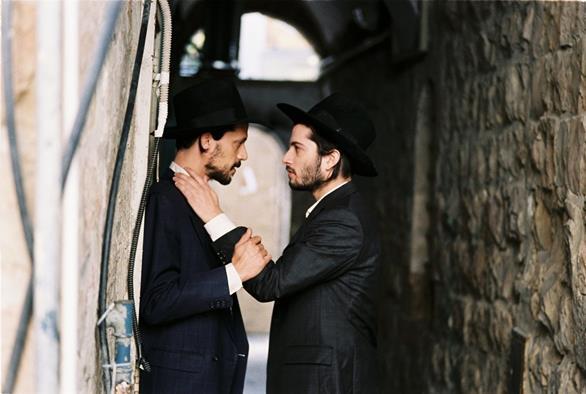
London Film Fest Day 7 - EYES WIDE OPEN


EYES WIDE OPEN is Haim Tabakman's immensely impressive and brave debut feature about the difficulty of reconciling a private life within a community of strict orthodoxy. To be sure, Tabakman has explored this issue by depicting a homosexual love affair within an Orthodox community in Jerusalem, but the issues would apply equally to, say, young girls threatened with "honour" violence in the UK, or, say, gays in the Catholic church. This is a film about people who cannot simply cut the ties from the communities who reject them and flee to a more tolerant place, but want to live out both their private life and their faith. The inability to choose on or the other is the tragedy.


The movie succeeds because it is resolutely NOT sensationalist but actually rather quiet and introspective and intimate. Zohar Strauss plays a butcher who is playing a role in his father's butcher's shop and as a husband and father. He seems to be a genuinely kind man, and a man of faith. He falls for a handsome young man (Ran Danker) who has already been expelled from one religious community. Aaron is warned by the Rabbi and more menacingly by a self-appointed group of young men. There is a particularly beautiful shot where the two are arguing in front of the shop about whether the relationship is tenable. A van pulls away and in the reflection we see that this whole argument has taken place in front of the menacing youths. And at the same time, the story is widened out, to show a young girl acquiesce to an arranged marriage.

This really is a powerful, sensitive relationship drama that shows a situation that is more widely relevant that a reductive plot summary might suggest. It is not at all sensationalist or exploitative, but authentic, credible, well-acted and well-photographed. It deserves to be widely seen.

EYES WIDE OPEN / EYNAIM PEKUKHOT played Cannes and Toronto 2009 and opened in September in France and Israel. It opens in Belgium on December 2nd.


reiview movies and books Copyright © 2012 -- Powered by Blogger